
It is 7:15 on a Tuesday night. You are sitting in the truck in your own driveway, boots still on, scrolling back through four inspections you ran today. Four roofs with real hail damage. Four homeowners who nodded, said “wow, I had no idea,” and took your card. You texted all four a number before dinner. By Friday, three have gone dark. No reply, no “we went another way,” just silence. One of them, you find out next week, signed with the crew that knocked her block on Thursday.
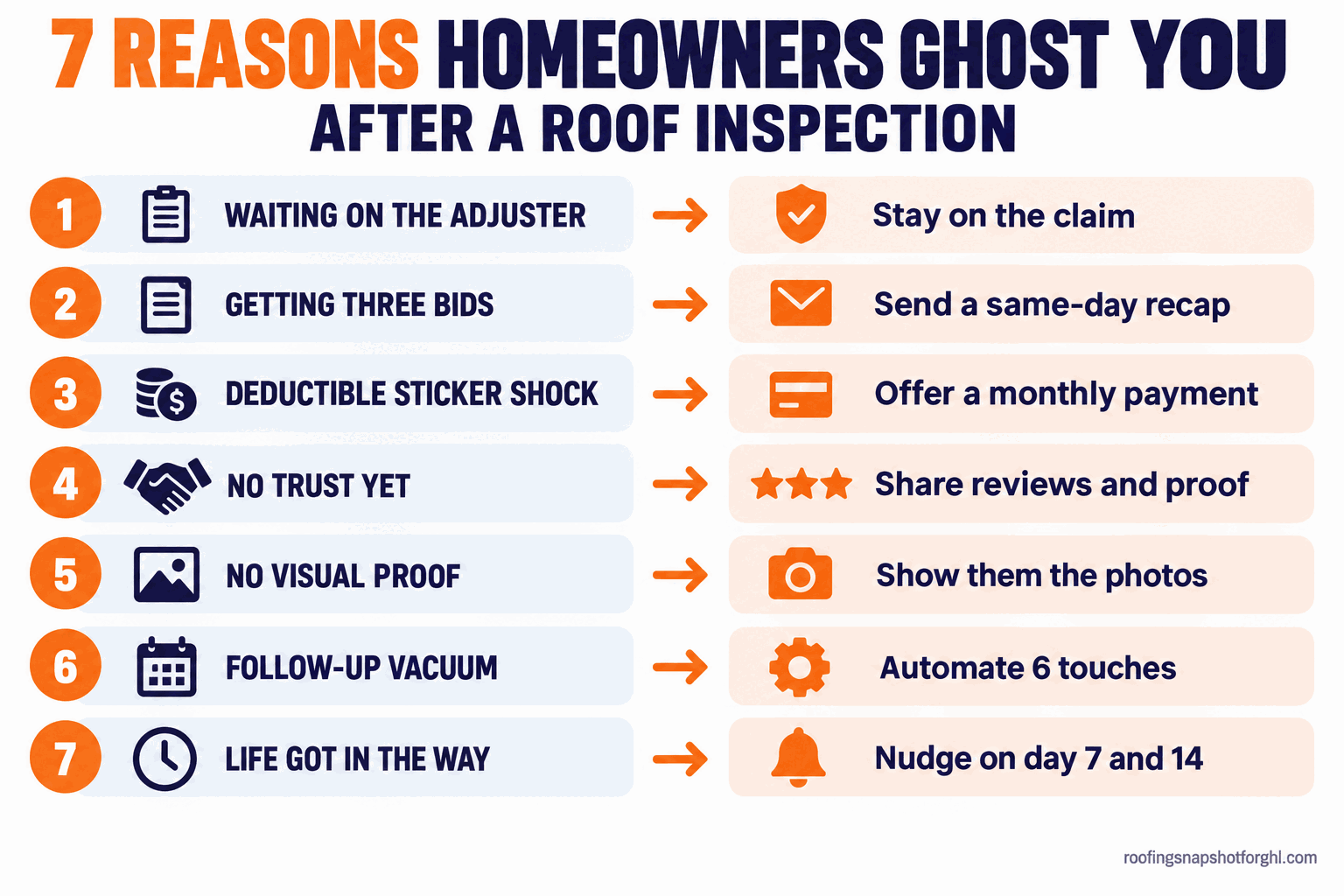
Here is the short answer, so you can stop blaming your pitch. Homeowners rarely ghost because your price was wrong or your inspection was bad. They go quiet because something stalled on their side, the adjuster, three competing bids, the deductible, plain life, and you went quiet at the same moment. The fix is not a smoother close or a lower number. It is a follow-up system that keeps showing up in the days after the inspection, so you are still the roofer they trust when the stall clears. This post walks the seven real reasons and the exact messages that pull them back.
Key Takeaways
- The silence is almost never about you. The homeowner is waiting on an adjuster, comparing bids, or scared of the deductible. Stop following up while they wait and you lose the job to whoever is still in front of them when the wait ends.
- Speed and persistence win it. The MIT and InsideSales Lead Response Management study found a rep about 21 times more likely to qualify a lead contacted in 5 minutes versus 30 (LRM study). HBR found the average company takes 42 hours to respond and 23% never respond at all (HBR). Most roofers quit after one text.
- That inspection cost real money. Roofing and gutters was the most expensive home-services lead category in 2025 at $228.15, against a $90.92 average (LocaliQ). Letting it ghost in silence burns a two-hundred-dollar bill.
- They are shopping you, not rejecting you. Advocates tell homeowners to get at least three bids from well-rated companies (Checkbook). The roofer who follows up best, not cheapest, usually wins. A spaced, four-to-six-touch sequence with a STOP option is service, not spam, and it runs itself once built.
Table of contents
- What the silence actually costs you
- The seven reasons at a glance
- Reason 1: They are waiting on the insurance adjuster
- Reason 2: They are collecting three bids
- Reason 3: The deductible scared them
- Reason 4: They do not trust you yet
- Reason 5: You documented for yourself, not for them
- Reason 6: Your follow-up is one text and then a vacuum
- Reason 7: Life got in the way
- Run the follow-up for a solo, mid-size, and large shop
- Steal this: the post-inspection follow-up sequence
- Keep it legal: TCPA and state solicitation law
- Objections
- Related reading
- FAQ
What the silence actually costs you
Start with what you spent to get on that roof. In 2025, roofing and gutters was the most expensive lead category in all of home services at $228.15 per lead, more than double the home-services average of $90.92 (LocaliQ 2025 benchmark). Every inspection started as a lead you paid for. When the homeowner goes dark and you do nothing, you did not lose a maybe, you set fire to a countable amount of money. We ran the full math in how much a roofing lead actually costs.
Add the storm reality. A hailstorm does not drop one roof, it drops a neighborhood. US major hail events hit 5,432 in 2025, up from 5,373 in 2024, and State Farm alone paid more than $5.6 billion in hail claims that year (Triple-I / NOAA). On a hit block, every roofer in a 200-mile radius plus the out-of-state crews know the money is there. The homeowner you inspected this morning has two more cards on the counter by Friday, which is how out-of-state storm chasers beat local roofers who quit following up.
Your inspection time is the most expensive thing you own in storm season. Spending it to leave a quote that competes with three others and a chaser in the driveway, then never touching it again, is how good crews stay small.
The seven reasons at a glance
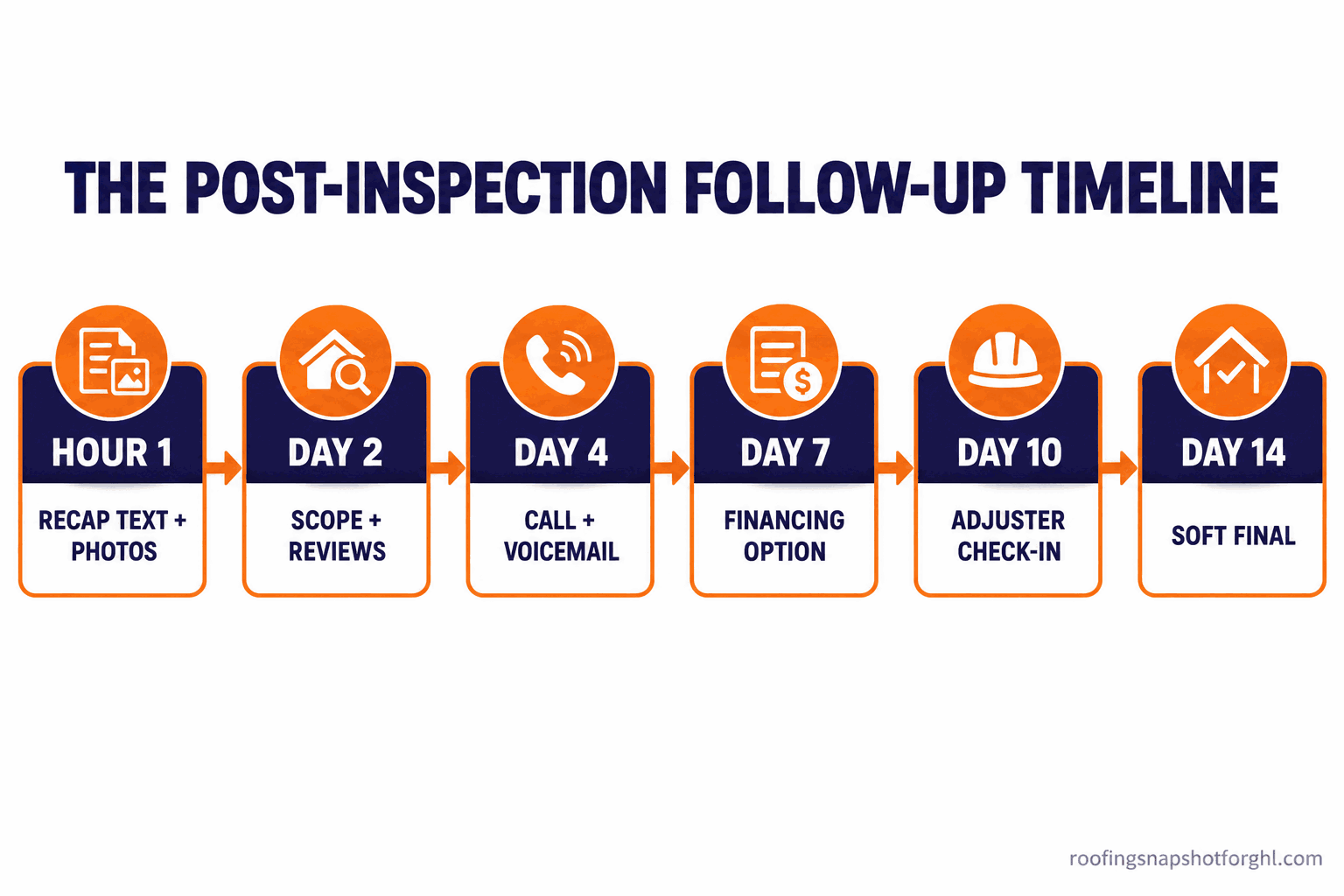
The silence looks like one thing, rejection. It is really seven different stalls, each with its own fix: waiting on the insurance adjuster, collecting three bids, deductible sticker shock, no trust yet, no visual proof left behind, a follow-up vacuum, and plain decision paralysis. The follow-up timeline below shows how spaced touches cover all seven, and the rest of this post walks each one.
Reason 1: They are waiting on the insurance adjuster
On a storm job the homeowner usually cannot say yes the day you inspect, even if they love you. They filed a claim, and nothing moves until the carrier’s adjuster comes out and issues a number, which takes days or weeks. During the wait you are not rejected, you are parked, and most roofers treat a parked lead like a dead one and stop calling. The homeowner, meanwhile, is anxious and confused about ACV versus RCV, which is where you either become their guide or fade out. We mapped the full timeline in why roofing insurance claims stall.
How it breaks, and the fix. It breaks when you go silent for two weeks, then text “any update?” once and give up. The fix is to stay in the picture: set a task for the adjuster’s scheduled date, offer to be on site when they come, and send a short note explaining what happens next in plain English. You keep your face on the claim without negotiating it, which in many states is illegal and is covered below.
Reason 2: They are collecting three bids
Consumer advocates flatly tell homeowners to get at least three bids from well-rated companies before they pick a roofer (Checkbook). So when you leave, you are entry number two of three on a legal pad. By the time the third roofer leaves, the damage you circled, the warranty, and the crew have blurred together, so the homeowner defaults to the cheapest or the pushiest.
How it breaks, and the fix. It breaks when your quote is a bare number with no reason attached. The fix is a same-day recap that re-sells the value while it is fresh: the photos, a one-line summary of what you found, and the one thing that sets your bid apart. That recap is the backbone of a real roofing estimate follow-up sequence.
Reason 3: The deductible scared them
A homeowner can love the plan and still freeze at a $2,000 or $3,000 deductible plus whatever the carrier will not cover. You see a reasonable number, they see a wall, and a wall left alone becomes “let me think about it,” which becomes silence. Most people do not have a few thousand dollars sitting ready, so they avoid the decision, which looks exactly like ghosting. Contractors who present financing on every job close noticeably more work: industry data has long put the lift around 18% more jobs closed with larger average tickets when a monthly payment is offered (via JLC).
How it breaks, and the fix. It breaks when you quote a lump sum and leave, assuming they will figure out the money. The fix is to put a monthly number next to the total, every time, through a financing partner, so the deductible is a payment they can picture instead of a cliff. We showed how in offer roofing financing without killing the close. The legal line: you can help them finance the deductible, you cannot offer to pay, rebate, or absorb it.
Reason 4: They do not trust you yet
An hour ago you were a stranger on a ladder. Roofing has a reputation problem, storm chasers, fly-by-night crews, horror stories, and the homeowner knows it. Trust is not built in one inspection, and while they wait, they are Googling you. BrightLocal’s 2026 consumer survey found 68% of people will only consider a business rated 4 stars or higher (BrightLocal). A thin or unanswered Google profile loses the job before you hear “no.”
How it breaks, and the fix. It breaks when your only trust signal was a handshake. The fix is to make proof part of the follow-up: a link to your Google reviews, a photo of a recent job on their street, a line that you are licensed, insured, and local. Keeping that review profile strong is its own project, covered in how to get more Google reviews.
Reason 5: You documented for yourself, not for them
Most roofers inspect for their own file. They climb up, confirm the hail hits, shoot photos for the claim, come down, and say “yep, you’ve got damage.” The homeowner, who will never get on that roof, has to take your word for it. That gap is where doubt lives, and doubt sends them shopping or stalling. People do not act on problems they cannot see.
How it breaks, and the fix. It breaks when the photos live on your phone and never reach them. The fix is to document the way you would for an adjuster, then hand it over before you leave and again in the recap text: chalk-circled hits, short video of the soft metals and mat exposure, the collateral on the gutters. Our storm damage roof inspection checklist is the field protocol that makes this hold up.
Reason 6: Your follow-up is one text and then a vacuum
This is the big one, and it is entirely in your control. HBR found the average company takes 42 hours to respond and 23% never respond at all (HBR). The MIT and InsideSales study found reaching out in 5 minutes instead of 30 made a rep about 21 times more likely to qualify the lead (LRM study). Most roofers send one quote, wait, and read the silence as a no. But the homeowner is not refusing you. Their single text slid off the screen under a pile of others, and with no second touch the lead decays on its own. The silence you read as rejection is a vacuum you never filled.
How it breaks, and the fix. It breaks when “follow-up” means texting people when you happen to think of them, which during a 200-lead storm week is never. The fix is an automated cadence that fires whether or not you remember, the same engine behind a compliant storm lead follow-up sequence and a disciplined roofing lead response time.
Reason 7: Life got in the way
Sometimes there is no clever psychology. The homeowner meant to call back. Then their kid got sick, work blew up, and two weeks passed. The window closed because nothing reminded them you existed, and by then the chaser who knocked Thursday was on the roof. Good intentions have a short shelf life: a homeowner who was a 9-out-of-10 on inspection day is a 4 by day ten if nothing touches them.
How it breaks, and the fix. It breaks when you assume “no reply” means “no.” The fix is a spaced, low-pressure nudge that keeps the door open: a gentle check-in on day seven, a soft final on day fourteen. Most “ghosts” in this bucket are not gone, they are waiting for a reason to re-engage, and the reason is you showing up one more time.
The economics of filling that vacuum are not subtle.
Cost per lead by category, 2025. Roofing and gutters is the most expensive lead in home services. Source: LocaliQ 2025 home-services search benchmarks.
Run the follow-up for a solo, mid-size, and large shop
The seven reasons are the same at every size. What changes is who runs the follow-up and how much is automated.
Solo operator. You are the salesperson, the crew, and the office, so you cannot babysit a cadence by hand. Automate the whole thing: the second an inspection ends, your phone fires the recap text, the value touch, and a call task that pings you so you actually dial on day four. Automation is not a luxury for a one-person shop, it is the only way you follow up at all.
Mid-size shop, two to three crews. The failure mode shifts from “no follow-up” to “inconsistent follow-up.” One rep is a bulldog, another forgets. The fix is a shared pipeline where every inspection auto-enters the same cadence, so no lead depends on one person’s memory, and you can finally see which rep lets warm inspections rot. This is where a real roofing sales pipeline earns its keep.
Large shop, four to five crews. At volume a storm drops hundreds of inspections a week, and a human cannot touch 300 leads six times each. The system runs the first five touches across SMS, email, and call tasks, scores who is engaging, and surfaces only the hot ones to your closers. The follow-up scales because the machine repeats and the humans decide.
Steal this: the post-inspection follow-up sequence
Here is the exact cadence that pulls ghosts back. It runs over two weeks, mixes channels, and ends every automated text with a STOP option. Keep the spacing, adjust the timing to your market.
Touch 1, within an hour (text, the recap). The single most important message, sent before you leave the street if you can.
Hi [First name], Dale here from [Company]. Great meeting you today. Here are the photos of what I found on your roof: [link]. Short version: [one line, e.g. “hail bruising across the south slope and damaged ridge caps”]. I will text a written scope by tomorrow. Questions in the meantime, just reply. Reply STOP to opt out.
Touch 2, day 2 (text, value + proof).
Hi [First name], here is your full written scope: [link]. Two things that set us apart on a job like yours: [warranty / local crew / we pull permits and haul the debris]. Our recent Google reviews, if it helps: [link]. Happy to walk through any of it by phone.
Touch 3, day 4 (call + voicemail, then text). Pick up the phone. If no answer, leave a short voicemail and follow with a text so there is a thread.
Voicemail: “Hi [First name], it’s Dale from [Company], following up on your roof. No pressure, just want to make sure you got the scope and answer any questions. I’ll send a quick text too.” Text: Tried you just now, no worries. Whenever you have five minutes I can walk you through the next step. What is the best time to reach you?
Touch 4, day 7 (text, the payment path). Dissolve the deductible wall.
Hi [First name], one thing folks often ask about is the out-of-pocket piece. We work with a financing partner, so most homeowners can spread it into a monthly payment instead of one lump sum. Want the quick pre-qualify link so you can see a number with no impact on your credit?
Touch 5, day 10 (text, adjuster check-in, storm jobs only). Keep your face on the claim without touching the claim.
Hi [First name], has your insurance adjuster been out yet, or is that still scheduled? Happy to be on site when they come so nothing gets missed on our end. Just let me know the date.
Touch 6, day 14 (text, the soft final). Make it easy to re-engage and easy to close the loop.
Hi [First name], I know life gets busy, so I will stop filling up your phone. If the roof is still on your list, I am here and your scope is ready whenever you are. If you have gone another direction, no hard feelings, a quick reply just helps me close out the file. Either way, thanks for having me out.
Keep it legal: TCPA and state solicitation law
A follow-up system that breaks the law is worse than no system. Two rules govern everything above.
TCPA and consent. Before you text a homeowner you need their consent, cleanest as express written consent captured when they book or hand you their number. Every automated message needs a working STOP, honored instantly. TCPA penalties run $500 to $1,500 per message, so a blast to a bought list is a lawsuit, not a campaign. Registering your number through A2P 10DLC is non-optional now, since US carriers block unregistered traffic, covered in A2P 10DLC registration for roofing contractors.
State solicitation and claims law. Several storm states restrict unsolicited post-storm contact and flatly bar you from negotiating the homeowner’s claim or offering to absorb their deductible. Wisconsin’s 2013 Act 24 and Florida Statute 489.147 are the usual examples, with penalties per violation. Your follow-up can guide, document, and finance. It cannot represent the homeowner to their insurer. The full map is in what roofers can and can’t legally say about insurance claims. Keep the copy to what is true, and never imply you are the insurer, the adjuster, or a public adjuster, or promise a free roof.
Objections
“Won’t all these texts annoy people and make me look desperate?” Only if they are pushy or empty. A recap with photos, a scope, a financing option, and a polite adjuster check-in are each genuinely useful to a homeowner in the middle of a roof decision. The desperate move is the opposite: quoting once, vanishing, then reappearing three weeks later asking “did you decide yet?”
“What if they already signed with someone else?” Then your day-fourteen final gets you a quick “we went another way,” you close the file, and you stop burning money on a dead lead. And a surprising number of “already signed” homeowners signed with a chaser they are nervous about, and your calm, still-here follow-up is exactly what pulls them back before work starts.
“I run a one-person shop and don’t have time to follow up on every inspection.” That is the whole point of automating it. You will never hand-text six touches to every inspection during a storm week. The system sends the texts and queues the one call that needs a human, so follow-up happens whether or not you remember, while you are on the next roof.
“Do I need to be technical to run this?” No. The sequence is just messages and timing. A done-for-you setup wires it into GoHighLevel once, then it runs on autopilot while you work the hot leads it surfaces.
Related reading
- How to close a roofing job on the first visit: the best way to beat ghosting is to not leave without a signature.
- Roofing estimate follow-up: the sequence that turns quotes into signed jobs goes deeper on the after-quote cadence.
- Why roofing insurance claims stall explains the adjuster timeline that parks half your storm leads.
- Storm lead follow-up sequence that stays legal covers the pre-inspection side of the same system.
Frequently asked questions about homeowners ghosting after a roof inspection
Why do homeowners stop responding after I give them a roofing quote?
Usually because something stalled on their side and you stopped following up at the same time. The three most common stalls are waiting on an insurance adjuster, comparing your bid against two or three others, and freezing at the deductible. None is a rejection, and a spaced follow-up over two weeks keeps you in front of them when the pause ends.
How many times should I follow up after a roof inspection?
Four to six touches over about two weeks: a same-day recap with photos, a value and proof text on day two, a call on day four, a financing nudge on day seven, an adjuster check-in on day ten for storm jobs, and a soft final on day fourteen. Mix text, email, and a call, and end every automated message with a STOP option. Most roofers quit after one, which is why persistence wins the job.
Is it legal to text homeowners to follow up on a roofing inspection?
Yes, with consent and the right guardrails. Capture express written consent when they book or hand you their number, include a working STOP in every automated message and honor it instantly, and register your number through A2P 10DLC so carriers deliver your texts. TCPA penalties run $500 to $1,500 per message, so never blast a bought or scraped list.
Can I tell a homeowner I'll handle their insurance claim or cover their deductible so they don't ghost me?
No. In a growing list of states, negotiating a homeowner's insurance claim without a license, or offering to pay, rebate, or absorb their deductible, is illegal, with penalties per violation under laws like Wisconsin's 2013 Act 24 and Florida Statute 489.147. You can document damage, guide them, and help them finance the deductible, but not represent them to the carrier or eat their out-of-pocket.
A homeowner ghosted me two weeks ago. Is that lead dead?
Often not. Many 'ghosts' got busy or are still waiting on their adjuster, not people who chose a competitor. A low-pressure soft-final text that makes it easy to pick back up pulls a meaningful share of them back. And if they did sign elsewhere, a polite nudge gets you a quick answer so you can close the file instead of guessing.