
It is the fifteenth of the month and you are staring at a whiteboard full of finished roofs nobody has paid you for. Tear-offs done, shingles on, crews gone to the next street. The money is stuck in a pile of files marked “waiting on insurance,” and every one stalled somewhere different. One waits on an adjuster who never scheduled the re-inspection. One got the first check, but the homeowner’s mortgage company is sitting on it. One has a supplement that vanished into an inbox three weeks ago. You did the work. The cash is just stuck.
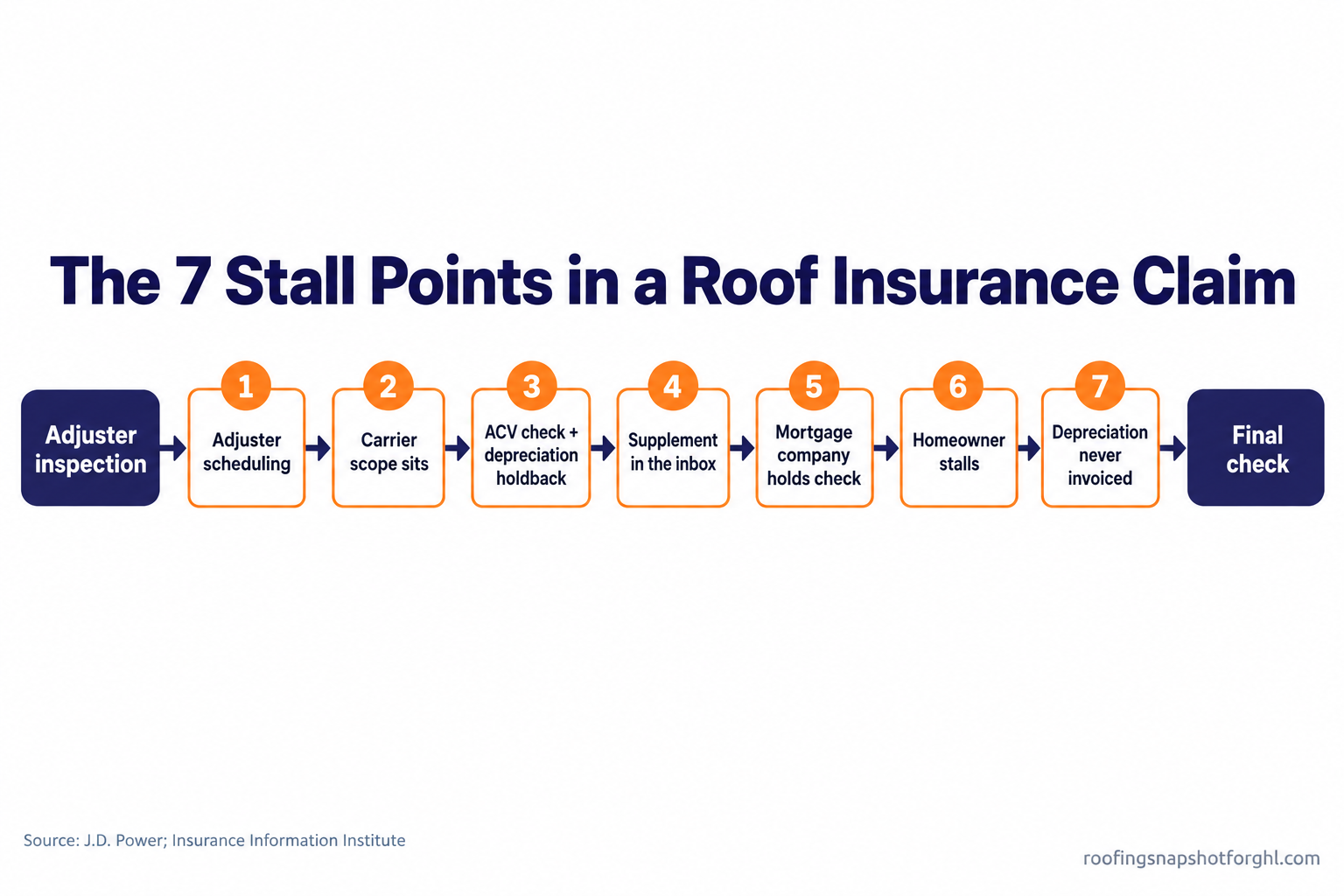
Here is the short version. A roof insurance claim almost never dies at the inspection. It stalls in the gaps between stages, and there are about seven of them, every one predictable. The shops that get paid fastest are not better negotiators and do not have friendlier adjusters. They treat the claim as a pipeline with a named owner and a follow-up clock on every stage, instead of a pile of files they check when they remember. This guide walks all seven stalls, shows how each one breaks, and gives you the fix and the copy you can steal, for a solo operator, a mid-size shop, and a large one.
Key Takeaways
- Claims stall in the gaps, not at the inspection. The money leaks between stages: adjuster scheduling, the sitting scope, the depreciation holdback, the forgotten supplement, the mortgage holdback, homeowner delay, and the uninvoiced final check.
- Time is the cost. Homeowners property claims now average 23.9 days from report to finished repairs, and 34.2 days for catastrophe claims (J.D. Power, 2024). On a finished roof, every day is your cash aging.
- The holdback nobody explains loses the most. Most replacement-cost roofs pay in two parts, actual cash value first and recoverable depreciation after you prove the work is done (Insurance Information Institute). The second check is the one shops forget to invoice for.
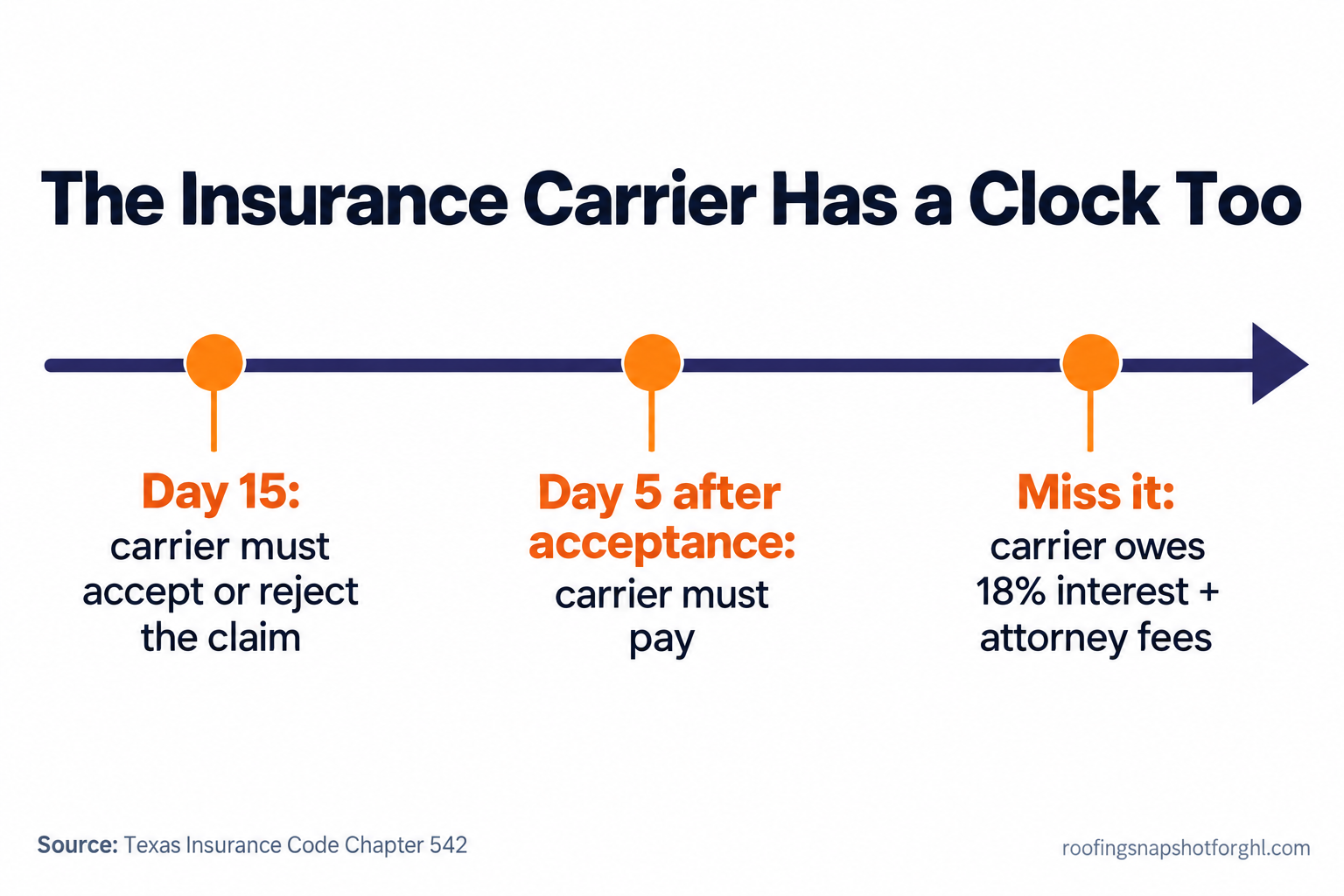
- Deadlines work in your favor. State prompt-payment laws put a clock on the carrier. In Texas the insurer must accept or reject within 15 business days and pay an accepted claim within 5, or owe 18 percent interest (Tex. Ins. Code ch. 542).
- Follow-up is the whole game, and a CRM runs it. A scheduled cadence on every stage, with a named owner, turns a 60-day file into a 25-day one. The copy to run it is below.
Table of contents
- What the stall is costing you
- The claim is a pipeline, not an event
- Stall 1: The adjuster never gets scheduled
- Stall 2: The carrier scope arrives and sits
- Stall 3: The ACV check and the holdback nobody explains
- Stall 4: The supplement goes into the inbox and dies
- Stall 5: The mortgage company is holding the check
- Stall 6: The homeowner stalls
- Stall 7: The recoverable depreciation is never invoiced
- Steal this: the claim follow-up copy
- Run it for a solo, a mid-size, and a large shop
- The legal line and the texting rules
- Objections
- FAQ
What the stall is costing you
Start with the number that hits your bank account: time. Homeowners property claims now take an average of 23.9 days from the day the claim is reported to the day repairs are finished, more than six days longer than in 2022, and for catastrophe claims that average jumps to 34.2 days (J.D. Power 2024 U.S. Property Claims Satisfaction Study). Those are the measured averages. The disputed and supplemented files you actually worry about run far past that, into two and three months.
Average days from reporting a property claim to finished repairs. The 2024 average is 23.9 days, over six days longer than 2022; catastrophe claims average 34.2 days. Source: J.D. Power 2024 U.S. Property Claims Satisfaction Study.
Now put a dollar figure on each day. The average roof replacement hit $17,631 in 2025, up 33 percent from the prior four-year average (Verisk). Multiply that by ten open claims and you are financing more than $170,000 of finished work while you wait. You paid for the shingles, the dumpster, and the crew weeks ago. A stalled claim is an interest-free loan to carriers and mortgage servicers, and it is the biggest reason a busy shop with full crews still feels broke.
Storm volume guarantees you keep playing this game. Severe convective storms, the hail and wind events that drive roof claims, caused an estimated $51 billion in insured U.S. losses in 2025, the third-costliest year on record, and hail alone drives up to 80 percent of severe-storm claims (Triple-I, via Digital Insurance). More claims means more files stalling in the same seven places unless you build something to stop it.
The claim is a pipeline, not an event
Most shops treat a claim as one thing that either happens or does not. It is not. It is a chain of handoffs, and like any chain it breaks at whichever link nobody is holding. The adjuster hands to you, you hand to the homeowner, the homeowner hands to their mortgage company, and the money moves only when each handoff lands. A file “waiting on insurance” is almost always waiting on a specific person to do a specific next thing. The reason you cannot tell which is that it lives in your head instead of on a board.
The fix is the one that runs the rest of your business: a roofing sales pipeline with a claims track built in, so every file sits in a named stage with a named owner and a follow-up clock. When a file enters a stage, the clock starts, and if nothing moves it in time, the system nudges whoever owns that stage. That is all a CRM is doing here: making sure no handoff goes quiet. Here are the seven stages where the quiet happens.
| Stall point | Why the file goes quiet | What moves it |
|---|---|---|
| 1. Adjuster scheduling | No one owns booking the inspection | Same-day request, a booked slot on your calendar |
| 2. The sitting scope | Carrier estimate arrives, comparison never gets done | 48-hour rule: compare scope the day it lands |
| 3. ACV check + holdback | Homeowner thinks the first check is everything | Explain the two-part payment up front |
| 4. The supplement | It sits in the adjuster’s inbox | A logged follow-up cadence, not one-off calls |
| 5. Mortgage holdback | Check is payable to the lender too | Start the endorsement packet the day it lands |
| 6. Homeowner stall | Deductible, decision, or missing documents | Scheduled nudges with one clear next step |
| 7. Final depreciation | No one invoices the second check | A “depreciation released” stage with a weekly flag |
Stall 1: The adjuster never gets scheduled
How it breaks. The homeowner files, the carrier assigns a field adjuster, and then the inspection just does not get booked. The adjuster is covering dozens of roofs across a storm zone, your office is slammed, and nobody owns the one call that puts a date on the calendar. The file sits two weeks before anyone notices there is no inspection date.
The fix. Make booking the inspection a stage with an owner and a same-day trigger. The moment a homeowner signs, your system prompts the office to request the adjuster meeting and, just as important, get your own rep on that same appointment so you are on the roof when the adjuster is. Being there is how the scope gets written off what is actually up there, not a satellite guess. Miss the meeting and you are supplementing from behind for the rest of the claim. An online scheduling and reminder flow earns its keep here: adjuster, rep, and homeowner all get the same confirmed time and a reminder that morning.
Stall 2: The carrier scope arrives and sits
How it breaks. The carrier estimate lands in an inbox and nothing happens for ten days. By the time someone opens it, the roof is fuzzy in everyone’s memory, the adjuster has moved to forty other files, and your window to catch the missed lines while the inspection is fresh has closed. The unread scope is the quietest, most expensive stall on this list, because it is where supplements are set up or lost.
The fix. A hard 48-hour rule. When the carrier scope arrives, you compare it to your estimate line by line within two business days, while the adjuster still remembers the roof. Mark the lines they missed, the lines priced short, the quantities that are off. That comparison is your supplement, and its speed decides whether it gets approved or argued. The full process, including the Xactimate language that gets lines approved instead of rejected, is in our guide to getting roofing supplements approved faster. For your pipeline the point is simple: the scope arriving should trigger a task with a two-day deadline, not land in a folder someone opens eventually.
Stall 3: The ACV check and the holdback nobody explains
How it breaks. The first check arrives thousands short of the estimate, the homeowner panics, and either demands answers or tells you to do a cheaper job. This stall creates the most friction, and it is almost always a communication failure. Most replacement-cost policies pay in two parts: the actual cash value, which is replacement cost minus depreciation, lands first, and the recoverable depreciation is released only after the work is complete and documented (Insurance Information Institute). The first check is supposed to be short. Nobody told the homeowner that, so they think the claim is underpaid and the job stalls over a number that was never the final number.
Illustrative two-part payout on a $17,631 roof with roughly 40 percent depreciation: the actual cash value check arrives first, and the recoverable depreciation is released after the work is proven complete. Actual splits depend on roof age and policy. Sources: Insurance Information Institute, Verisk.
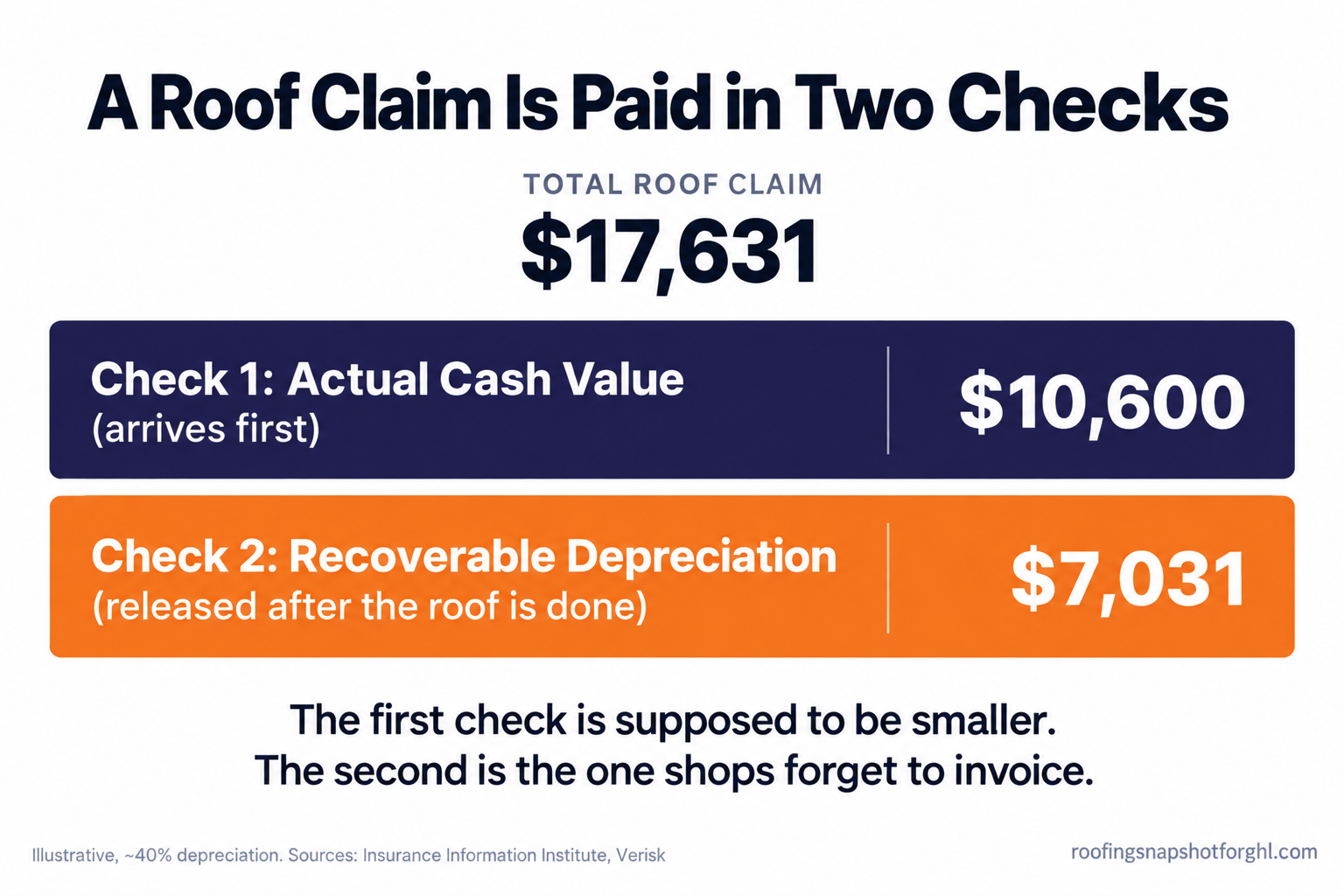
The fix. Explain the two-check structure before the first check ever arrives, in writing, so it is never a surprise. The steal-this homeowner message is below. When the homeowner understands that check one is the down payment and check two comes when the roof is done, the panic disappears and the job moves. A one-page explainer sent the day the claim is approved removes more stalls than any negotiation.
Stall 4: The supplement goes into the inbox and dies
How it breaks. You submitted a clean, documented supplement two weeks ago and heard nothing. It did not get denied. It got buried under the next fifty files on the adjuster’s desk, and because you followed up once, got voicemail, and moved on, it is now invisible. Supplements do not die from a “no.” They die from silence.
The fix. A scheduled, logged follow-up cadence that runs from the day you submit until you get a written decision: receipt at day 2, questions at day 5, a call and email at day 10, a polite supervisor escalation at day 15. The exact copy is in the steal-this section. Automate it because manual follow-up loses to a busy week every single time. The moment a file hits “supplement submitted,” a CRM schedules the whole sequence, drafts each message, and reminds you to make the day-10 call. It is the same discipline behind any insurance claim follow-up system, pointed at the adjuster. Keep a paper trail of every touch, because dates matter if the file ever goes to appraisal.
Stall 5: The mortgage company is holding the check
How it breaks. The check arrives made payable to the homeowner and their mortgage lender, both. Until the lender signs off, the money sits in their account, not yours. For a smaller claim on a current loan this is routine, but larger claims get released in stages tied to inspections, and if nobody owns the paperwork the check can sit a month (HSH). Shops seeing this for the first time lose weeks just figuring out why the homeowner “got paid” but you did not.
The fix. Treat the mortgage endorsement as its own stage that starts the day the check lands. Help the homeowner send the lender what it needs up front: a copy of the adjuster’s worksheet, your contract, and often a W-9 (HSH). Many states put a clock on the lender once you comply; in Texas, a lender holding proceeds must release them within 10 days of getting the documentation it required (UpHelp). Anticipate this on every financed home, start the packet immediately, and hand the homeowner a checklist instead of letting them discover the holdback the hard way.
Stall 6: The homeowner stalls
How it breaks. The claim is approved, the money is available, and the homeowner goes quiet. Sometimes it is the deductible they did not budget for. Sometimes a second opinion. Sometimes they just stop answering once the tarp is up and the urgency wore off. A claim cannot move faster than the homeowner, and homeowner silence is one of the most common reasons a fully approved file sits for weeks.
The fix. A homeowner track separate from the adjuster track, with one clear next step in every message. Not “let us know,” which asks them to figure out what to do. Instead: “The next step is signing the completion authorization, here is the link.” You cannot legally absorb or discount their deductible, so do not try. What you can do is remove every other friction point, offer legitimate financing where the deductible is the blocker, and keep a scheduled, human-sounding nudge going so the file never goes fully cold. The mechanics match any estimate follow-up sequence, aimed at a homeowner who already has an approved claim.
Stall 7: The recoverable depreciation is never invoiced
How it breaks. This is the quietest leak of all. The roof is done, the first check cleared, everyone moved on, and the recoverable depreciation, the entire second check, is never claimed because no one owned the last step. You earned that money. You just never sent the completion certificate and final invoice that releases it, so it stays with the carrier. On a $17,631 roof with 40 percent depreciation, that is roughly seven thousand dollars you walked away from, per job, quietly, forever.
The fix. A “depreciation released” stage at the end of every claims pipeline, plus a weekly report that flags any file where the work is complete but the final check has not landed. The trigger is final inspection: the day a job passes, the system prompts you to submit the completion certificate and final invoice, then runs the same cadence until the check clears. Tracking this is one of the roofing KPIs worth watching every week, because it is pure recovered profit on work you already did.
Steal this: the claim follow-up copy
The whole system comes down to messages that actually get sent. Here is the copy, verbatim. Swap the brackets, keep the tone professional and about the roof, never about negotiating the claim.
That set is the difference between a file that moves and one that sits. It is also the part every busy shop skips, because sending it by hand never survives a storm week.
Run it for a solo, a mid-size, and a large shop
The seven stalls do not change with your size. Who owns them, and how much you automate, does.
Solo operator. You are the salesperson, estimator, follow-up, and sometimes the crew. Your stalls are 1, 4, and 7, because you physically cannot chase an adjuster or invoice a depreciation check while you are on a roof. Automate those three first. Let the system book the adjuster meeting, run the supplement cadence, and flag completed jobs with no final check. You do not need heavy software for a few claims a month, you need the follow-up to run without you.
Mid-size, three to five crews. Now your enemy is the handoff. The office books the inspection, a rep walks the roof, someone else does the scope comparison, and the file falls into the crack between them. Stall 2 and Stall 5 are where you bleed, because the scope sits and the mortgage packets pile up. Put every claim on one pipeline with a named owner per stage and hard entry triggers, so the scope arriving creates a two-day task automatically and the first check landing opens a mortgage-endorsement stage. This is the size where a claims track pays for itself in a single storm, and where a dedicated GoHighLevel VA running the follow-up out of the CRM is often cheaper than the depreciation checks you are losing.
Large shop with a claims coordinator. You have the people, so your leak is visibility. With dozens of open files, claims slip because no one can see the whole board at once. You need reporting: files by stage, average days-to-decision by adjuster and carrier, every approved file with no final check, and total recovery per rep. At this scale a custom claims workflow that assembles supplement packets and surfaces stalled files on a dashboard is usually the highest-ROI software you own, because a half-percent gain in days-to-check across hundreds of files is real money.
Solo shops win by automating follow-up, mid-size shops win by fixing handoffs, large shops win by making the board visible. Same seven stalls, different pressure point.
The legal line and the texting rules
Two things turn a claims system from an asset into a liability if you build them wrong, so get them straight first.
First, the legal line. You are a roofing contractor, not a public adjuster. You can document damage, prepare and submit an estimate with the homeowner’s written authorization, and discuss the scope of your work with the adjuster. You cannot negotiate the settlement, interpret the policy, represent the homeowner as their agent, or promise the job will “cost them nothing.” Waiving or absorbing the deductible is flat-out illegal in many states, a third-degree felony in Florida (Fla. Stat. 489.147). Keep every message about the roof and the estimate, never the claim and the deductible. The full state-by-state breakdown is in our guide to what roofers can and can’t legally say about insurance claims.
Second, the texting rules. Every automated text and call to a homeowner or adjuster is regulated. You need prior express consent on file, and your business texting registered under A2P 10DLC, or your messages get filtered and you expose yourself to penalties of $500 per message under the Telephone Consumer Protection Act (47 U.S.C. 227). A real CRM handles consent capture and registration as part of setup.
One upside hides in the law: deadlines cut your way too. State prompt-payment statutes put a clock on the carrier, not just on you. In Texas the insurer must accept or reject a claim within 15 business days of getting everything it asked for, and pay an accepted claim within 5 business days, or owe 18 percent annual interest plus your attorney’s fees (Tex. Ins. Code ch. 542). Knowing your state’s version of that clock turns a polite follow-up into a firm, documented one.
Objections
“I already use CompanyCam and EagleView, isn’t that enough?” Keep them, they are excellent. But a photo app and a measurement report are not a claims pipeline. They capture evidence and measurements, which matters for Stall 2, but they do not schedule the adjuster follow-up, open a mortgage-endorsement stage when the check lands, or flag which finished jobs never got their depreciation check. CompanyCam and EagleView are adjacent tools that feed the pipeline. They are not the pipeline, and confusing the two is exactly why finished roofs still sit unpaid in shops that own great software.
“Isn’t tracking the claim basically public adjusting?” No, not if you stay in your lane. You are submitting the scope of the work in your signed contract with the homeowner’s authorization, and keeping your own file moving. You are not negotiating their settlement or interpreting their policy (NAPIA). Following up on your own supplement is no more public adjusting than following up on any invoice.
“My adjusters just ignore me anyway.” They ignore undocumented, one-off follow-up. A logged cadence of professional, specific touches, with dates and a claim number on every one, is much harder to ignore, and it removes the “I never got it” excuse. When a well-documented file is still stonewalled past your state’s prompt-payment deadline, that deadline and the appraisal clause are your pressure, and a clean paper trail is what makes them usable.
“Won’t the automated texts annoy homeowners?” The opposite, when they are written like a human and sent at the right moment. A homeowner mid-claim is anxious about money and silence. A clear “here is what is happening and what comes next” text is the most reassuring thing they get all week. Annoyance comes from generic blasts, not from timely, specific updates about their roof and their money.
Frequently asked questions about stalled roof claims
Why does a roof insurance claim take so long?
Because it is a chain of handoffs, and it stalls wherever nobody owns the next step: adjuster scheduling, an unread carrier scope, the depreciation holdback, a supplement sitting in an inbox, a mortgage company holding the check, homeowner delay, and an uninvoiced final check. Homeowners property claims averaged 23.9 days from report to finished repairs in 2024, and 34.2 days for catastrophe claims, per J.D. Power. Disputed or supplemented files run much longer.
Why is my first insurance check so much smaller than the estimate?
Most replacement-cost policies pay in two parts. The first check is the actual cash value, replacement cost minus depreciation, and it is supposed to look smaller. The second check, the recoverable depreciation, is released after the work is finished and documented. A short first check is normal, not an underpayment, as long as you have a replacement-cost policy.
What is recoverable depreciation and why do shops lose it?
It is the gap between the actual cash value first check and the full replacement cost. The carrier holds it back and releases it only after you prove the roof is complete with a completion certificate and final invoice. Shops lose it when no one owns that last step, so the job finishes, everyone moves on, and the second check is never claimed.
Why is the mortgage company holding my customer's insurance check?
On a financed home, larger checks are usually payable to both the homeowner and the lender, so the lender holds the funds until repairs are documented, often releasing larger claims in stages tied to inspections. To speed it up, send the lender the adjuster's worksheet, the contract, and a W-9 early. Many states, such as Texas, require release within 10 days once you provide what they asked for.
Can a roofing contractor legally follow up on an insurance claim?
Yes, within limits. You can document damage, submit an estimate with the homeowner's written authorization, and discuss the scope of your work with the adjuster. You cannot negotiate the settlement, interpret the policy, represent the homeowner, or waive the deductible, which crosses into unlicensed public adjusting and, for deductibles, insurance fraud in states like Florida.
What is the fastest way to stop claims from stalling?
Put every claim on a pipeline with a named owner and a follow-up clock on each stage, so no handoff goes quiet. Automate the adjuster cadence, the homeowner updates, and a final-check flag. Documentation gets claims approved; scheduled follow-up keeps them from being forgotten. A CRM runs both.
The whiteboard that clears itself
Go back to that whiteboard on the fifteenth. Under this system it does not pile up. The adjuster meeting was booked the day the homeowner signed. The scope got compared inside 48 hours. The homeowner knew the first check would be short before it arrived. The supplement had a follow-up clock on it. The mortgage packet went out the day the check landed. And the day each roof passed final, the depreciation invoice went out and got chased until it cleared. The files still move through seven stages, but none go quiet, because a system holds every handoff instead of your memory. You did the work. This is how you get paid for it, and you do not have to build the pipeline from scratch.