
You are standing in the driveway, ladder back on the rack, and the homeowner just asked the question every roofer waits for: “So what do we do next?” This is the moment. Either you pull out a scope and a price and leave with a signed contract and a deposit, or you say “I’ll put some numbers together and email you a quote,” shake hands, and drive off. If you drive off, here is what happens. Tomorrow the out-of-state crew that has been knocking the storm-hit blocks all week shows up on that same porch, and they do not say “I’ll email you.” They sign the roof while you are still building a spreadsheet. The inspection you nailed just fed a competitor.
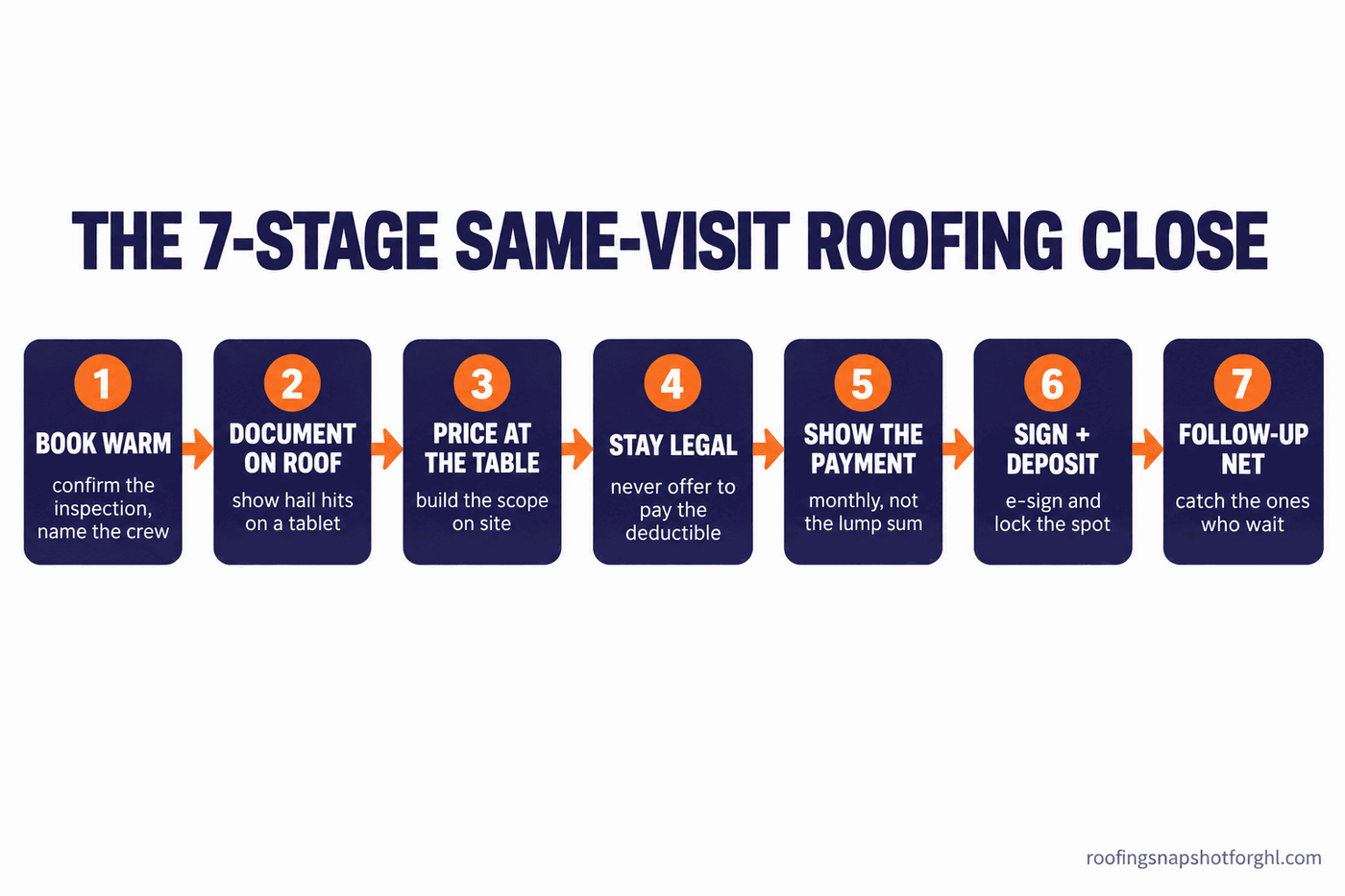
Here is the short answer. You fix this with a same-visit close system: a repeatable path from the booked appointment to a signed contract and a collected deposit, done on the first trip, every time, instead of leaving to “send a quote.” It is seven stages: book the inspection so you arrive warm, document the damage for the homeowner on the roof, build the scope and the number at the kitchen table, keep the deductible and insurance talk legal, put the monthly payment on the table instead of the lump sum, ask for the signature and take the deposit before you leave, and catch the ones who do not sign today with a follow-up net that actually fires. This is that system, stage by stage, with the exact words you can steal and the way each stage breaks when you wing it.
Key Takeaways
- Speed is the whole game. The classic MIT and InsideSales Lead Response Management study found a firm is about 100 times more likely to make contact when it responds in 5 minutes versus 30 minutes, and 21 times more likely to qualify the lead (Lead Response Management study, Oldroyd, MIT/InsideSales). The same urgency that wins the appointment wins the signature: the roof goes to whoever asks for it first.
- The “I’ll email you a quote” exit is where deals die. Every day you wait is another day for the storm-chasing crew already working the block to sign your roof. US major hail events hit 5,432 in 2025 (Triple-I / NOAA), so the competition on a hit neighborhood is real and fast.
- Price at the table, not from the office. Contractors who present financing on every quote close about 18% more jobs and write tickets about 30% larger (EnerBank USA via JLC). The lump sum scares people. A monthly number does not.
- Know the legal line before you open your mouth about the deductible. Wisconsin’s 2013 Act 24 and Florida Statute 489.147 both bar offering to pay or rebate a homeowner’s insurance deductible to win the job, with penalties per violation (Wis. Act 24) (Fla. Stat. 489.147). One wrong sentence on the porch can void the contract and fine you.
- The money is in the room once. State Farm alone paid more than $5.6 billion in hail claims in 2025 (Triple-I / NOAA). A roof you leave unsigned is not a maybe. It is revenue you handed to the next truck.
Table of contents
- What losing the first visit actually costs you
- The same-visit close system at a glance
- Stage 1: Book the inspection so you arrive warm
- Stage 2: Document the damage on the roof, for the homeowner
- Stage 3: Build the scope and the number at the table
- Stage 4: Keep the deductible and insurance talk legal
- Stage 5: Put the monthly payment on the table
- Stage 6: Ask for the signature and take the deposit
- Stage 7: The follow-up net for the ones who do not sign today
- Run it for a solo, a mid-size, and a large shop
- Steal this: the same-visit close scripts
- Objections
- Related reading
- FAQ
What losing the first visit actually costs you
A roof you do not close on the first visit is not a warm lead sitting patiently in your pipeline. On a storm-hit street it is a roof the next crew gets. The math starts with speed. The old MIT and InsideSales Lead Response Management study found that reaching out in five minutes instead of thirty made a company roughly 100 times more likely to connect and 21 times more likely to qualify the lead (Lead Response Management study). That speed wins the appointment, and the same law governs the signature: whoever asks for the roof first, with a real number and a pen, usually gets it.
Now add the storm reality. US major hail events hit 5,432 in 2025, up from 5,373 in 2024 (Triple-I / NOAA), and State Farm alone paid more than $5.6 billion in hail claims that year (Triple-I / NOAA). A hailstorm does not drop one roof. It drops the whole block, and every roofer in a 200-mile radius, plus the out-of-state chasers, know it. The homeowner you inspected this morning will have two more cards on the counter by Friday. We walked through how that plays out in why out-of-state storm chasers beat local roofers. The one defense that holds is closing before they knock.
Then there is the second trip itself. Every roof you leave to “send a quote” is a drive back out, a reschedule, a chase, and a close rate that drops with every day of silence. Your inspection time is the most expensive thing you own in a storm, and spending it to email a quote into a void, where it competes with three other quotes and a chaser in the driveway, is how good shops stay small. The fix is not working harder on the roof. It is refusing to leave without the answer.
The same-visit close system at a glance
The first-visit close fails in the same predictable places: you show up a stranger, document for your file instead of for the homeowner, build a great scope and then say “I’ll email it,” freeze on the deductible question, drop a $14,000 number with no payment option, never actually ask for the signature, and have no net when they say “let me think.” Each of those is a stage, and each one has a fix.
- Book the inspection so you arrive warm so the homeowner already trusts you before you are on the ladder.
- Document the damage on the roof, for the homeowner so they see the problem with their own eyes, on a screen, in the driveway.
- Build the scope and the number at the table so you present a real price on the first visit, not a promise of one.
- Keep the deductible and insurance talk legal so one wrong sentence does not void the contract or fine you.
- Put the monthly payment on the table so the number is a decision they can say yes to, not a wall.
- Ask for the signature and take the deposit so you leave with a job, not a maybe.
- Build the follow-up net for the no-signs so the ones who need a day still come back to you and not the chaser.
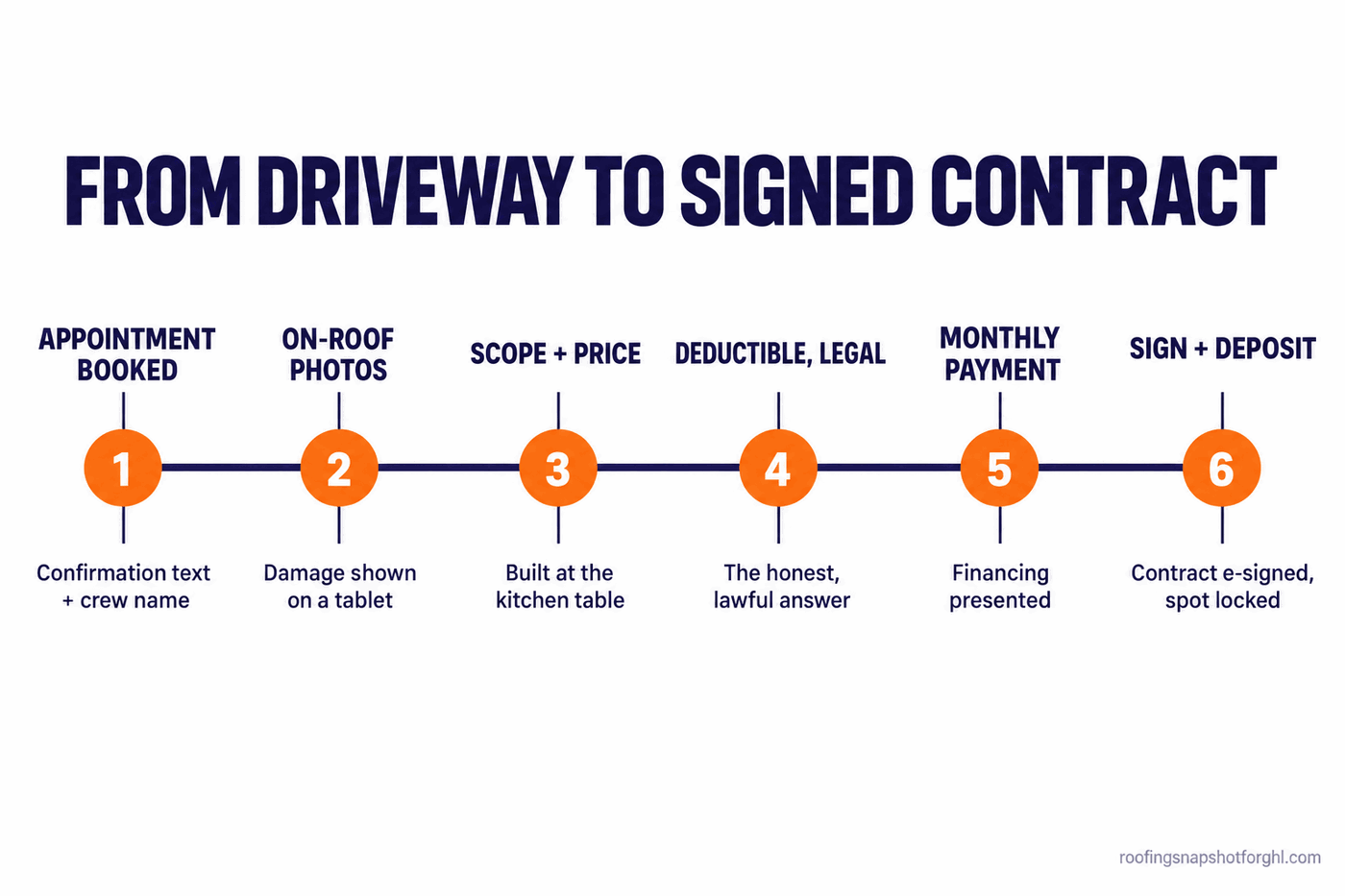
Stage 1: Book the inspection so you arrive warm
The close starts before you leave the shop. A homeowner who booked an appointment with a company they have never heard of treats you like a salesman. A homeowner who got a confirmation text, saw your crew lead’s name, and glanced at your Google reviews treats you like the roofer they already decided on. Same roof, completely different conversation on the porch.
Setup steps. The second an inspection is booked, fire an automated confirmation with the date, the window, the name and photo of who is coming, and a line that lowers the threat level: “No pressure, no obligation, I will walk your roof and show you exactly what I find.” Add a day-before reminder and a morning-of “on my way” text. This is the same confirm-and-remind logic that keeps appointments from evaporating, which we built out in how to reduce roofing inspection no-shows. Speed to that first contact matters too, and we broke down the real numbers in roofing lead response time.
How it breaks. The cold arrival. You pull up unannounced, or hours late, to a homeowner who forgot you were coming and now feels ambushed. They spend the inspection with their arms crossed, and no matter how good your scope is, they “need to think about it,” which means they are going to shop you. Reviews matter here too: BrightLocal’s 2026 survey found 68% of people will only consider a business rated 4 stars or higher (BrightLocal, 2026). A thin or stale profile loses the close before you knock.
Stage 2: Document the damage on the roof, for the homeowner
Most roofers inspect for themselves. They climb up, confirm the hail hits, shoot photos for the file, come down, and say “yep, you’ve got damage.” The homeowner, who cannot and will not get on that roof, has to take your word for it. That gap is where doubt lives, and doubt is what sends them shopping.
Setup steps. Document on the roof the way you would document for an adjuster, then show it to the homeowner before you talk price. Photos and short video of the hail bruising, the soft metals, the mat exposure, the collateral on the gutters and the AC fins, all on a tablet or phone you hand to them in the driveway. Chalk-circle the hits. Count them out loud. The goal is that the homeowner sees the damage with their own eyes on a screen, so the roof replacement is their conclusion, not your pitch. Our storm damage roof inspection checklist is the field protocol that makes this documentation hold up.
How it breaks. The invisible inspection. You find real damage, you know it is real, but you never show it, so the homeowner is deciding on faith. Then the next crew hands them a tablet full of circled hits and a video walkthrough, and suddenly you are the one who “just looked around for ten minutes.” One line of caution: documenting and showing damage is smart, but representing the homeowner to their insurer, or adjusting the claim for them, is not your job and in many states is illegal, which we get to in Stage 4.
Stage 3: Build the scope and the number at the table
This is the stage that separates shops that close on the first visit from shops that email quotes into the void. You already have the measurements, or you can pull them on the spot. You already have the damage documented. There is no real reason to leave and “put numbers together” except habit and fear. Build the scope at the kitchen table, in front of them, and present a real number.
Setup steps. Have your pricing ready to assemble on site. For retail jobs, that means a measurement you trust, whether from a tool like EagleView or Hover or a quick on-site measure, loaded into a template that spits out a good-better-best scope. Those measurement apps are exactly that, measurement tools, not your CRM and not your pricing engine. For insurance jobs, your scope follows the carrier’s estimate, often built in Xactimate, and your job at the table is to explain it in plain English: here is what the insurer approved, here is your deductible, here is any upgrade you are choosing to pay for. Present three options and walk them from top to bottom, letting them talk you down, which feels like winning to them.
How it breaks. The “let me email you a quote” exit, the single most expensive sentence in roofing. The minute you say it, you convert a hot prospect in front of you into a cold lead in your inbox, competing with everyone else’s quote and a chaser in the driveway. If you genuinely cannot price on site, at minimum present a range and a hold: “Roofs like yours run $X to $Y, and I can lock your exact number and your spot today with a deposit.” Do not leave empty-handed.
Stage 4: Keep the deductible and insurance talk legal
This is the stage most roofing sales training skips, and it is the one that can cost you the contract and a fine. When the homeowner asks “what about my deductible,” there is a right answer and there is a sentence that voids your contract and exposes you to penalties. Know the difference before you are standing on the porch.
The rule. In a growing list of states, a contractor cannot offer to pay, waive, rebate, or absorb the homeowner’s insurance deductible to win the job. Wisconsin’s 2013 Act 24, the original “storm chaser” law, bars promising to pay or rebate any part of a property insurance deductible as an inducement, with a forfeiture of $500 to $1,000 per violation (Wisconsin Act 24). Florida Statute 489.147 does the same and adds advertising and disclosure rules (Fla. Stat. 489.147), Texas regulators have cracked down on the practice (Texas Department of Insurance), and Colorado, Minnesota and others have parallel bans. Those same laws, plus public-adjuster rules in states like Florida, also limit you from negotiating or adjusting the claim for the homeowner. That is the public adjuster’s lane, not yours. We laid out the state-by-state picture in roofing insurance claim laws.
How it breaks. The deductible wink. “Don’t worry about your deductible, we’ll take care of it,” is the most common illegal sentence in storm roofing. It feels like good salesmanship. It is a forfeiture waiting to happen, and in some states a criminal exposure. The legal and honestly more persuasive answer is to tell the truth: the deductible is the homeowner’s responsibility, it is the one out-of-pocket number in an insurance job, and you can show them how financing makes it manageable without anyone breaking the law.
Stage 5: Put the monthly payment on the table
The number scares people. A $14,000 roof sounds like a car. A payment of a couple hundred a month sounds like a phone bill. On retail and out-of-pocket jobs, and on the deductible portion of insurance jobs, presenting a monthly option instead of a lump sum is the single biggest lever on your first-visit close rate.
Setup steps. Have a financing option ready to present at the table, not as a last-ditch rescue when they balk, but as the default way you quote. Pay-per-job lenders like Wisetack charge a flat fee near 3.9% with no annual cost, while subscription platforms run a flat yearly fee and no per-loan charge (Hearth). Present the payment and the price together: “The full roof is $14,200, or it’s about $235 a month, and either way I can lock it today.” The data on why this works is blunt. Contractors who put financing on every quote close about 18% more jobs and write tickets about 30% larger (EnerBank USA via JLC), and one roofer’s close rate on jobs over $10,000 climbed from 27% to 38% after making financing standard (ContractorPlus). The full playbook is in offer roofing financing without killing the close.
How it breaks. The lump-sum wall. You present one big number, the homeowner’s eyes glaze, and they retreat to “we need to talk about it,” which is code for “that is more than we have in the bank today.” You never gave them a way to say yes. The payment option is not about making the roof cheaper. It is about turning an impossible number into a decision.
Stage 6: Ask for the signature and take the deposit
Here is the uncomfortable truth about roofing sales: most inspections that should close do not, because the roofer never actually asks. They present, they answer questions, they say “let me know what you think,” and they leave. The ask is the job. Everything before it was setup.
Setup steps. When the scope and the payment are on the table, move straight to the signature as the natural next step, not a separate scary event. “This all make sense? Great, I’ll get you on the schedule, I just need your signature here and a deposit to lock your spot and your materials.” Use a digital contract the homeowner can e-sign on your tablet or their phone, and a deposit link they can tap right there. Then stop talking. The silence after the ask is where the deal closes; whoever speaks first loses, and it should not be you. Log the signed job straight into your pipeline so production, materials, and the customer communication sequence all kick off automatically.
How it breaks. The soft ask and the paper problem. “Take your time, call me if you want to move forward” hands the decision to the homeowner’s busy week and the next crew’s hard close. And a paper contract you have to drive back with builds a second visit into your own process. The assumptive close plus a one-tap e-signature plus a deposit link is what converts a good inspection into a job on the board.
Stage 7: The follow-up net for the ones who do not sign today
Not everyone signs on the first visit, and that is fine, as long as you have a net. The shops that lose these leads are the ones whose entire follow-up plan is “I’ll give them a call in a few days,” which never happens because three more storms hit and you forget. The net has to be automatic.
Setup steps. Any inspection that does not close goes into an automated follow-up sequence the moment you mark it “quoted, not signed.” A same-day text with the photos and the number, a next-day call task, a two-day text, a check-in at day five, and a final one at day ten, mixing text and a human call, every one of them tied to their quote. This is the exact sequence logic we detail in the roofing estimate follow-up sequence, and because it is SMS, your number has to be registered under A2P 10DLC or the texts never deliver, which we cover in A2P 10DLC registration for roofing contractors. Keep an opt-out on every message and honor STOP instantly.
How it breaks. The leak. You quote 20 roofs, five sign on the spot, and the other 15 go into a mental to-do list that reality erases by Thursday. Meanwhile the chaser who knocked after you has those 15 on a hard follow-up cadence. The difference between a 25% close rate and a 45% close rate is almost never the pitch. It is whether the no-signs got followed up like it was automatic, because it was.
Run it for a solo, a mid-size, and a large shop
The seven stages do not change. Who runs them and how much you automate does.
Solo operator, 1 crew. You are the salesperson, the estimator, and the closer, which means the close system has to live in your pocket, not in your head. The appointment confirmations, the e-sign contract, the deposit link, and the no-sign follow-up all fire automatically so you are not trying to remember them at 7 p.m. after a day on roofs. For a one-person shop, the same-visit close is survival: you cannot afford to inspect a roof twice, so you close it once.
Mid-size, 3 to 5 crews with sales reps. Now the problem is consistency across people. One rep closes 40% on the first visit, another closes 15% and emails quotes all day, and your revenue is a coin flip based on who caught the lead. Standardize the system. Every rep runs the same booked-warm confirmation, the same documentation protocol, the same at-the-table scope, the same legal deductible script, and the same follow-up net, all logged in one pipeline so you can see which rep is leaking and coach the specific stage they skip.
Large shop, 6 or more crews. At volume, the first-visit close is a machine you report on, not a talent you hope for. Every appointment, inspection, quote, signature, and deposit is tracked, so you can watch first-visit close rate by rep and by market and spot the rep who never asks for the signature. A multi-county hailstorm that drops 80 inspections in a week is only winnable when the booking, the on-site close, and the follow-up net run the same way 80 times without anyone dropping a lead.
Steal this: the same-visit close scripts
Here is the language, verbatim, for the moments that decide the job. Swap in your company name and numbers. Every automated text carries an opt-out.
Notice the pattern. Every stage moves toward the signature, the deductible answer is honest and legal, the price always comes with a payment, and the ask is direct. None of it requires a second trip.
Objections
“I can’t price a roof on the spot, every job is different.” Most can be, with the measurement and a template ready. For the genuinely complex job, present a tight range and lock the appointment with a deposit, then confirm the exact number within 24 hours. The goal is not a perfect quote on the hood of your truck. It is refusing to leave with nothing when a chaser is working the block.
“Pushing for a signature on the first visit feels like a hard sell.” It is only a hard sell if you skipped the documentation and the honest deductible talk. When the homeowner has seen the damage with their own eyes and understands the payment, asking for the signature is just the obvious next step, not pressure. The pressure play is the chaser’s game. Yours is clarity plus a pen.
“I already use AccuLynx or JobNimbus to run my jobs.” Keep it. Those are production CRMs for managing work after it is sold. The gap most of them leave is front-end speed: the booked-warm confirmations, the on-site e-signature and deposit, and the automatic follow-up on the ones who did not sign. Run the close system alongside your production software so a signed contract drops straight into the pipeline you already use. We compared what those platforms cost and cover in what roofing software actually costs in 2026.
“What about offering to cover the deductible to beat the other guy?” Do not. It is illegal in Wisconsin, Florida, Texas, Colorado and a growing list of states, with real penalties (Wisconsin Act 24). Beat the other guy on showing up warm, documenting the damage, presenting a payment, and closing on the spot. Those win the job legally and they do not come back to bite you.
Related reading
- Why out-of-state storm chasers beat local roofers
- The roofing estimate follow-up sequence
- Offer roofing financing without killing the close
- Roofing lead response time
- Roofing insurance claim laws, state by state
- How to reduce roofing inspection no-shows
Close
Back to that driveway, ladder on the rack, “so what do we do next?” This time you do not say “I’ll email you a quote.” You hand the homeowner the tablet, walk them through the hail hits they just saw you circle, tell them the truth about their deductible, show them the roof as a monthly payment, and ask for the signature with a deposit to lock their spot. They sign on your tablet before you pull out of the driveway. The chaser who knocks tomorrow is a day too late.
The inspection was never the hard part. Leaving with a signed contract instead of a promise is. Build the same-visit close once, let the confirmations and the e-sign and the follow-up net run on their own, and the roof you inspect is the roof you keep.
Frequently asked questions about closing roofing jobs on the first visit
What is a good first-visit close rate for a roofing company?
It varies widely by lead type and rep experience, and the figures floating around are mostly from vendor blogs, so treat them as directional. Industry guides commonly put the overall close rate around 20 to 27%, with strong teams that quote on site and offer financing reaching 35 to 45% on retail work. The practical point is less about the exact benchmark and more about the gap: shops that close on the first visit with a documented scope and a payment option consistently outperform shops that email quotes and hope.
Can I offer to pay or waive a homeowner's insurance deductible to win the job?
No, not in a growing number of states. Wisconsin's 2013 Act 24, Florida Statute 489.147, and similar laws in Texas, Colorado, Minnesota and others prohibit offering to pay, rebate, or absorb a homeowner's insurance deductible as an inducement to sign, with penalties per violation (Wisconsin Act 24). The deductible is the homeowner's legal responsibility. Present financing to make it manageable instead of promising to cover it.
How do I price a roof on the first visit without guessing?
Have your measurement and pricing ready to assemble on site. Use a trusted measurement, whether from a tool like EagleView or Hover or a quick on-site measure, loaded into a good-better-best template for retail jobs, and follow the carrier's approved estimate for insurance jobs. Present three options and a monthly payment. For a genuinely complex roof, present a tight range and lock the job with a deposit, then confirm the exact number within a day.
Why do I keep losing jobs to out-of-state storm chasers?
Usually speed. On a hail-hit block the whole neighborhood is in play, and the crew that documents the damage, presents a payment, and asks for the signature first tends to win. If you leave to email a quote, you give the next crew a day to close your roof. Closing on the first visit, plus an automatic follow-up net for the undecided, is the defense.
Should I use financing or just quote the cash price?
Present both, with the monthly payment leading. Contractors who put financing on every quote close roughly 18% more jobs and write about 30% larger tickets (EnerBank via JLC). The lump sum is a wall for most homeowners. A monthly number is a decision they can make at the table.
Can I automate the booking, the contract, and the follow-up without a full-time office person?
Yes. The confirmations, the day-of reminders, the e-signature contract, the deposit link, and the no-sign follow-up sequence all fire off the appointment and job status you already track, so a solo operator can run the same professional close process as a large shop. It is a one-time build, and a prebuilt roofing automation install sets it up in about a day.