
You are standing in the driveway with the homeowner, tablet in hand, and you just said the number. Fourteen thousand two hundred. You watch their face do the thing it always does. The shoulders drop, the eyes go to the gutter, and they say the line you have heard a hundred times. “Let me talk to my spouse and get back to you.” You already know how that ends. The job you inspected, measured, and priced walks across the street to the guy who said “about two hundred a month” instead of fourteen grand.
Here is the short answer. You offer roofing financing without killing the close by putting a monthly payment on the table before you ever say the full price, by letting the homeowner prequalify in sixty seconds with a soft credit check that does not touch their score, and by automating the follow-up so a pending application becomes a signed contract instead of a dead lead. The shops that win big-ticket jobs are not better talkers. They make the price feel small and the decision feel safe. This is that system, stage by stage, with the words you can steal and the one legal line that will put you in handcuffs if you cross it.
Key Takeaways
- Lead with the payment, not the price. Contractors who present financing on every quote close about 18 percent more jobs and write tickets about 30 percent larger (John Harris, EnerBank USA, via JLC). The number scares people. Two hundred a month does not.
- Prequalify with a soft pull. A soft credit check lets a homeowner see real offers in under a minute without hurting their score (Wisetack). No scary commitment, no reason to stall.
- Know what it costs you. Pay-per-job lenders charge a flat fee near 3.9 percent, subscription platforms run $1,499 to $4,999 a year with no per-loan fee, and legacy dealer-fee lenders can take 10 to 20 percent or more on a 0 percent promo (Hearth). Pick the model that fits your volume.
- Follow up or lose it. A financing application dies in a homeowner’s inbox, not at the credit decision. A scheduled follow-up cadence is what turns “approved” into “signed,” and that is exactly what a CRM automates.
- Never touch the deductible. You can offer financing. You cannot use it to pay, waive, or rebate a homeowner’s insurance deductible. That is a felony in Florida and illegal in at least 28 states (Colorado Roofing Association).
Table of contents
- What skipping financing actually costs you
- The 6-stage financing system at a glance
- Stage 1: Set up your lender stack before you need it
- Stage 2: Prequalify the homeowner before you quote
- Stage 3: Present the monthly payment, not the lump sum
- Stage 4: Make applying take sixty seconds
- Stage 5: Automate the approval and pending follow-up
- Stage 6: Track the financed job from approved to funded
- Which lender fits your shop
- Run it for a solo, a mid-size, and a large shop
- The legal line you cannot cross
- Steal this: the financing copy
- Objections
- FAQ
What skipping financing actually costs you
Roofs are expensive and getting worse. A full replacement runs about $9,530 nationally, with a normal range of $5,870 to $13,223 and a high end past $46,000 on big or steep homes (Angi, 2026). That is not a credit-card number for most households. It is a number people put off, and a roof people put off leaks for another winter while they price-shop you to death.
Financing changes the math on the porch. When the question is “do I have fourteen thousand dollars” the answer is usually no. When it is “can I do a hundred and ninety a month” the answer is usually yes. That reframe is worth real money. Hearth’s funded-loan data puts the average financed roofing project at $12,618 (Hearth), because financing lets homeowners trade up from a patch to a full replacement.
There is a reason the biggest shops already do this. On the Remodeling 550 list, about 96 percent of the top 50 contractors offer financing versus just 83 percent of the bottom 50 (JLC). The real-world lift is just as blunt. One roofer’s close rate on jobs over ten thousand dollars went from 27 to 38 percent after putting financing on every quote, and the average job climbed from about $11,400 to $15,800 (ContractorPlus).
Close rate on jobs over $10,000, one roofing shop, before and after offering financing on every quote. Source: ContractorPlus, 2026.
The cost of not offering it is the gap between those two bars, every week, on every quote you hand over without a payment attached.
The 6-stage financing system at a glance
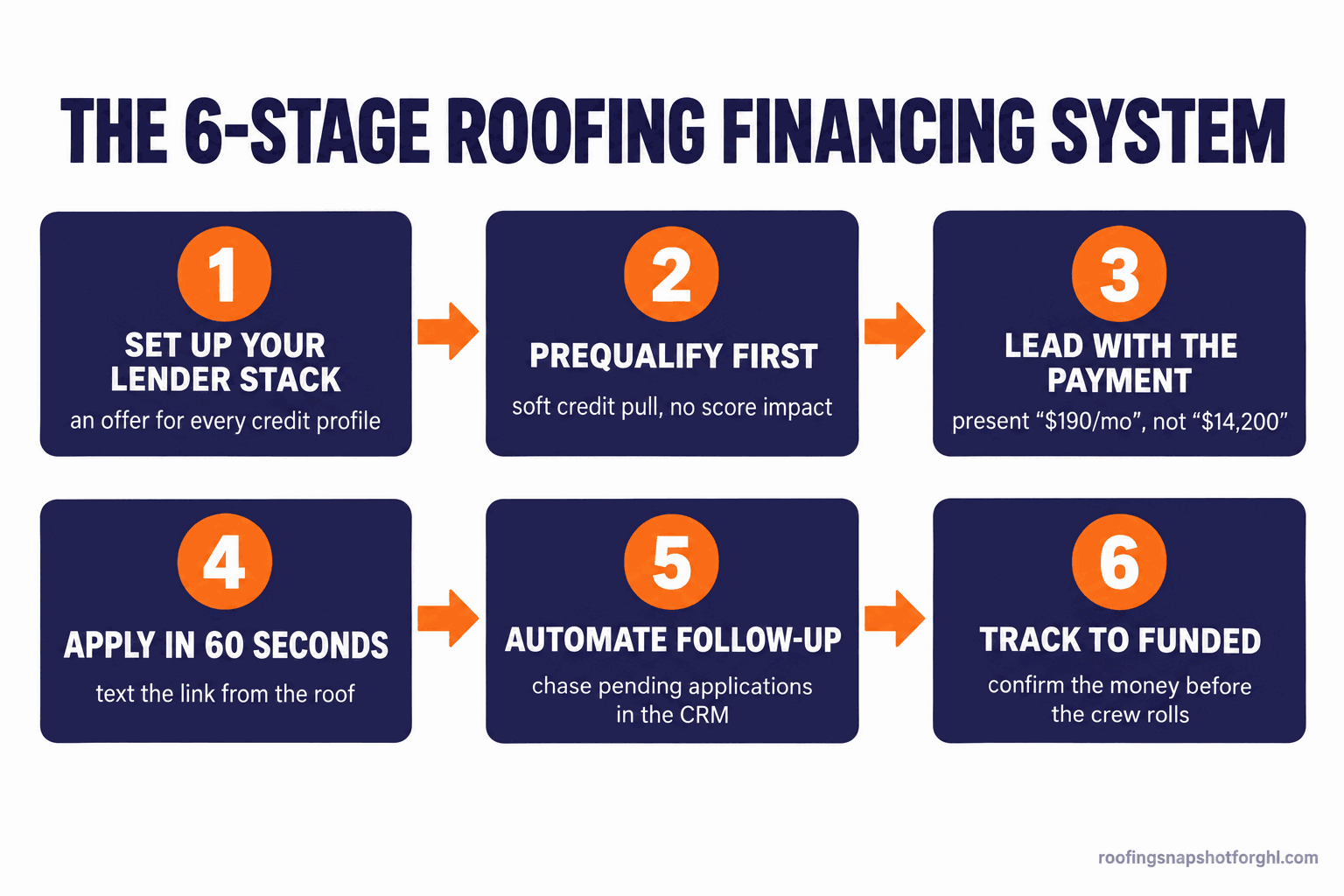
Financing fails for roofers in predictable ways. The lender gets set up and nobody uses it. The rep mentions it after the price instead of before. The link sits in the homeowner’s phone and never gets tapped. The approval comes back and nobody follows up. Each is a stage, and each has a fix. Here is the whole path.
- Set up your lender stack so you have an offer for every credit profile, not one lender that declines half your customers.
- Prequalify the homeowner with a soft pull before you quote, so you present a payment you know they can get.
- Present the monthly payment first, anchored against the full price, never the full price alone.
- Make applying take sixty seconds with a link you text from the roof, not a paper form at the table.
- Automate the follow-up on pending and approved applications so nothing stalls in an inbox.
- Track the financed job to funded so you know the money is real before the crew rolls.
Stage 1: Set up your lender stack before you need it
One lender is a trap. Every lender has a credit box, and the homeowner who falls outside it gets declined, feels embarrassed, and ghosts you. The fix is a stack: a prime lender for strong credit, a near-prime option for the middle, and a second-look lender for thin or bruised files. Platforms like Hearth and Acorn Finance route one application across a panel of lenders so the homeowner sees several real offers instead of one yes-or-no.
Setup steps. Pick a primary lender and a backup with a different credit appetite. Get your contractor account approved (a few days and a W-9). Load your logo and license so the prequal page looks like you, not a bank. Decide which promotional plans you will offer, because a 0 percent plan costs you more in dealer fees than a standard-interest one.
How it breaks. The most common failure is a single lender with a narrow box. You run twenty applications, half decline, and you decide financing does not work for your customers. It does. You had one door instead of three.
Stage 2: Prequalify the homeowner before you quote
The smartest move in the whole system is prequalifying before you price. A soft credit check shows the homeowner their real offers, terms, and monthly payments in under a minute, using just name, address, date of birth, and the last four of their Social, and it does not affect their credit score (Wisetack). You run it during the inspection, on your phone, while you are already on site.
Now you are not guessing. You reach the pricing conversation already knowing this homeowner can get, say, $14,000 at $205 a month for 84 months, and you build the quote around that payment. The price reveal stops being a cliff and becomes a confirmation of something they already saw and liked.
How it breaks. Reps skip this because it feels awkward to ask for a date of birth before they have earned trust. Frame it as a favor: “Let me check what payment options you qualify for so I can build a quote that fits your budget. It is a soft check, it will not touch your credit.” Nobody says no to that.
Stage 3: Present the monthly payment, not the lump sum
This is the stage that saves the close. People do not evaluate a roof against their bank balance. They evaluate it against their monthly budget. Fourteen thousand dollars competes with their savings. Two hundred a month competes with a streaming bundle and a tank of gas. One of those is a fight you lose and one is a fight you win.
Present the payment first, then anchor the full price against it. “Your options come out to about a hundred and ninety a month. The full replacement is fourteen thousand two hundred if you’d rather pay it outright, but most folks go with the payment.” You gave them a door for their budget and a door for cash, and let them pick. Never open with the big number alone, because the big number alone is the reason they stall.
How it breaks. The rep reveals the full price first, watches the shoulders drop, then scrambles to mention financing as a rescue. By then the homeowner has already decided to think about it. Financing after the sticker shock is damage control. Financing before it is a close. Tie this into your sales pipeline stages so every rep presents it the same way.
Stage 4: Make applying take sixty seconds
An application that needs a laptop, a scanner, and a quiet evening will not get done. An application that is a text link tapped in the driveway gets done while you are still standing there. Once the homeowner likes the payment, text them the full application link, they tap it, fill in a few fields, and get a decision in minutes. Wisetack handles terms from 3 to 120 months and projects from $500 to $65,000 through that one link (Wisetack).
Collect the signature and the application in the same visit. A homeowner who said “that payment works” and then went inside for the night will talk themselves out of it by morning. Get the application started before you leave the driveway.
How it breaks. You email a PDF “to fill out whenever” and it never gets filled out. Or the link goes to a generic bank page that looks nothing like your brand and the homeowner gets cold feet. Keep the flow branded and on the phone. This is the same speed-to-lead muscle that wins the first call (lead response time).
Stage 5: Automate the approval and pending follow-up
Here is where roofers leave the most money on the table, and where a CRM earns its keep. Applications come back in three states: approved, pending (needs a document or a co-signer), and declined. Each needs a different, timed follow-up, and no human remembers to run all three by hand across thirty open quotes.
Wire it into your CRM so the pipeline does the remembering. An approval triggers a same-day text to lock the install date. A pending application triggers a reminder to upload the missing document, then a call task if it still sits after a day. A decline routes quietly to your second-look lender. It is the same follow-up engine that stops insurance jobs from stalling in the insurance claim follow-up system and estimate follow-up playbooks.
Stage 6: Track the financed job from approved to funded
Approved is not funded. The lender pays you after the job is complete and the homeowner confirms the work, usually by ACH a few business days later. Until then the money is a promise. Build a pipeline stage for it so your office knows the difference between “homeowner approved” and “cash in the account,” and so nobody rolls a crew on a deal that still needs a co-signer or a document.
How it breaks. You treat approval as the finish line, schedule the crew, finish the roof, then find the funding stalled on a missed verification step. Now you are chasing payment on a completed job. Add a funding-confirmation step and tie the crew schedule to it.
Which lender fits your shop
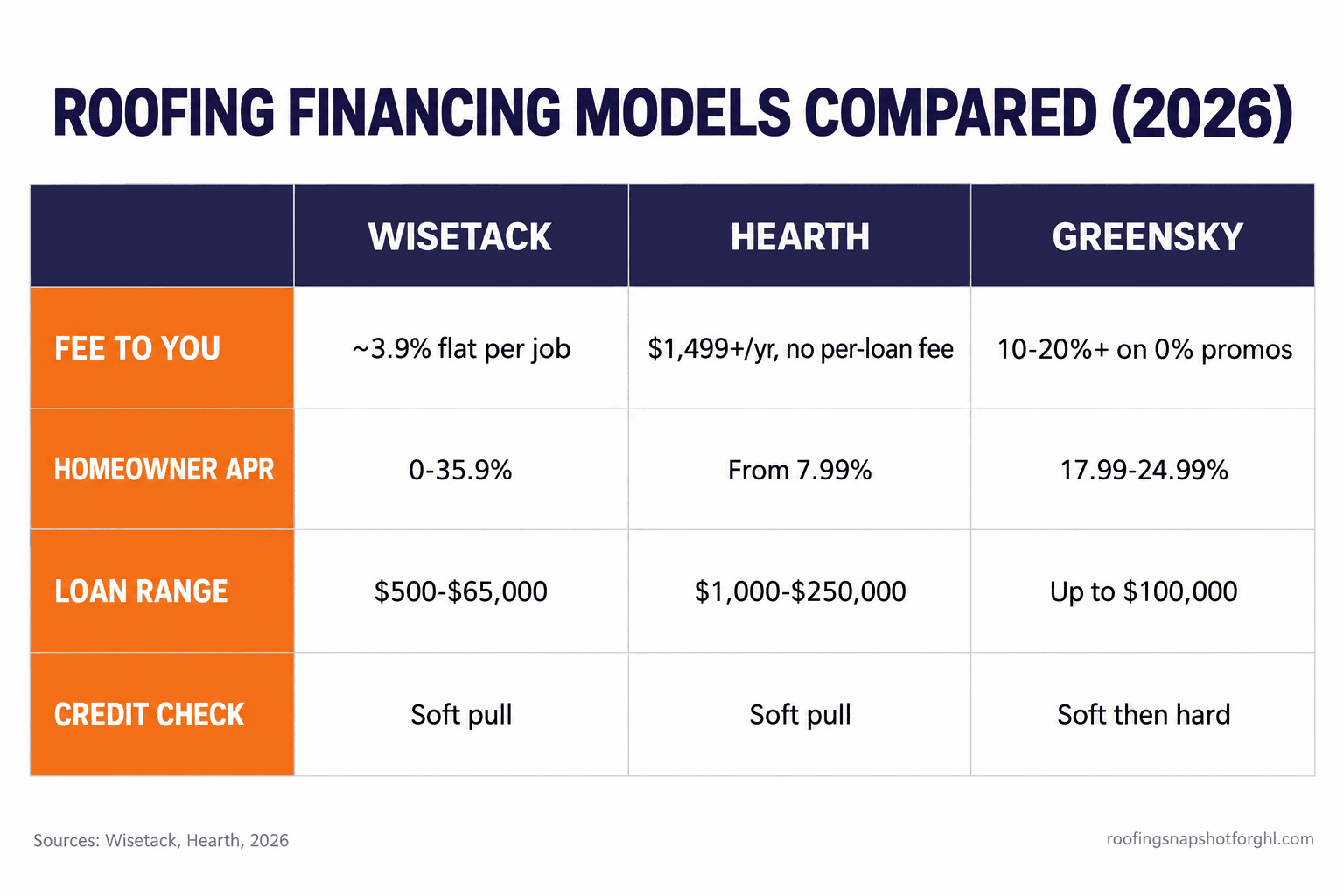
There is no single best lender. There is the right fee model for your volume. Pay-per-job lenders like Wisetack charge a flat fee near 3.9 percent and nothing when you do not use them, which suits a lower-volume shop. Subscription platforms like Hearth charge a flat annual fee and take no per-loan cut, which pays off once you finance enough jobs to spread it. Legacy dealer-fee lenders can bury 10 to 20 percent or more into a 0 percent promo, which is why that “free” 0 percent offer is often the most expensive thing on the menu.
Roofing financing models compared (2026)
| Plan | WisetackRecommended | Hearth | GreenSky |
|---|---|---|---|
| Price | 3.9% / job | $1,499+/yr | Dealer fee varies |
| Feature 1 | Flat ~3.9% fee per financed job, no subscription | Flat annual subscription, no per-loan fee | 10–20%+ dealer fee on 0% promos |
| Feature 2 | Homeowner APR 0–35.9% by credit | Homeowner APR from 7.99% | Homeowner APR 17.99–24.99% |
| Feature 3 | Projects $500–$65,000 | Loans $1,000–$250,000 | Loans up to $100,000 |
| Feature 4 | Soft pull, no score impact | Soft-pull multi-lender marketplace | Soft pull, then hard on acceptance |
| Feature 5 | Best for lower or mixed volume | Best for higher, steady volume | Best for 0% promos, if you do the math |
| View Wisetack | View Hearth | Compare options |
Do the fee math on a real job first. On a $12,618 roof, a 3.9 percent flat fee is about $492. A 15 percent dealer fee on a 0 percent promo for the same roof is about $1,893. The 0 percent plan the homeowner loves can cost you nearly fourteen hundred dollars more, so either build that into your price or steer toward a standard-interest plan where the homeowner carries the cost of the money, not you.
Run it for a solo, a mid-size, and a large shop
The framework is the same. What changes is who runs each stage and how much you automate.
Solo operator, 1 crew. You are the salesperson, so you run the prequal on your own phone and present the payment yourself. Use a pay-per-job lender so there is no subscription to justify in a slow month. Keep the stack simple: one good lender plus one second-look option, with two or three automated texts behind it.
Mid-size, 3 to 5 crews. Now reps present differently and some skip financing entirely. Standardize it. Build the payment-first pitch into the sales process and make the prequal a required step before any quote goes out. The subscription model starts paying off here, and your CRM should route pending applications to the office automatically.
Large shop, 6 or more crews. Volume makes the fee math a real line item, so you negotiate rates and may run two lenders to arbitrage approvals and cost. Follow-up is fully automated and reported: close rate by rep, average ticket by plan, funding time by lender. At this size a half-point of close rate is a truck payment. This is where a connected tech stack matters, because a financing tool that does not talk to your CRM creates the exact inbox leak this system is built to stop.
The legal line you cannot cross
Financing is legal and encouraged. There is one place it turns into a crime, and roofers get arrested for it every storm season. You cannot use financing, a rebate, or a credit to pay, waive, or cover a homeowner’s insurance deductible. At least 28 states ban waiving or rebating deductibles (Colorado Roofing Association). In Texas the fine runs up to $2,000 with up to six months in jail (Texas Department of Insurance). In Florida two contractors who dressed up a deductible rebate as an “advertising agreement” were charged with nine counts of insurance fraud, a third-degree felony (Florida CFO). Financing the out-of-pocket portion is fine. Structuring the deal so the homeowner never really pays the deductible is fraud. Read the full breakdown in our roofing insurance claim laws guide.
There is a second, quieter rule. The moment you regularly arrange consumer credit, you can become an “arranger of credit” under the Truth in Lending Act and Regulation Z, which governs how credit terms get advertised (CFPB, Regulation Z). You cannot splash “0% financing” or “$99 a month” on a yard sign without the required terms attached. Let the lender’s compliant flow do the disclosing, and keep your own marketing to “financing available.”
Steal this: the financing copy
Here is the language, verbatim, for the three moments that matter. Adjust the numbers to the real offer the homeowner prequalified for.
Those three messages, automated through your CRM, are the difference between a financing tool you pay for and a financing tool that pays you.
Objections
“Won’t customers think I’m pushing them into debt?” Not if you lead with the soft prequal and leave the cash door open. You are not pushing a loan. You are showing a homeowner the roof fits their monthly budget, then letting them choose. The pushy version hides financing until after the sticker shock. The helpful version offers it up front as one of two clear doors.
“What if I already use AccuLynx or JobNimbus?” Keep it. Financing is a separate tool that lives alongside your CRM. The piece most roofing CRMs do poorly is the timed follow-up on pending applications, which is where the money leaks. Run the lender through your existing system and bolt the follow-up automation on top (software cost breakdown).
“Do I need to be technical?” No. The lender onboarding is a form and a W-9. The follow-up automation is the part that takes real setup, and the part worth paying to have done right, because a half-built sequence leaks the same jobs a manual process does.
“The fees eat my margin.” Only if you ignore the fee math in Stage 5. Price the fee into the job, or use a standard-interest plan where the homeowner carries the cost of the money. A 3.9 percent fee on a job you would have lost entirely is not a cost, it is the price of a job you now have. Compare that to what a dead lead costs you.
Close
Back to the driveway. This time you ran the soft prequal during the inspection, so when you got to the number you did not say fourteen thousand two hundred. You said “about a hundred and ninety a month, and I can text you the link right now.” The homeowner tapped it, got approved on their phone while you packed up the ladder, and signed before you pulled out. The guy across the street who only knows how to say the big number is still waiting on a callback that is not coming.
Financing does not close the job by itself. The payment-first pitch, the soft pull, and the automated follow-up close the job. The lender is just the tool that makes the payment possible. Build the system once and every quote you hand over carries a payment, not a cliff.
Frequently asked questions about roofing financing
Does offering financing really increase my close rate?
Yes. Contractors who present financing on every quote close about 18 percent more jobs and write roughly 30 percent larger tickets (EnerBank USA, via JLC). One roofer went from a 27 to a 38 percent close rate on jobs over $10,000 (ContractorPlus).
What does roofing financing cost me as the contractor?
It depends on the model. Pay-per-job lenders charge a flat fee near 3.9 percent per job. Subscription platforms run $1,499 to $4,999 a year with no per-loan fee. Dealer-fee lenders can take 10 to 20 percent or more on a 0 percent promo (Hearth). Do the fee math on a real job first.
Will a financing check hurt my customer's credit score?
No. Prequalification uses a soft credit pull that shows real offers in under a minute without affecting the score. A hard pull only happens if they accept an offer and move forward (Wisetack).
Can I use financing to cover a homeowner's insurance deductible?
No. Using financing, a rebate, or a credit to pay, waive, or cover a deductible is illegal in at least 28 states and a felony in Florida (Colorado Roofing Association). You can finance the legitimate out-of-pocket portion. You cannot structure the deal so they never pay the deductible.
Can I advertise 0% financing on my website and trucks?
Carefully. Once you regularly arrange consumer credit you may fall under the Truth in Lending Act and Regulation Z, which require specific terms whenever you advertise a rate or payment (CFPB). Keep your own marketing to 'financing available' and let the lender's flow handle rate disclosures.
How do I stop financing applications from stalling?
Automate the follow-up. Most financing is lost at the pending stage, where a homeowner qualified but needs to upload a document. A CRM sequence of an approval text, a pending reminder, and a call task recovers those jobs. It is the single highest-return part of the system.