
It is a Tuesday in late June and the hail that made your spring feels like a year ago. Three weeks back your crews were turning down work. This week two crews are washing trucks because the board is empty, and payroll is due Friday whether they lay a shingle or not. You are not out of business. You are between storms. That gap, the one nobody talks about at the trade show, is where a roofing company quietly loses the money it made in the surge.
Here is the short version. Idle crews are not a weather problem, they are a pipeline problem. The fix is not to pray for hail. It is a year-round pipeline built from the cheap, warm demand you already own, past customers, referrals, repairs, and maintenance, so the board stays full in the flat weeks. This is the month-by-month playbook, with the messages you can steal and how each stage breaks.
Table of contents
- What an idle crew actually costs you
- Why the gap happens: the roofer’s year
- The year-round playbook, stage by stage
- Steal this: the off-season message pack
- Which fix fits your shop? Three scenarios
- One legal thing before you text your database
- Objections, answered honestly
- FAQ
What an idle crew actually costs you
Most owners track cost per lead and ignore the number that does more damage: a crew that shows up with nothing to build. Run the math on your board. The BLS puts the median roofer wage at $50,970 a year, with about 166,700 roofers employed as of May 2024 (BLS). That is roughly $24 an hour before payroll taxes, comp, and the truck. A two-man crew you keep on payroll through a dead week is $400 to $500 a day with zero revenue attached. Two crews for two flat weeks is real money, straight out of the margin you earned in the storm.
The trap is that the storm hides the leak. In a big hail week you are so slammed the idle weeks feel like a fair trade. They are not. Feast-or-famine staffing is the hardest thing about running a roofing company: one month you turn work away, the next your best installer takes a job across town because you could not keep him busy. Losing a trained crew is worse than losing a job. Most contractors cannot find enough skilled workers, and construction needed an estimated 439,000 net new workers in 2025 just to keep up (National Roofing Contractors Association). Replace that installer and you pay to recruit and train, down a producer in the next surge.
So the real cost of idle time is not just this week’s wage. It is the crew you lose, the customer the door-knocker signs while your guys wash trucks, and the momentum you rebuild each season.
Why the gap happens: the roofer’s year
Storm work is lumpy because weather is lumpy. Peak severe-hail season runs roughly March through August and moves north through the year, starting on the Texas Gulf Coast in late February and not reaching the northern plains until midsummer (Insurance Information Institute). In any single market you get a handful of big event weeks and a long tail of quiet weeks.
On top of that sits the ordinary seasonal calendar. Spring and fall are the busy stretches across most of North America. Winter is the dreaded slow season: once it stays below about 40 degrees, asphalt shingles stop sealing and installs slow to a crawl (RoofSnap, ServiceTitan). Stack the two and you get a year with two or three hot spikes and a lot of flat road between them.
That is the part you cannot change. What you can change is what runs on the board during the flat road. The shops that stay busy year-round are not luckier with weather. They built a second engine, one that does not need a storm to produce work. Here is how to build it.
The year-round playbook, stage by stage
Five stages plus one permanent fix, each with a job, a message, and a way it breaks.
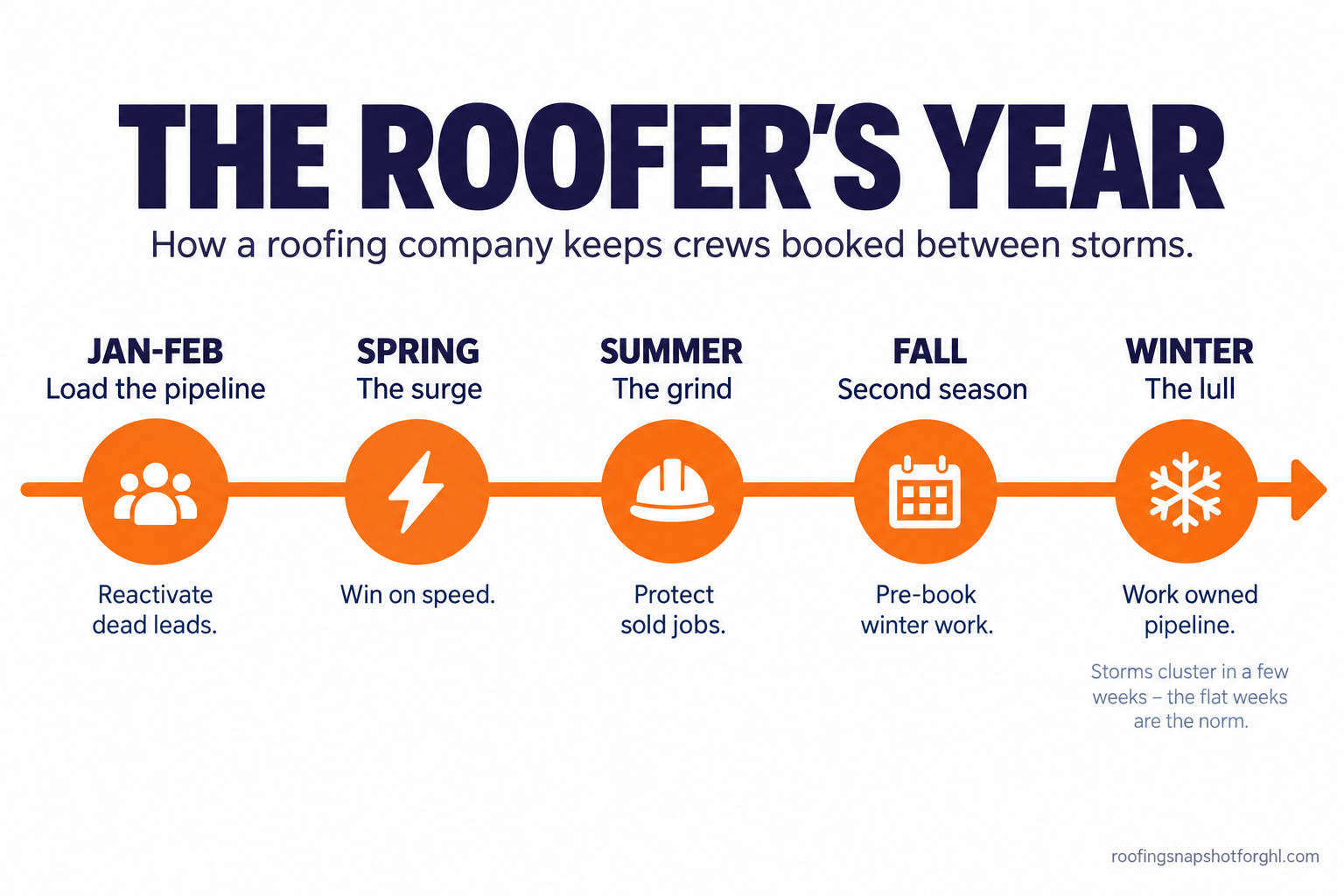
Stage 1: Load the pipeline before the surge (January to February)
The quiet start of the year is prep time, not downtime. Fill the funnel now so that when the first storm hits you are scrambling to lay shingles, not find leads. Reactivate every dead lead in your CRM: the inspections that never closed, the “call me in spring” homeowners, the stalled insurance jobs. That database is the cheapest pipeline you own.
How it breaks: most shops let last season’s leads rot in a spreadsheet and buy fresh, expensive leads in the surge instead. If your only plan for spring is to turn the ads back on, you are paying full retail for demand you could have warmed up for pennies. Build the reactivation campaign now, not in May. Our database reactivation playbook has it.
Stage 2: The spring surge, win on speed not spend
When the storm hits, dozens of homeowners fill out forms in the same hour, and whoever answers first signs the roof. The gap between a lead landing and a human contacting it is the whole ballgame.
How it breaks: your crews are on roofs, so the phone rings out and the web form sits unread until lunch. By then the out-of-state door-knocker has been to the porch. Automate the instant response: a missed-call text-back and a speed-to-lead SMS that fires the second a form comes in. See why a 30-second response wins storm jobs.
Stage 3: The summer grind, protect the jobs you already sold
Mid-summer the storm high fades but production is still heavy. The risk shifts from getting leads to not dropping the ones you already sold. Jobs stall between inspection and build, supplements sit unfiled, and homeowners go quiet. Every stalled job is a crew-day you cannot fill because the paperwork is not done.
How it breaks: the pipeline clogs in the middle. A job sold in June is still not built in August because nobody chased the adjuster or ordered material. Keep it moving with defined sales pipeline stages and automated status updates.
Stage 4: The fall push, run your second season
Fall is the year’s second peak, and the weather still cooperates. This is your last clean run of install-friendly days, so convert every warm lead you have been sitting on and book the repair and maintenance work that carries you into winter.
How it breaks: shops treat fall like a victory lap and coast, then hit December with an empty board. Use it to pre-book winter repair and maintenance, and to ask every summer customer for the referral and the review while the job is fresh.
Stage 5: The off-season lull, work the pipeline you own (winter)
This is the stage the whole article is built around, because it is where crews go idle. When new storm demand dries up, you stop buying cold leads and mine the warm demand you already have. Three sources fill a winter board: your past-customer database, referrals, and non-storm work like repairs, maintenance, gutters, and ventilation.
The economics are the point. Here is what a lead costs by channel.
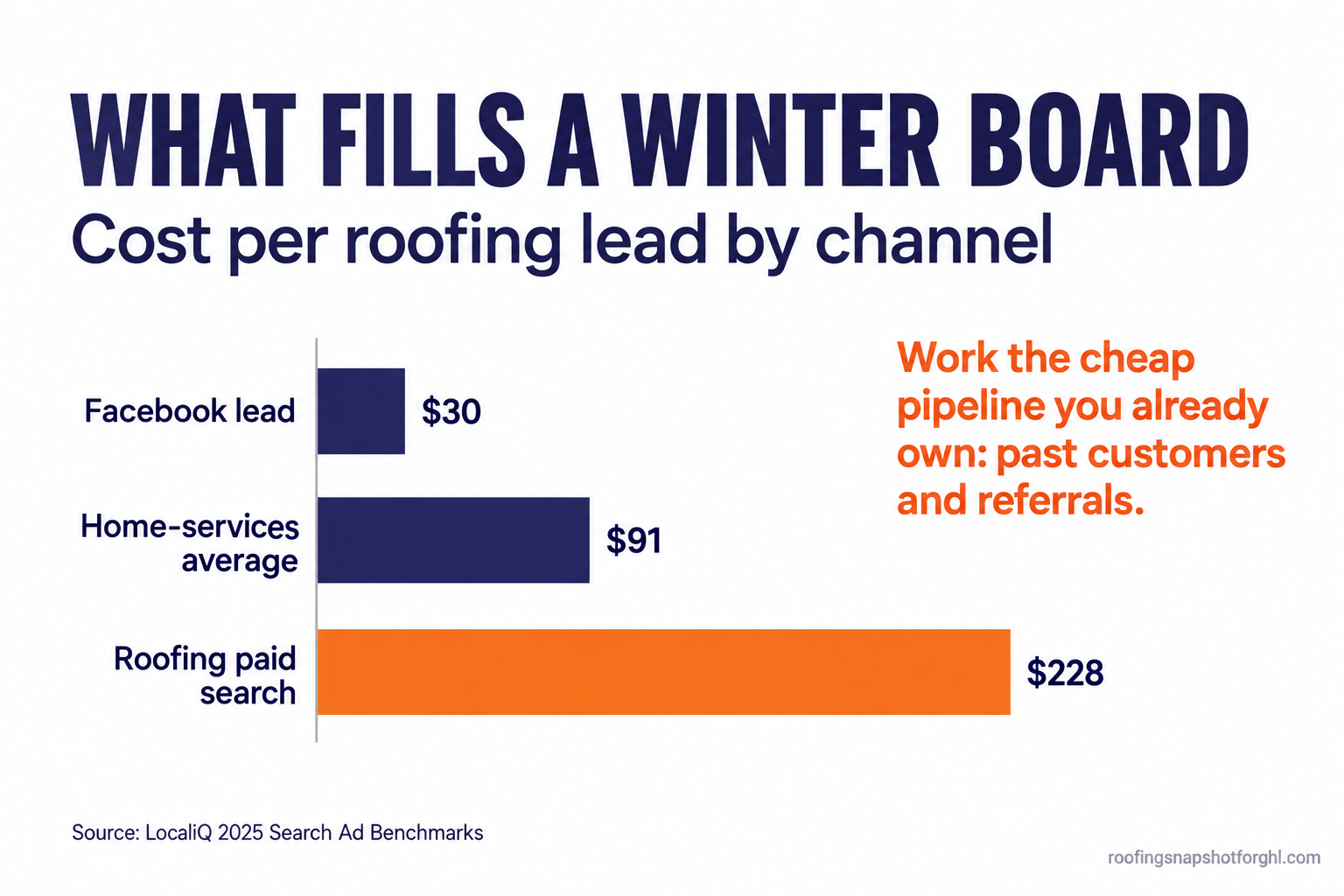
Buying $228 storm clicks in a dead winter is the most expensive way to fill a board. Working your own database is the cheapest, and it converts better because a past customer already trusts you. Industry benchmarks put referral and past-customer close rates around 30 percent or higher, versus low teens for cold marketplace leads and low single digits for paid clicks (GetTheReferral).
Close rate by lead source, percent. Referrals and past customers close far higher than cold, purchased leads. Source: GetTheReferral.
How it breaks: the winter reactivation never happens because it is manual, and manual work is the first thing to slide when the owner is doing everything. If turning cold contacts into signed repairs depends on remembering to send texts, it will not get done. That is what a database reactivation campaign and a standing referral program are for: they run whether or not you remember.
Stage 6: The permanent fix, make the pipeline run itself
Doing all of the above by hand works for one season, then it slips. The permanent fix is a system that keeps the funnel warm automatically: reactivation sequences on a schedule, review requests the day a job wraps, referral asks built into the close, and follow-up across SMS, email, and Facebook without you touching it. Marketing automation returns $5.44 for every dollar spent (Nucleus Research), because the machine never forgets to follow up and never takes a week off.
How it breaks: you buy a CRM, never finish wiring the automations, and it becomes an expensive contact list. The tool is not the system, the workflows are. Build them out or start from a pre-configured setup that already has them.
Steal this: the off-season message pack
Here is the copy that fills a winter board. Load these into your CRM once and let them run, with an opt-out and consent on file (the legal section covers it).
Route happy customers to your public Google profile and unhappy ones to your phone, so problems get fixed in private. The mechanics are in our guide on getting more Google reviews for roofers. Five short messages on autopilot are the difference between a full winter board and an empty one.
Which fix fits your shop? Three scenarios
The honest answer to “how do I keep my crews busy between storms” depends on your size.
The solo operator or one-crew shop
You are the salesperson, the estimator, and half the time the guy on the roof. The idle labor is you, and every hour not on a job or selling one is zero revenue. Buying expensive storm clicks in a slow month bleeds you fast.
Your fix: live off owned demand. An automated reactivation text to past customers and a standing referral ask cost almost nothing and fill the gaps with warm work that closes. Add winter repair jobs, perfect for one crew. You need automation, not headcount.
The two-to-three-crew growing shop
You have an office person now, maybe a salesperson, and real storm volume in season. Your problem is the whipsaw: you staff up for the surge, then cannot keep everyone busy in the lull, and lose trained people to the shop down the road.
Your fix: this is the sweet spot for a real system. Run automated reactivation and referral campaigns year-round so the board never empties, track every job through defined pipeline stages so nothing stalls mid-summer, and pre-book winter maintenance in the fall. Smooth the curve enough to keep your core crews on payroll all year.
The larger storm-restoration operation
Multiple crews, supplement coordinators, a sales team, hundreds of leads in a storm week. Your idle-crew problem is the biggest in dollar terms, and chasing storms across regions is how many big shops try to solve it, at high cost and risk.
Your fix: build a second revenue engine that does not depend on hail: a real non-storm division, a maintenance-plan program that produces recurring winter work, and a reactivation and referral machine large enough to matter at your volume. The money you save by not overpaying for cold leads funds supplement recovery instead. The system pays for itself when it keeps even one crew off the bench for a month.
One legal thing before you text your database
Everything above leans on automated texting, and automated texting has rules. Get them wrong and the campaign meant to fill your winter board gets you filtered, blocked, or fined instead.
First, consent and registration. To send automated marketing SMS in the U.S. you need prior consent and registration for A2P 10DLC, the carrier program that governs business texting. Skip it and your messages get throttled or blocked, killing your reactivation when you need it. Every text above includes an opt-out for a reason. Our A2P 10DLC registration guide walks through the setup.
Second, claims language. Several states, including Florida under SB 76 and Wisconsin under 2013 Act 24, bar contractors from negotiating insurance claims for a homeowner or offering to absorb deductibles. So the “we handle your insurance claim for you” copy a lot of roofing sites run can be illegal where you operate, and it can slip into a reactivation text. We cover what roofers can and can’t legally say about insurance claims state by state.
Objections, answered honestly
“My crews aren’t really idle, I just send them home when it’s slow.” Sending them home does not make the cost disappear, it moves it. Either you pay them anyway to keep them around, or you cut their hours and lose them to a shop that keeps them busier. Fill the board with owned demand and the send-them-home weeks get rare.
“Isn’t winter just dead? Shingles don’t seal in the cold.” Full tear-off installs slow in the cold, true. But repairs, leak fixes, emergency work, maintenance check-ups, gutters, and ventilation do not stop, and neither does selling spring work at locked-in pricing. Winter is slow for one job type, not your whole business.
“I don’t have time to send all these texts.” Correct, which is why it has to be automated. If keeping the pipeline warm depends on you remembering, it will not happen in the busy weeks, which are the weeks it matters. A system sends the reactivation, the referral ask, and the review request on its own. You set it up once.
“Do I need to be technical to build this?” To wire it from scratch, somewhat, and that is the honest downside of a flexible platform like GoHighLevel. That is why pre-built roofing systems exist: someone else does the wiring, so you get working automations without learning the platform.
Back to that Tuesday in June with two crews in the yard. The fix was never a bigger storm. It was the reactivation text that should have gone out in January, the referral ask that should have fired when the spring jobs closed, and the maintenance offer that should already be booking winter work. Build the engine that runs those on autopilot, and the flat weeks stop costing you money.
FAQ
Keeping roofing crews busy between storms: common questions
Why do roofing crews sit idle between storms?
Because storm demand is lumpy. Hail clusters into a few peak weeks per market (there were 5,432 major U.S. hail events in 2025, concentrated in spring and summer), and ordinary demand dips in winter. Crews go idle when a shop's only pipeline is new storm demand and nothing runs in the gaps.
How much does an idle roofing crew actually cost?
The median roofer earns about $50,970 a year per the BLS, roughly $24 an hour before taxes and comp. A two-man crew kept on payroll through a dead week costs $400 to $500 a day with no revenue attached. The bigger cost is losing a trained installer to a competitor, because skilled labor is scarce.
What work can roofers do in the winter slow season?
Plenty that isn't a full tear-off: leak repairs, emergency fixes, roof and gutter check-ups, ventilation, and interior-safe tasks. It's also the best time to sell spring installs at locked-in pricing and to reactivate past customers. Winter is slow for one job type, not the whole business.
Is it cheaper to buy leads or work my database in the off-season?
Working your database is far cheaper and converts better. Cold paid clicks are the most expensive lead you can buy and close in the low single digits, while past customers and referrals close around 30 percent or higher at a fraction of the cost.
Do I need to register for A2P 10DLC to text my past customers?
Yes. Automated business SMS in the U.S. requires prior consent and A2P 10DLC registration with the carriers. Skip it and your reactivation texts get throttled or blocked. Include an opt-out in every message, and check your state's rules on insurance-claim language before you send anything about storm claims.