
You went looking for a roofing CRM the same week three vendors made you book a demo just to hear a price. Then you landed on Roofr, and the number was right there on the page: free to start, $349 a month at the top, no per-seat fee. After a month of being sized up by sales reps, that feels like fresh air. The question that matters: is that the real cost, and is Roofr enough to run a storm-driven roofing business on?
Here is the short answer. Roofr’s plans run from a free Starter tier up to $349 a month for Scale, with no charge per user, which is genuinely rare in this category (Roofr, 2026). The sticker is honest, but it is not the whole bill: measurement reports are priced per report, and the pieces that make it feel like a real CRM (payments, SMS, the AI Receptionist, the instant estimator) sit on higher tiers or cost extra. The bigger truth is that Roofr is a very good measure, estimate, and invoice tool with a light CRM attached. It is not a storm-to-deposit machine that chases leads in seconds, tracks a claim from inspection to deposit, and follows up across channels on its own. This post breaks the price down tier by tier, prices the add-ons the sticker hides, and tells you where Roofr stops short for a one-to-five-crew storm shop.
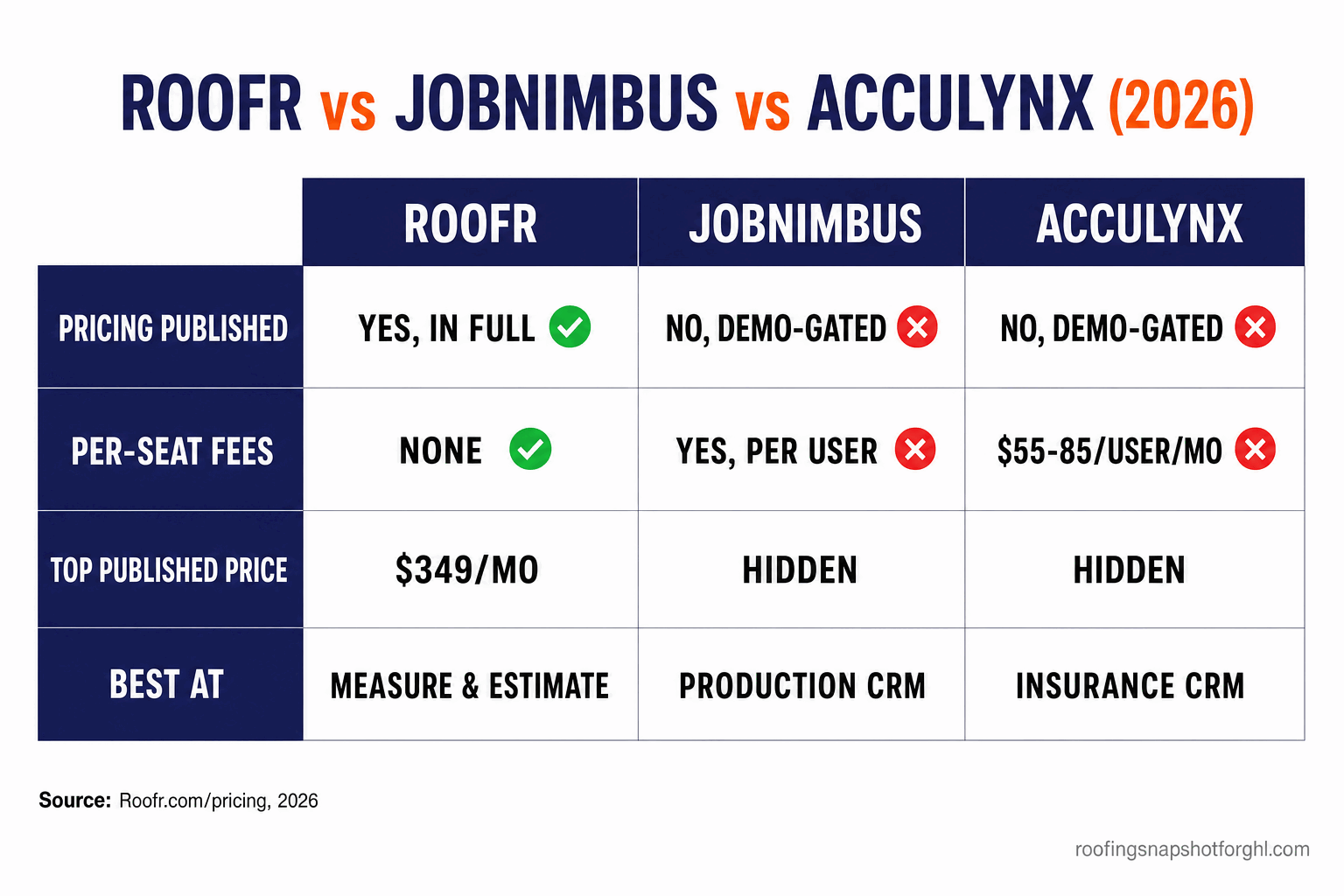
Key Takeaways
- Roofr publishes everything, which almost no competitor does. Starter is free, and the top Scale tier tops out at $349 a month, with no per-seat fee and unlimited users on every paid plan (Roofr, 2026).
- The sticker is not the bill. Measurement reports cost $13 to $19 each, and SMS, the Instant Estimator, Roofr Sites, and the AI Receptionist are paid add-ons (Roofr, 2026).
- Roofr is strongest at the front of the job: fast measurements, quick priced proposals, clean invoicing. That is where it earns its keep.
- Roofr is thin where a storm shop lives: deep claim tracking, true speed-to-lead, and multi-channel follow-up are not what it was built to do.
- It is still the price anchor. Use its published price to force a real number out of any demo-gated vendor like AccuLynx or ServiceTitan.
Table of contents
- Why a published price is worth noticing in roofing software
- What Roofr actually costs in 2026, tier by tier
- The costs the sticker price hides
- Three real cost scenarios: solo, mid-size, and large
- Where Roofr is genuinely strong
- Where Roofr stops short for a storm shop
- Roofr vs JobNimbus vs AccuLynx at a glance
- A compliance note before you automate follow-up
- Objections, answered straight
- Frequently asked questions
Why a published price is worth noticing in roofing software
Most roofing software makes you earn the price: you book a demo, answer discovery questions about crew count and job volume, and the number you hear is tuned to what the rep thinks you will pay. AccuLynx and ServiceTitan are the two most opaque names in the category, and AccuLynx pulled its last public plan off its website in 2026 (PricingSaaS, 2026). A company that hides the price is reserving the right to charge you more than the shop down the road.
Roofr does the opposite. Every tier, every add-on, and the per-report fees are on the pricing page, and the paid plans do not charge per seat (Roofr, 2026). You can budget without a sales call, and you get an anchor: when a demo-gated vendor dances around your question, you put a real number on the table and make them justify the gap. We priced the whole field in what roofing software actually costs in 2026, and Roofr is the one line you can trust without a quote.
What Roofr actually costs in 2026, tier by tier
Roofr runs four plans. Prices are from the Roofr pricing page, which quotes both a monthly and a lower annual rate (Roofr, 2026).
Starter: $0 a month. Free, with pay-as-you-go measurement reports at $19 each on 24-hour delivery, one basic job board, ten trial proposals and invoices, material ordering, email, and calendar. Unlimited users even on the free plan. No payments, no SMS, no real CRM depth. For a brand-new one-truck operator testing the water, that is a fair deal.
Measure+: about $109 to $209 a month. Built around measurements. You get cheaper reports ($13 each), faster delivery windows, material and waste-factor calculations, CSV exports, and your branding on the reports. If your pain is “EagleView costs too much and I want fast, cheap measurements with the waste math built in,” this is the plan. It is not where you run a pipeline.
Essentials: about $209 to $249 a month. This is where Roofr starts to feel like software you run a business on: unlimited proposals, invoices, and work orders, credit card and ACH payments, signable PDFs, unlimited e-signatures, and a flexible job board with automations. SMS shows up here, though the pricing page also lists texting as a paid add-on in places, so confirm what your plan includes. For a lot of small shops, Essentials is the realistic starting point.
Scale: about $299 to $349 a month. The top tier adds seven job boards, custom tags and work types, crew management, a performance dashboard, job costing, QuickBooks integration, and role-based permissions. This is the plan for a shop that wants reporting and multiple pipelines, not just estimates. Unlimited users still, so a ten-person office pays what a two-person shop does.
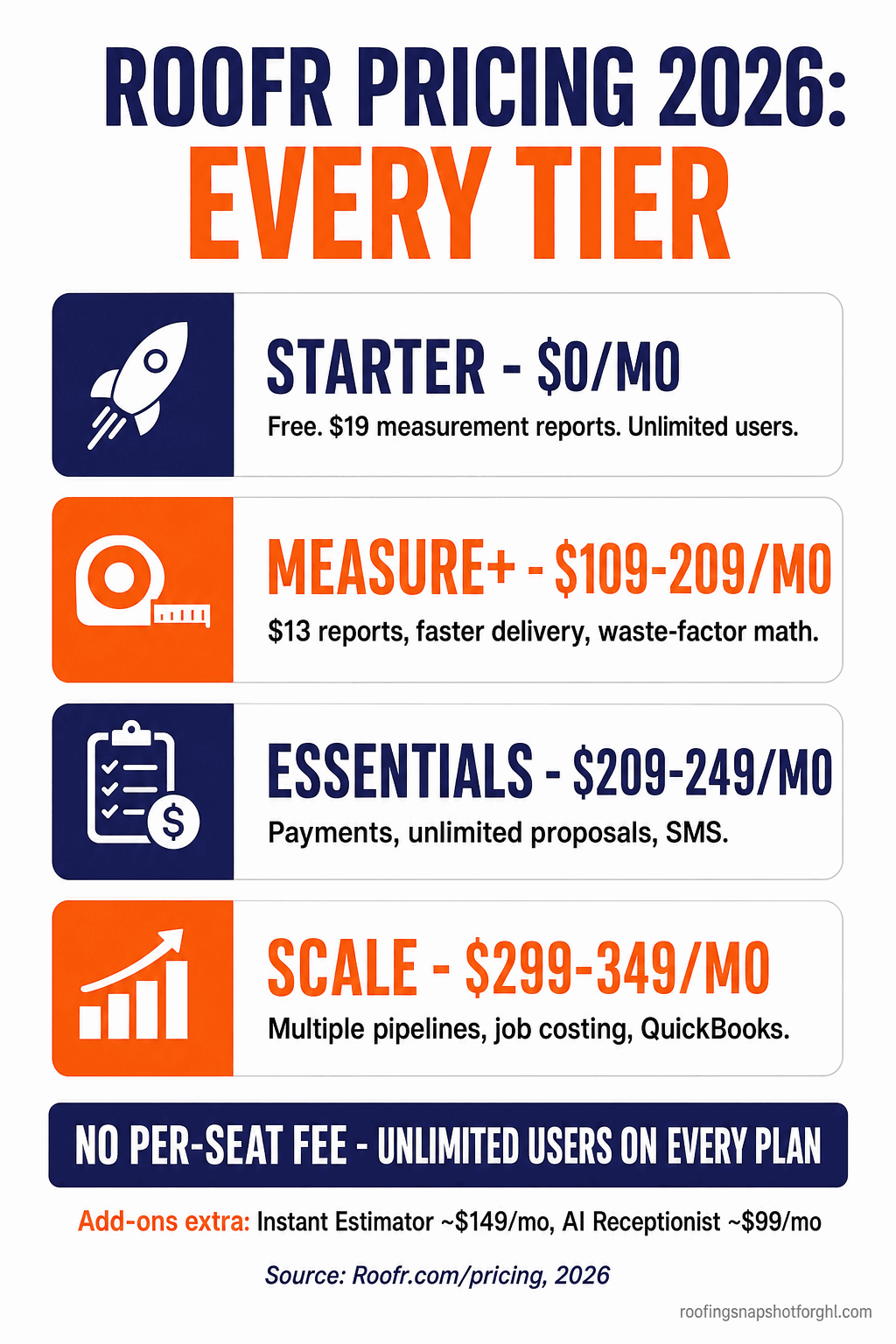
The flat-per-company price is the headline. On a per-seat platform, hiring three storm-season reps raises your bill. On Roofr, it does not, so a shop that doubles its office in April and trims it in August saves real money over a year. For contrast, our AccuLynx pricing teardown shows a per-user model climbing past $1,000 a month for a mid-size team.
The costs the sticker price hides
Roofr is honest about its prices, but honest is not all-inclusive. Four costs sit outside the monthly number.
1. Per-report measurement fees. Measurements are not free on any plan. You pay $13 to $19 per report depending on tier and delivery speed (Roofr, 2026). The failure mode is volume: a shop pulling 150 measurements in a busy storm month adds $1,950 to $2,850 on top of the subscription. That is competitive against EagleView, but it scales with how busy you are. Budget reports as a variable cost, not a rounding error.
2. The add-on stack. The pieces that make Roofr feel modern are add-ons. The Instant Estimator runs around $125 to $149 a month, the AI Receptionist around $85 to $99, and Roofr Sites (the website builder, in beta) a similar amount (Roofr, 2026). Turn on two or three and your real monthly cost jumps $250 to $400 over the sticker. Stacked, they quietly rebuild the bill.
3. SMS billing. Texting is central to speed-to-lead, and Roofr lists it as included on some plans and as a roughly $49 a month add-on in the feature table (Roofr, 2026). The failure mode is assuming it is in your plan, then finding it is an extra line the month you turn it on. Confirm in writing what your plan includes.
4. The migration you may eventually face. Nobody prices this at signup. If Roofr turns out too light for your claim volume in two years, moving your job history, photos, and contacts into a deeper system is real work. Our guide on migrating a roofing business to GoHighLevel walks through getting your data out cleanly.
Three real cost scenarios: solo, mid-size, and large
“What does Roofr cost” depends on your shop, so run it three ways, using published plan prices plus realistic report volume and common add-ons.
The solo operator (1 truck). Starter free, or Essentials at around $209 to $249 for payments and proposals. Say 25 measurements a month at $13 to $19, so $325 to $475 in reports. Add nothing fancy and you are near $500 to $700 a month all-in, most of it reports. For a one-truck shop, the flat plan plus pay-as-you-go measurements is genuinely cheap, and you can start free.
The mid-size team (5 to 8 people). Scale at $299 to $349 for the pipelines and reporting, roughly 80 reports a month at $13 ($1,040), plus the Instant Estimator and AI Receptionist ($210 to $250). A realistic $1,550 to $1,650 a month all-in. Still no per-seat tax, but the reports and add-ons, not the plan, are now most of the bill. This is Roofr’s sweet spot.
The large operation (15-plus people). Scale is still $349 because there is no per-seat fee, remarkable next to a per-user competitor where 15 seats alone can run past $1,000 (Projul, 2026). But a high-volume shop pulls maybe 200 reports a month, so $2,600 in measurements, plus the full add-on stack. Call it $3,000-plus a month all-in, dominated by report volume, not the flat plan.
Estimated Roofr all-in monthly cost by shop size, using published plan prices plus realistic report volume at $13 per report and common add-ons. The plan price is flat; reports and add-ons drive the total. Source: Roofr pricing, 2026.
The lesson is in the shape: the subscription barely moves, while report volume and the add-on stack drive the total. Roofr’s price scales with how busy you are, not how many people you hire, which is far friendlier for a storm shop than per-seat pricing.
Where Roofr is genuinely strong
Roofr is very good at the front half of a roofing job. Measurements are fast, accurate, and cheaper per report than pulling everything from EagleView, with waste-factor and material math that saves real time on takeoffs. The Instant Estimator, where enabled, turns a measurement into a priced proposal in minutes. The proposals look professional, the e-signature and payment flow is clean, and QuickBooks integration on Scale keeps the books from becoming a second job. Users rate it highly for exactly this front-of-job work (Capterra, 2026). Our primer on how to measure a roof in squares pairs well with any tool you choose.
Where Roofr stops short for a storm shop
Here is the part a Roofr salesperson will not lead with, and it matters most if you chase storms. Storms are not a side niche: the US logged 5,432 major hail events in 2025, up from 5,373 in 2024 (Insurance Information Institute, 2026), and every one is a race to the door.
Speed-to-lead is not its job. Roofr helps you quote a lead you already have. It is not built to detect a new lead and fire a text back in under a minute, every time, day or night, so you beat the out-of-state crew to the door. That instant, reliable first-touch is the discipline that decides who signs the roof, and we broke it down in why the out-of-state storm chaser beat you to the neighborhood. If a lead sits for twenty minutes because nobody was at a desk, no measurement tool saves that job.
Insurance claims are thin. A storm-restoration business lives or dies on the claim pipeline: inspection scheduled, adjuster met, scope agreed, supplement filed, RCV and ACV tracked, recoverable depreciation chased, deposit collected. Roofr can hold the job and the documents, but it is not a purpose-built inspection-to-deposit engine with the follow-up cadences that stop a claim stalling for weeks. That stalling is where restoration revenue quietly leaks, mapped in why roofing insurance claims stall.
Multi-channel follow-up is light. Signing storm roofs means hammering follow-up across SMS, email, web, and Facebook, with automations that nudge a cold lead back to life and route a review request the day after a tear-off. Roofr has automations, but it is a roofing operations tool, not a reactivation machine. The jobs you lose are rarely the ones you quoted. They are the ones that went quiet while you were up a ladder.
None of this makes Roofr bad. It makes it a front-of-job tool. If your business is mostly retail replacements and your pain is measuring and quoting, Roofr may be all you need. If your business is storms, claims, and winning the speed race, you need an automation layer Roofr was never built to be. That layer is what the Roofing Snapshot installs into your own GoHighLevel account, at one flat price, so lead capture, speed-to-lead, and claim tracking run themselves while Roofr does the measuring.
Roofr vs JobNimbus vs AccuLynx at a glance
The honest comparison is not “which is best.” It is “which half of the job does each own, and what does it cost.” JobNimbus and AccuLynx both hide pricing behind a demo and run per-user models, so the numbers below are third-party estimates, not quotes (Projul, 2026; PricingSaaS, 2026). Roofr is the only line you can take to the bank.
| What matters to a 1-5 crew shop | Roofr | JobNimbus | AccuLynx |
|---|---|---|---|
| Pricing published | Yes, in full | No, demo-gated | No, demo-gated |
| Per-seat fees | None, unlimited users | Yes, per user | Yes, ~$55-85/user/mo |
| Realistic monthly, mid-size team | ~$1,500-1,650 all-in | Four figures, per user | ~$800-1,200+ |
| Measurements | Core strength, $13-19/report | Add-on, not included | Integration add-on |
| Speed-to-lead automation | Light | Texting is a paid add-on | Add-on heavy |
| Insurance-claim pipeline | Thin | Deeper | Deep |
| Best at | Measure, estimate, invoice | Production CRM | Insurance-restoration CRM |
Read that table as a map, not a scoreboard. Roofr wins on price transparency and front-of-job speed; the two demo-gated CRMs go deeper on production and claims, and charge for it per seat. For the common head-to-heads, see JobNimbus vs AccuLynx and ServiceTitan alternatives for roofers.
A compliance note before you automate follow-up
Whatever tool you pick, the follow-up you build on top has to stay legal, and this is where roofers get burned. First, claims language: several states bar a contractor from negotiating an insurance claim or offering to eat the deductible, so the “we handle your insurance claim for you” copy that half the industry still runs can cross a line. The rules differ by state, and we cover them in roofing insurance claim laws. Second, texting: the moment you automate SMS follow-up, you are in TCPA and A2P 10DLC territory, which means real consent, a working opt-out, and a registered campaign, or your messages get blocked and your number flagged. We laid out a compliant cadence in the storm lead follow-up sequence that books inspections without breaking the law. Any tool sends whatever you configure. Making sure it is legal is on you.
Objections, answered straight
“Roofr is cheap and shows its price. Why would I need anything else?” Because price transparency and front-of-job speed are not the same as a system that signs storm roofs. If your lost jobs are the ones that went cold while you were on a roof, or the claims that stalled for weeks, the fix is an automation layer for speed-to-lead and claim tracking, not a better measurement tool. Many shops run both: Roofr for measurements, flat-cost automation for everything after the quote.
“I already pay for EagleView and a separate CRM. Does Roofr replace both?” It can replace your measurement spend and give you a light CRM, which is why it appeals to shops tired of three bills. Whether it replaces your full CRM depends on how much claim and production depth you need, and heavy insurance restoration will feel thin on Roofr alone. For how juggling disconnected tools quietly costs you jobs, see why disconnected roofing software costs you jobs.
Frequently asked questions
How much does Roofr cost per month in 2026?
Starter is free, Measure+ runs about $109 to $209 a month, Essentials about $209 to $249, and Scale about $299 to $349, with no per-seat fee and unlimited users on every paid plan. Measurement reports are billed separately at $13 to $19 each (Roofr, 2026).
Does Roofr charge per user?
No. Every paid Roofr plan includes unlimited users at a flat company price, so hiring more people does not raise your subscription. That is unusual in roofing software, where AccuLynx and JobNimbus both run per-user models (Roofr, 2026).
What is not included in Roofr's monthly price?
Measurement reports ($13 to $19 each) and several paid add-ons: the Instant Estimator (around $125 to $149/mo), the AI Receptionist (around $85 to $99/mo), Roofr Sites, and SMS on some plans. Add your report volume and add-ons to the plan price for the real cost (Roofr, 2026).
Is Roofr good for a storm-restoration roofing company?
For the front of the job, yes: fast measurements and quick priced proposals get a number to a homeowner fast. For claim tracking from inspection to deposit, instant speed-to-lead, and multi-channel follow-up, Roofr is light, and most storm shops pair it with a dedicated automation layer.
Why do roofers use Roofr's price to compare other software?
Because Roofr is the only major roofing platform that publishes full pricing, it works as an anchor. When a demo-gated vendor avoids naming a number, point to Roofr's published $349 top tier with no per-seat fee and make them justify the difference (Roofr, 2026).
You went looking for a CRM whose price you could actually read, and in Roofr you found one. Just be clear about what you are buying. Roofr is an excellent way to measure, estimate, and invoice at a flat, honest price, and for a retail-replacement shop that may be the whole answer. If your business is storms, the measuring was never the part you were losing. The part you were losing is the lead that went cold and the claim that stalled, and that is a different machine entirely.