
It is 7:40 in the morning and the phone will not stop. A line moved through overnight, your Facebook form caught eleven leads before sunrise, and your cousin dropped another dozen names from the neighborhood he canvassed. You are already on a steep 8:12 with a nail gun in your hand. By the time you climb down, eat lunch, and finally start calling people back, it is 2 p.m. and half of them already have a yard sign from the out-of-state crew that answered in ninety seconds. The leads did not go cold because your price was high. They went cold because nobody touched them while they were hot.
Here is the short answer. You win storm leads with a follow-up sequence that fires the second a lead comes in, hits them in the first five minutes with a text, then runs a tight cadence of texts, calls, and emails over two weeks, all of it written to stay inside the three laws that put roofers in real trouble: the TCPA, the carrier texting rules known as A2P 10DLC, and your state’s contractor solicitation law. Speed books the inspection. Compliance keeps the money you make. This is that sequence, stage by stage, with the copy you can steal and the one line that turns a helpful text into a lawsuit.
Key Takeaways
- Speed is the whole game. Contact a web lead within an hour and you are about 7 times more likely to have a real qualifying conversation than a rep who waits just one hour longer, and 60 times more likely than one who waits a day (Harvard Business Review, 2011). After a storm, every minute you are on the roof is a minute the lead is calling the next guy.
- The volume is real. State Farm alone paid more than $3.8 billion for hail home-repair claims in 2024 (State Farm). A single storm can dump dozens of leads on a 1-to-5-crew shop in a night. You cannot hand-chase them. You need a sequence.
- Get consent before you text. The TCPA requires prior express written consent before you send marketing texts with an automated system, with statutory damages of $500 to $1,500 per message (47 U.S.C. 227). A single bad blast to fifty storm leads is real exposure.
- Register before you send. Since February 2025, carriers block business texts from numbers that are not registered under A2P 10DLC (Twilio). An unregistered shop’s “instant” text never arrives.
- Watch your words, not just your speed. Florida bars you from adjusting or interpreting the claim unless you hold a public adjuster license, with fines up to $10,000 per occurrence (Fla. Stat. 489.147), and at least 28 states ban waiving the deductible (Colorado Roofing Association). “We handle your insurance claim” copy is a fast way to lose your license.
Table of contents
- What slow, sloppy storm follow-up costs you
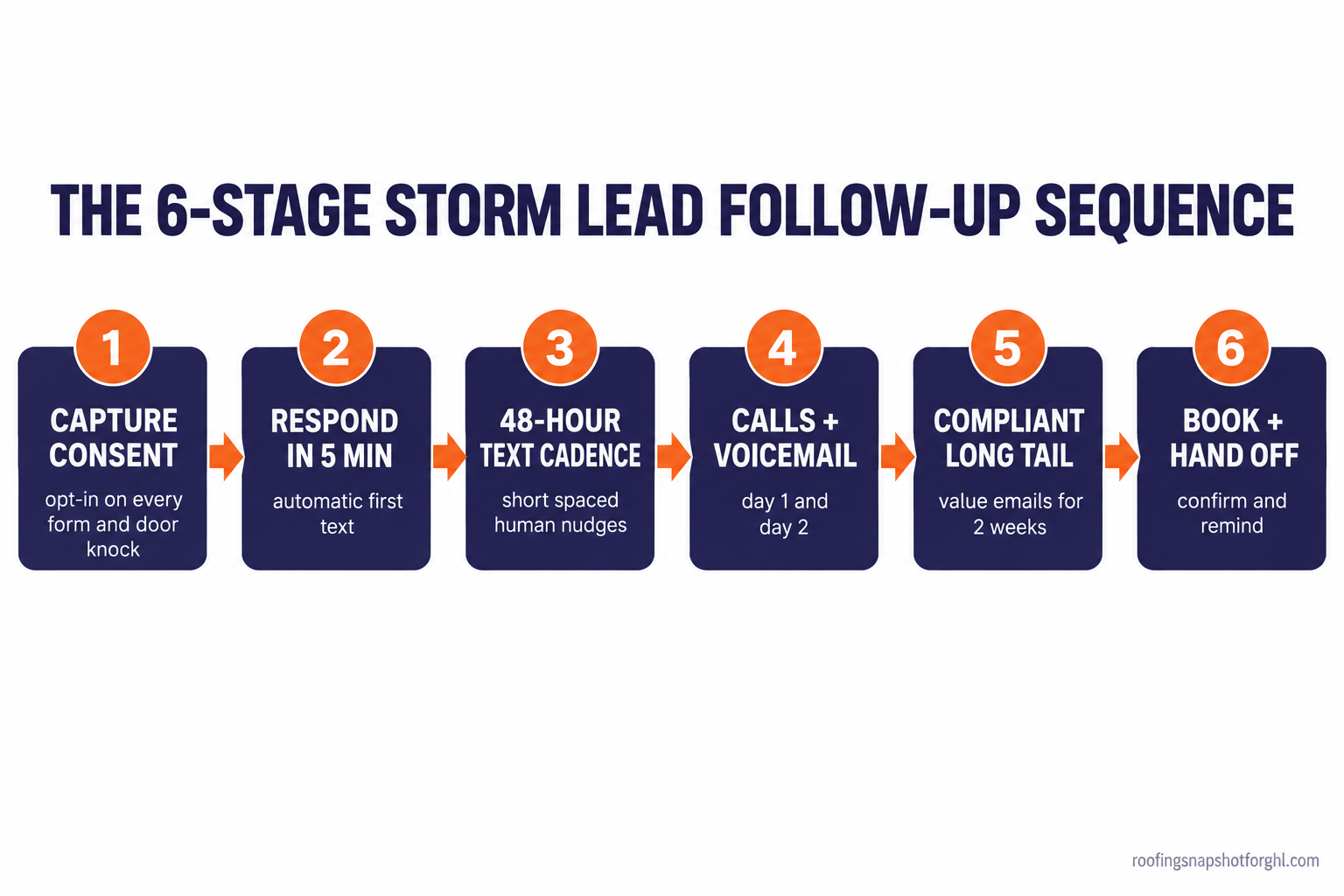
- The 6-stage sequence at a glance
- Stage 1: Capture consent at the first touch
- Stage 2: Respond in five minutes, automatically
- Stage 3: Run the 48-hour text cadence
- Stage 4: Layer in the calls and voicemail
- Stage 5: Keep a compliant long tail
- Stage 6: Book the inspection and hand off clean
- Run it for a solo, a mid-size, and a large shop
- The three laws that shape every message
- Steal this: the storm lead follow-up copy
- Objections
- FAQ
What slow, sloppy storm follow-up costs you
A storm does not hand you a steady drip of leads. It hands you a flood, all at once, all with the same expiration date. Hail alone did enough damage in 2024 that State Farm paid out more than $3.8 billion on home hail-repair claims (State Farm), and the storms that matter to you land in a few counties over a few hours. When that front moves through, your pipeline goes from quiet to forty new names overnight, and every one of those homeowners is about to get knocked, called, and texted by everybody else in a hundred-mile radius.
The clock is brutal and it is measurable. Harvard Business Review’s study of thousands of leads found that reaching out within an hour made a rep about 7 times more likely to have a meaningful qualifying conversation than one who waited just sixty minutes longer, and about 60 times more likely than one who waited 24 hours or more (HBR, 2011). On a roof, you do not have an hour. You are up there for four. By the time you are back on the ground, the lead has had three other contractors in their phone.
You paid for most of those leads through Facebook ads, Local Services Ads, or the gas and hours your canvassers burned. A lead you never contact in time is money set on fire, and the gap between a shop that answers in five minutes and one that answers at 2 p.m. is not talent. It is a system that works while you are on the roof. See the full math in how much a roofing lead costs and why a 30-second response wins storm jobs.
Relative likelihood of a qualifying conversation by first-contact speed, indexed to the 24-hour-plus group (set to 1). Source: Harvard Business Review, “The Short Life of Online Sales Leads,” 2011.
The cost of slow follow-up is the gap between that first bar and the last one, multiplied by every lead a storm drops on you. The fix is not working harder on storm day. It is building the sequence once so it works for you.
The 6-stage sequence at a glance
Storm follow-up fails for roofers in the same predictable ways every season. The lead comes in and nobody sees it for hours. The first text is a stiff “Thanks for your interest” that sounds like a robot. The texts go out from an unregistered number and never land. The cadence stops after one try. And somewhere in there, a rep sends copy that promises to handle the insurance claim, which is a different kind of problem entirely. Each of those is a stage, and each has a fix.
- Capture consent at the first touch so every later text is legal, not a lawsuit waiting to happen.
- Respond in five minutes, automatically, because the first contractor to reply usually books the inspection.
- Run a 48-hour text cadence of short, human messages that move the lead toward a scheduled time.
- Layer in calls and voicemail on a set rhythm so you hit the people who do not text back.
- Keep a compliant long tail of value over the next two weeks for the homeowners who are not ready yet.
- Book the inspection and hand off clean so the lead becomes a job on the board, not a note in a phone.
Stage 1: Capture consent at the first touch
This is the stage everybody skips and the one that keeps you out of court. Before you send a single automated marketing text, federal law wants the homeowner’s prior express written consent, clear and recorded. The cheapest place to get it is the moment they become a lead: the web form, the Facebook lead form, the QR code on the door hanger, the field your canvasser taps on a tablet.
Setup steps. Add a short, plain opt-in checkbox or line to every lead source: “By submitting, you agree to receive calls and texts from [Company] about your roof, including automated messages. Message and data rates may apply. Reply STOP to opt out.” Store the timestamp, the page, and the wording with the contact record so you can prove consent later. For door-knock leads, have the canvasser capture it on the tablet the same way, not on a paper pad that never gets entered.
How it breaks. The usual failure is a bought list or a spreadsheet of names your canvasser scribbled, blasted with texts nobody agreed to receive. That is the single fastest way to turn a storm into a legal bill, because TCPA damages run $500 to $1,500 per message (47 U.S.C. 227). Fifty names times fifteen hundred dollars is a number that ends shops. We walk through the texting-registration side of this in detail in A2P 10DLC registration for roofing contractors.
Stage 2: Respond in five minutes, automatically
The homeowner who just filled out your form is sitting on their couch looking at a brown water stain, phone in hand, and they filled out three other forms too. Whoever texts first owns the conversation. You will not win that race by hand on storm day, because you are on a roof. You win it with an automated first reply that fires the instant the lead hits your CRM, day or night.
Setup steps. Build one workflow: a new lead triggers an immediate text and, a minute later, a voicemail drop or a ring to your sales line. The text is short and human, names the storm, and asks one easy question. The point is not to sell. It is to start a conversation while the stain is still wet. This is the same engine behind never missing an after-hours storm call.
How it breaks. Two ways. The shop that has the automation but never registered its number under A2P 10DLC, so the “instant” text silently fails to deliver. And the message that reads like a form letter: “Thank you for your submission. A representative will contact you.” That gets ignored. A real one gets a reply.
Stage 3: Run the 48-hour text cadence
Most storm leads do not reply to the first text. That is normal, and it is not a reason to quit. The money is in the cadence: a short series of texts across the first 48 hours, each one a different angle, each one easy to answer. The goal of every message is the same, which is to get a yes to a specific inspection time.
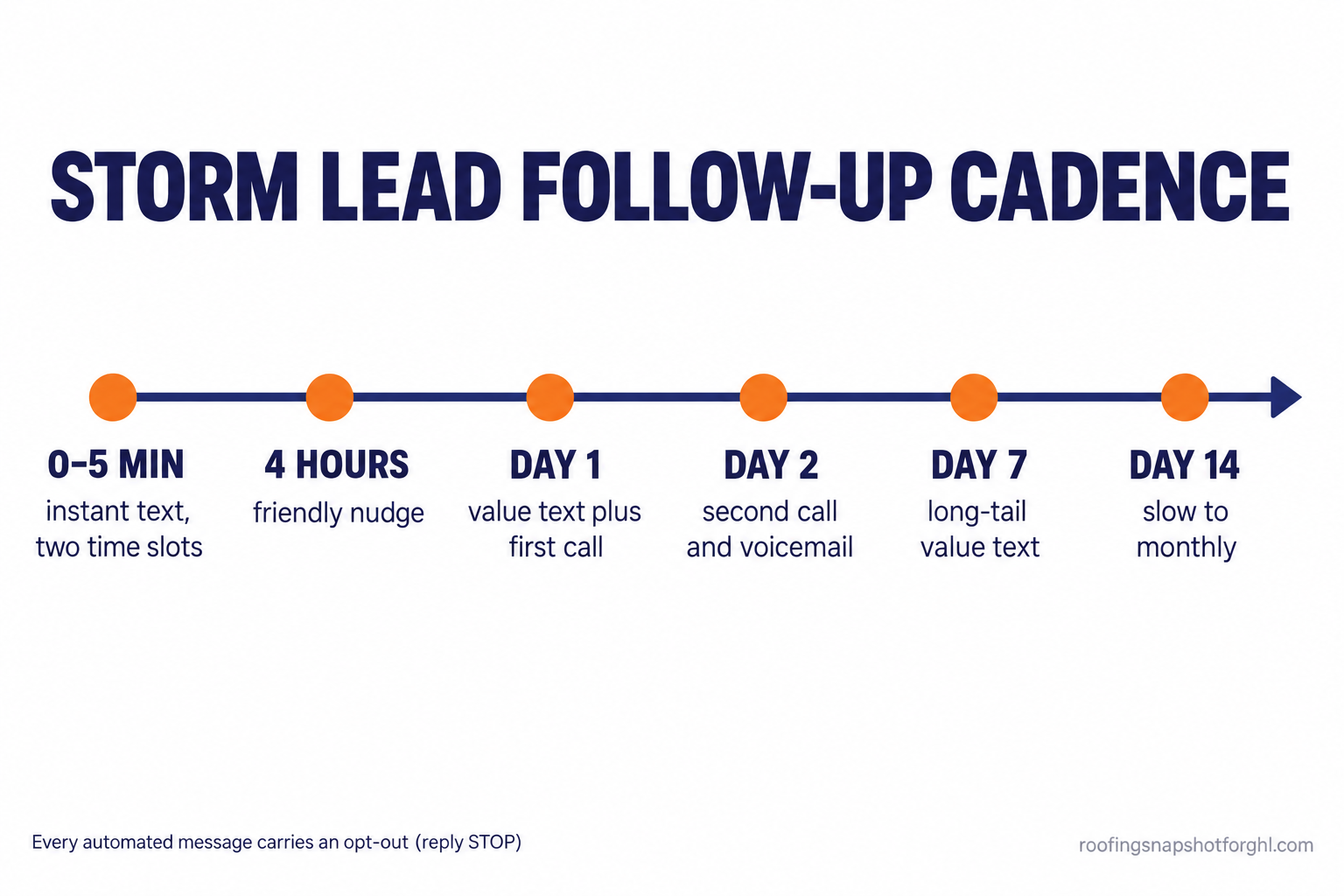
Setup steps. Space them so you are present without being a pest. A good default is the instant reply, then a nudge about four hours later, one the next morning, and one more that evening. Keep each under two sentences. Offer two concrete time slots instead of asking “when works for you,” because a choice is easier to answer than a blank. Every text carries an opt-out, because that is both the law and good manners.
How it breaks. The cadence that is all pressure and no value. Four texts that each say “just following up” train the homeowner to ignore you. Mix it: one offers a time, one answers the question every storm lead has (whether this costs them anything beyond their deductible), one is a quick photo of damage you are finding in their area. Tie it into your sales pipeline stages so every lead moves the same path.
Stage 4: Layer in the calls and voicemail
Texts book the people who like to text. Calls book everybody else, especially older homeowners who are often the best storm customers because they own the home outright and have had the same insurer for twenty years. The sequence is not texts instead of calls. It is texts and calls on a rhythm.
Setup steps. Add call tasks to the same workflow: a call on day one if the texts get no reply, another on day two at a different time, and a voicemail each time that references the storm and your earlier text so it does not feel cold. Keep calling hours inside the TCPA window of 8 a.m. to 9 p.m. in the person’s local time. After a few attempts across texts and calls, the lead either books or moves to the long tail.
How it breaks. Calling at the wrong hour, or calling someone who told you to stop. Both are TCPA problems. If a homeowner replies STOP or asks you not to call, that has to flow back into the CRM and suppress every future automated touch immediately. A manual process forgets. A workflow does not.
Stage 5: Keep a compliant long tail
Plenty of storm leads are not ready in the first two days. The spouse is out of town, they are getting a second opinion, they are waiting to see if the insurer will even open a claim. A shop with no long tail loses all of those. A shop with one picks them up three weeks later when the other contractors have given up.
Setup steps. After the 48-hour push, drop non-responders into a slower nurture: a short email or text every few days for two weeks, then monthly. Lead with value, not pressure. A plain-language note on what to do before the adjuster comes. A reminder that most policies have a deadline to file after a storm. A single real photo of damage you found two streets over. Each keeps you top of mind without crossing into claim advice you are not licensed to give.
How it breaks. The long tail that quietly becomes spam, or that drifts into telling people how to handle their claim. Keep the value real and the claim talk general. The automation that stops jobs from stalling once a claim is live lives in the insurance claim follow-up system.
Stage 6: Book the inspection and hand off clean
A booked inspection is the finish line of this sequence, not a closed job. The handoff is where speed-built goodwill gets wasted. The homeowner said yes to Thursday at 10, then nobody confirms, the crew runs late, and the lead you fought to book ghosts the appointment.
Setup steps. The moment a time is booked, fire a confirmation text with the date, a one-tap reschedule link, and the name and photo of who is coming. Send a reminder the night before and the morning of. This alone is the difference between a full inspection calendar and a half-empty one, and we built the whole thing in how to reduce roofing inspection no-shows.
How it breaks. Treating “booked” as “done.” No confirmation, no reminder, no map pin for the crew. The lead forgets, the crew shows to an empty driveway, and the slot you could have given another storm customer is gone.
Run it for a solo, a mid-size, and a large shop
The six stages do not change. Who runs them and how much you automate does.
Solo operator, 1 crew. You are the whole sales team, so the sequence is your lifeline on storm day. Automate everything you can: the consent line, the instant text, the full 48-hour cadence, the appointment reminders. Keep the call tasks on your own phone and knock them out between roofs. The automation is the only way one person covers forty overnight leads without dropping half.
Mid-size, 3 to 5 crews. Now you have reps, and reps follow up differently or not at all. Standardize it. Texts fire automatically for every lead, and the CRM routes call tasks to the right rep with a clock on them. Track response time by rep, because a storm week exposes who is fast and who is leaking jobs. This is also where door-knock data needs to flow into the CRM the same night, not a week later off a paper pad.
Large shop, 6 or more crews. Volume makes the laws a real liability and the speed a real edge. Consent capture has to be airtight across every source, STOP handling instant and global, and your A2P registration sized for the volume a multi-county storm creates. Follow-up is fully automated and reported: speed-to-lead by source, book rate by rep, no-show rate by crew. At this size a few minutes of average response time is the difference between signing a neighborhood and watching it sign with someone else.
The three laws that shape every message
This is the part most roofing blogs get wrong or skip, and it is the part that protects the business you are building. Three separate rulebooks govern how you follow up with a storm lead.
The TCPA (how and when you can contact). Before you send automated marketing texts or make automated calls, you need prior express written consent, and you can only call between 8 a.m. and 9 p.m. in the homeowner’s time zone (FCC). Damages run $500 per message and up to $1,500 for willful violations (47 U.S.C. 227). Note that a 2023 FCC rule that would have tightened consent even further, the “one-to-one” rule, was struck down by a federal appeals court in January 2025 (Morrison Foerster), so the long-standing written-consent standard is what still governs you. Get consent at the first touch and honor every STOP and you are clear.
A2P 10DLC (whether your text even arrives). This is the carrier system, not a government law, but it is just as binding in practice. Since February 2025, U.S. carriers block business texts sent from numbers that are not registered through The Campaign Registry with a verified brand and campaign (Twilio). An unregistered shop can build the perfect sequence and watch every message fail silently.
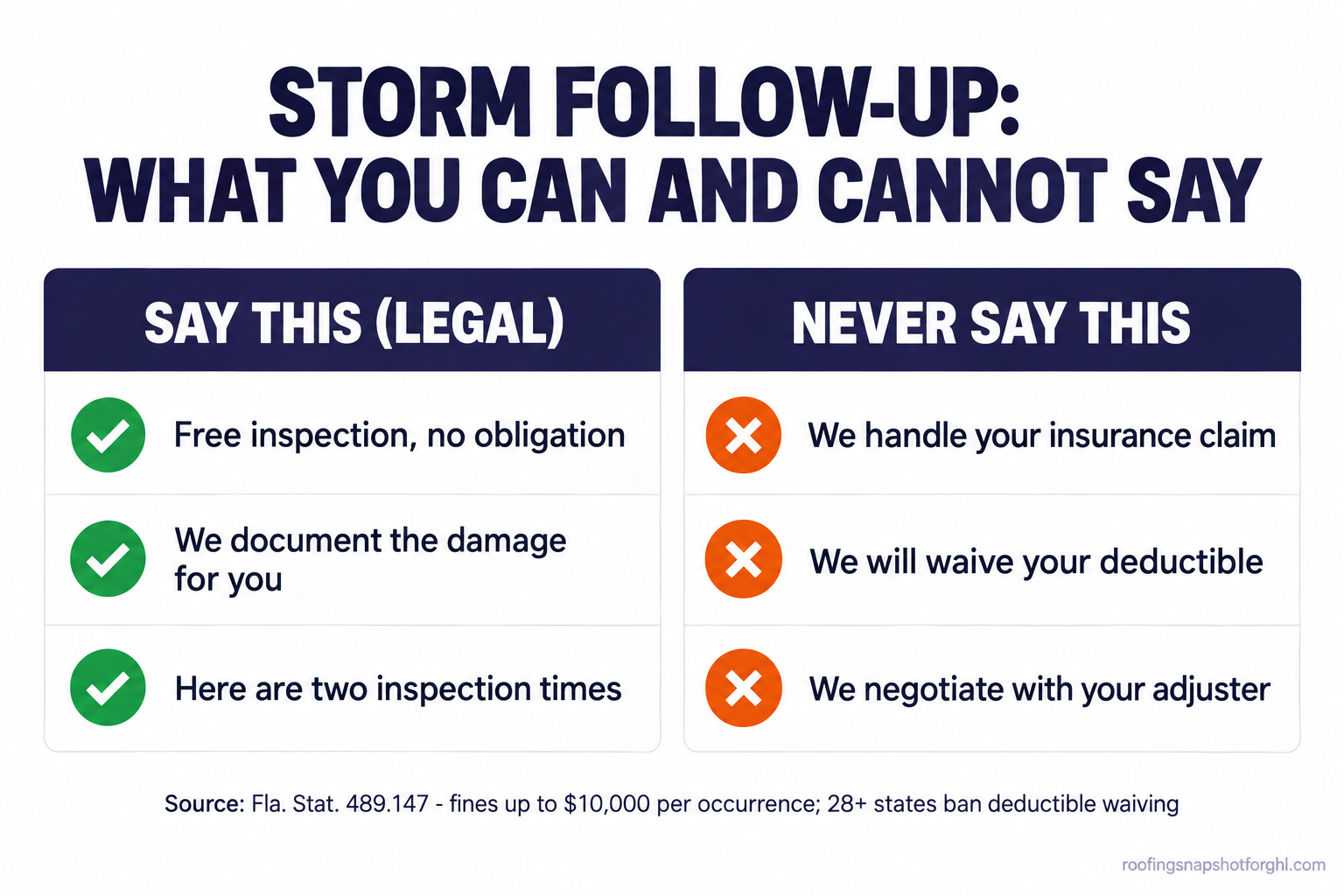
State solicitation and claims law (what you can say). This is where “we handle your insurance claim” copy gets roofers in trouble. In Florida, you cannot adjust, interpret, or negotiate a homeowner’s claim unless you hold a public adjuster license, and prohibited solicitation carries fines up to $10,000 per occurrence (Fla. Stat. 489.147). Wisconsin’s Act 24 bars paying or rebating a homeowner’s deductible to win the job and requires a plain-language notice before you contract (Wis. Stat. 100.65). At least 28 states ban deductible waiving outright (Colorado Roofing Association). The full state picture is in our roofing insurance claim laws guide. The rule for your copy is simple: offer to inspect, document, and give a free estimate. Never offer to handle the claim, interpret coverage, or make the deductible disappear.
Steal this: the storm lead follow-up copy
Here is the language, verbatim, for the moments that matter. Swap in your company name and the real storm. Every automated message carries an opt-out, and none of it offers to handle the claim.
Notice what none of those say. None of them promise to file, negotiate, or handle the claim. None of them mention waiving or covering a deductible. They offer a free inspection and a free estimate, which is exactly what you are licensed to do, and they move the homeowner toward a time on your calendar.
Objections
“Won’t homeowners find four texts in two days annoying?” Not if they agreed to hear from you and the texts are useful. The annoying version is four identical “just following up” messages. The version that works offers a time, answers the cost question, and shows a real photo. People whose roof just got torn up by hail want a contractor who moves fast. The ones who do not reply STOP, and you honor that instantly.
“What if I already use AccuLynx or JobNimbus?” Keep your CRM. The piece most roofing CRMs do poorly is the timed, multi-channel follow-up that fires in five minutes at 2 a.m. and handles STOP globally. Run the follow-up engine alongside your existing system, or consolidate. We compared the real costs in what roofing software actually costs in 2026.
“Do I need to be technical to set this up?” No. The consent line is one sentence on your forms. The A2P registration is a form you file once through your texting platform. The part that takes real work is the automated sequence and the STOP handling, which is exactly the part worth having built right, because a half-wired sequence leaks the same jobs a paper pad does.
“Isn’t the compliance stuff overkill for a small shop?” It is the opposite. A big shop can absorb one TCPA complaint. A 1-to-5-crew shop cannot absorb fifty messages times fifteen hundred dollars, and it cannot absorb a license suspension in a claims state. The compliance is not a tax on the system. It is what lets you run the system at storm volume without betting the business.
Close
Back to 7:40 a.m. This time the storm hit and the sequence woke up before you did. Every overnight lead got a human text in the first five minutes, with two inspection times and an opt-out, from a registered number that actually delivered. By the time you climbed down off that 8:12, your calendar had six inspections booked and the long tail was working the rest. The out-of-state crew that only knows how to knock is still driving the neighborhood looking for the doors you already have on the board.
Speed books the inspection. The cadence catches the ones who do not answer the first time. The compliance is what lets you keep every dollar you make instead of handing it to a TCPA lawyer or a state regulator. Build the sequence once, get the consent and registration right, and the next storm works for you instead of running you into the ground.
Frequently asked questions about storm lead follow-up
How fast do I actually need to respond to a storm lead?
As close to instant as you can get, and definitely inside the first few minutes. Harvard Business Review found that contacting a web lead within an hour made a rep about 7 times more likely to have a qualifying conversation than one who waited just an hour longer, and 60 times more likely than one who waited a day (HBR, 2011). After a storm you are competing with everyone, so an automated five-minute reply is the floor, not the goal.
Do I legally need consent before texting a roofing lead?
Yes. The TCPA requires prior express written consent before you send automated marketing texts, with statutory damages of $500 to $1,500 per message (47 U.S.C. 227). Capture a clear opt-in on every form, Facebook lead, and door-knock tablet, and store the timestamp and wording so you can prove it.
Why are my business texts not getting delivered?
Most likely your number is not registered under A2P 10DLC. Since February 2025, U.S. carriers block business texts from numbers without a verified brand and campaign registered through The Campaign Registry (Twilio). You register once through your texting platform, then your messages deliver.
What can I say in storm follow-up without breaking the law?
Offer a free inspection, free documentation, and a free estimate. Do not offer to file, negotiate, interpret, or adjust the insurance claim unless you hold a public adjuster license, and never offer to pay, waive, or rebate the deductible. Florida fines prohibited conduct up to $10,000 per occurrence (Fla. Stat. 489.147), and at least 28 states ban deductible waiving (Colorado Roofing Association).
What happens when someone replies STOP?
Every future automated text and call to that person must stop immediately and globally across your system. Honoring opt-outs is both a TCPA requirement and the reason your sender reputation stays healthy. A CRM workflow suppresses them instantly; a manual process forgets, which is how shops end up with complaints.
Can I text leads my canvassers collected door to door?
Only if the canvasser captured consent the same way a web form would, with the homeowner agreeing to receive calls and texts. A name and number scribbled on a pad is not consent. Capture the opt-in on the tablet at the door, or call those leads by hand instead of dropping them into the automated sequence.