
It is a slow Thursday in February, the phone is not ringing, and you are finally picking one real system to run the shop. Somebody at a trade show told you to look at Leap. Your buddy down the road ran JobProgress and got moved onto Leap whether he wanted it or not. And when you go to Leap’s site for a price, there is no price, just a “Book a demo” button. So here you are, trying to figure out what this thing costs and whether it fits a storm-and-insurance shop before you hand a salesperson your cell number.
Here is the short answer first. Leap is a strong in-home sales and proposal platform for retail-heavy roofing and a reasonable CRM, but it is not built to answer a storm call in five seconds or chase a cold lead for you. Reported pricing runs about $79/month for a stripped Essential plan up to roughly $298/month plus about $99 per extra user for the Team plan most shops need. If a big chunk of your revenue is financed retail jobs closed at the kitchen table, Leap earns its look. If you live off hail events and insurance claims, weigh it against JobNimbus, Roofr, and AccuLynx first, and know that none of the four fixes the speed-to-lead gap quietly costing you jobs. This post tears down what Leap really costs, explains the JobProgress merger, and shows where each tool fits.
Key Takeaways
- Leap does not publish pricing. Third-party listings report Essential ~$79/month, Team ~$298/month plus ~$99 per additional user, and SalesPro Premium ~$750/month for six users (Capterra, 2026). Reported, not official.
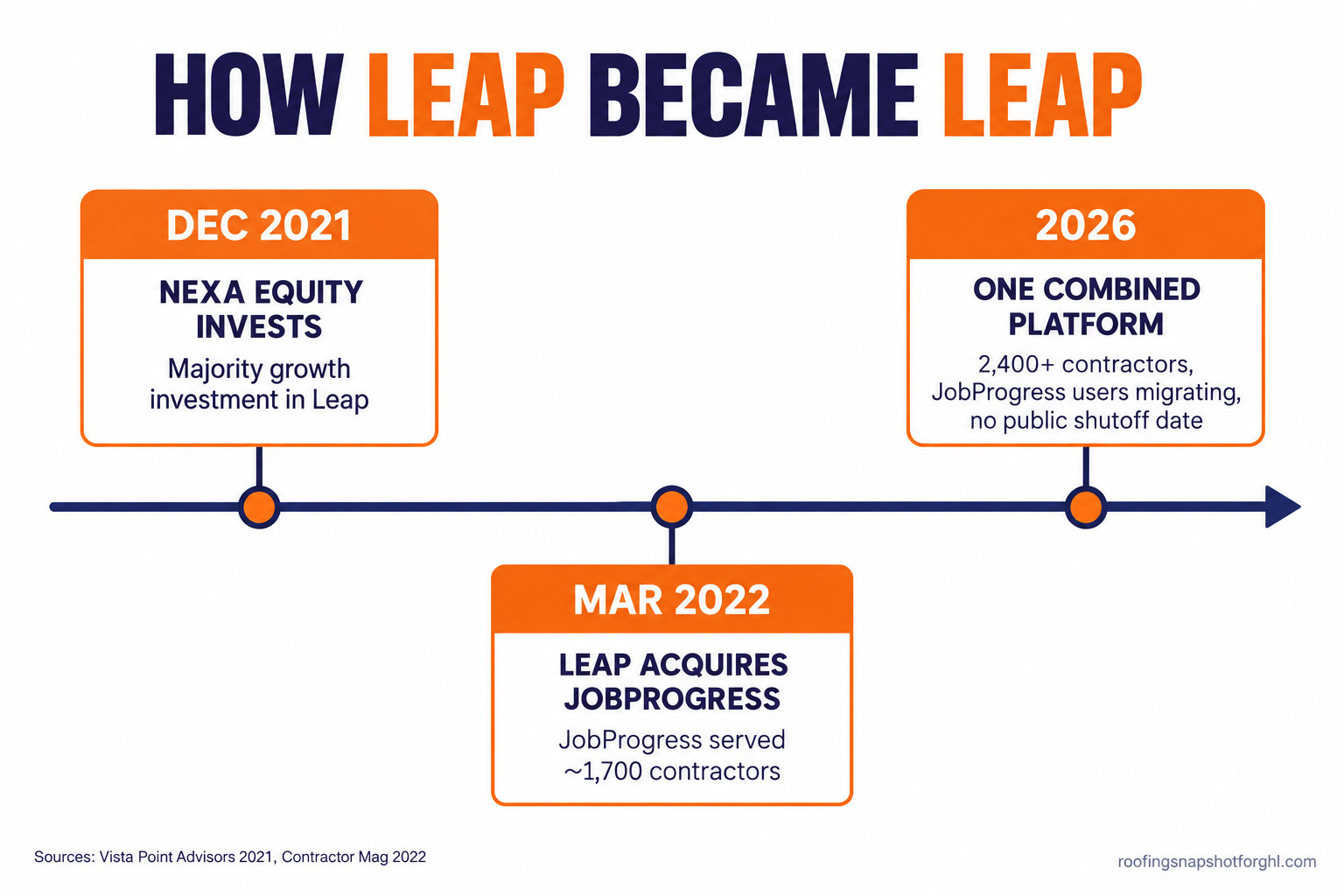
- Leap is owned differently than people think. Nexa Equity took a majority investment in December 2021, and Leap acquired JobProgress in March 2022, not 2024 (Contractor Mag, 2022).
- Leap’s strength is the in-home retail close: SalesPro proposals, digital contracts, and GreenSky financing (Leap, 2026).
- Leap’s weakness for storm shops: it logs leads, it does not hunt them. None of the four was built for five-second speed-to-lead.
- Roofr is the only one of the four that publishes pricing (Roofr Help Center, 2026), the honest anchor for any comparison.
Table of contents
- What the wrong CRM decision costs
- What Leap is (and where JobProgress went)
- What Leap really costs in 2026
- What Leap is genuinely good at
- Where Leap leaves a storm roofer exposed
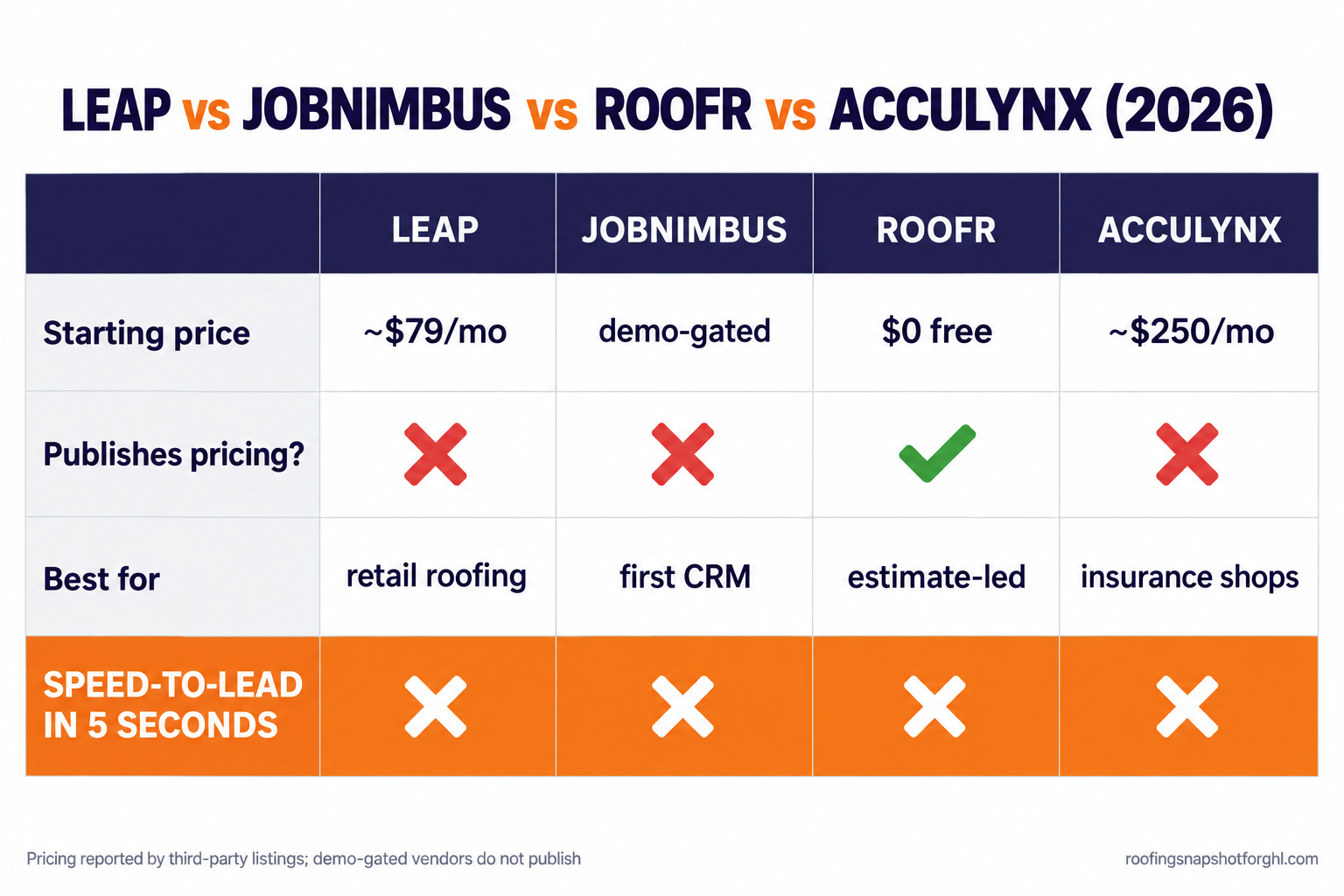
- Leap vs JobNimbus vs Roofr vs AccuLynx
- Three scenarios: solo, mid, large
- The gap none of the four closes
- The compliance layer nobody demos
- Objections
- FAQ
What the wrong CRM decision actually costs a storm shop
Picking the wrong platform is not a $300 mistake. It is a season of leaked jobs plus the bill to migrate off it and do the whole thing again. Two facts about roofing make the stakes high.
First, the work comes in violent waves. NOAA’s Storm Prediction Center logged 5,432 major hail events in the US in 2025, up from 5,373 in 2024 (Insurance Information Institute, 2026, citing NOAA SPC), and State Farm alone reported paying more than $5.6 billion in hail claims in 2025 (III, 2026). When a storm rolls through, your system either helps you catch that wave in the first 48 hours or it is a filing cabinet you update after the jobs are signed by someone else.
Second, the response window is brutal. A Harvard Business Review audit found the average first response to a web lead took about 42 hours, with 23% of companies never responding at all (Harvard Business Review, 2011). A CRM logs the lead, but somebody still has to see it and call, and on a storm Thursday that somebody is you, on a ladder. The real cost of the wrong tool is the per-seat fee you did not model, the migration you do twice, and the cold leads piling up while you compare feature lists.
What Leap actually is (and where JobProgress went)
Before you can price Leap, you have to know what you are actually buying, because the company behind it changed shape a few years ago and a lot of roofers are confused about it.
Leap is a home-improvement sales and operations platform, strongest at the in-home sale. Its flagship is SalesPro, a tablet app a rep uses on the homeowner’s couch to build an estimate, present good-better-best options, pull financing, and get a digital contract signed before leaving (Leap, 2026). Behind it sits Leap CRM: leads, jobs, documents, scheduling, production tracking, and a QuickBooks sync. It serves roofing alongside siding, windows, and general remodeling.
Two corporate moves explain why you keep hearing the name. In December 2021, Nexa Equity made a majority growth investment in Leap (Vista Point Advisors, 2021). Then in March 2022, Leap acquired JobProgress, a contractor CRM serving roughly 1,700 businesses (Contractor Mag, 2022), bringing the combined platform to 2,400-plus contractors. If you are reading “January 2024” for that acquisition, it is wrong; the deal closed in 2022.
The practical part for a JobProgress holdout: those customers are being migrated onto the Leap platform (JobProgress, 2026), with no public shutoff date posted. Reason enough to decide now rather than get moved onto a tier and a price you did not choose.
What Leap really costs in 2026
Here is the frustrating truth: Leap does not publish pricing. Like AccuLynx and JobNimbus, everything runs through a demo. So every number below is reported by third-party software directories, not confirmed by Leap.
As reported on current listings (Capterra, 2026, and GetApp, 2026):
- Essential: about $79/month, a flat, stripped-down tier.
- Team: about $298/month including the first user, plus roughly $99/month per additional user. The tier most real shops land on.
- SalesPro Premium: about $750/month, reported to include six users.
- SalesPro Enterprise: contact sales.
One honest caveat: the listings are not perfectly consistent. At least one table labels Team “$298/year” while other directories read it as “$298/month.” The monthly reading repeats across the most sources, but it is the kind of ambiguity only a demo settles. Contract length and onboarding fees are not published anywhere I could verify, so do not assume a free month-to-month deal.
Reported entry-tier monthly price, 2026. Third-party figures for the demo-gated vendors (Leap, JobNimbus, AccuLynx) plus Roofr’s published tier; per-user fees change the real bill at scale. Sources: Capterra, Projul, Roofr, PricingSaaS, 2026.
The entry sticker is the trap, not the answer. Leap’s Team plan at roughly $99 per added user behaves like a per-seat platform once you staff up: three reps is one number, eight reps in storm season is a very different one. Run the math on your peak headcount. Our 2026 roofing software pricing teardown breaks down every vendor’s all-in cost, and our AccuLynx pricing breakdown shows how fast per-seat models climb.
What Leap is genuinely good at
Credit where it is due. Leap is built around the moment a homeowner decides to buy, and for a retail-heavy shop that moment is everything.
The in-home close. SalesPro is a genuinely good tablet presentation tool. A trained rep builds a branded proposal, shows good-better-best options, and adjusts the price live across the kitchen table. For out-of-pocket retail work, that closes better than a handwritten number on a business card.
Financing at the table. Leap integrates financing, with GreenSky named as a partner (Leap, 2026). Offering a monthly payment inside the same app, before the emotion of a $14,000 roof fades, saves deals, as long as you present it the right way.
Digital contracts and a real CRM. Contracts signed on the spot mean no “I’ll sign tomorrow,” which in roofing means “the next door-knocker gets the job.” Behind that, jobs, scheduling, production tracking, and a QuickBooks sync let Leap run the back office, a legitimate single system for a retail-led shop.
Where Leap leaves a storm roofer exposed
This is the part the demo will not dwell on, and it decides whether Leap fits a hail-and-insurance operation.
Failure mode 1: built for retail, not the insurance claim. Leap’s center of gravity is the in-home sale and financing. Storm restoration lives and dies on the supplement: documenting damage, tracking RCV versus ACV, chasing the adjuster, following the claim to deposit. AccuLynx was built around that workflow. If half your jobs are insurance, test Leap’s claim tracking hard against your supplement process first.
Failure mode 2: it logs the storm lead, it does not chase it. When a hail call comes in while your crews are on roofs, Leap drops the lead into a pipeline stage and waits for a human. On a 60-lead storm day nobody notices in time, and the homeowner has already talked to the out-of-state crew that knocked an hour ago.
Failure mode 3: the per-user bill scales with your storm hires, and the price is a guess until the demo. At roughly $99 per added user, the Team plan gets expensive exactly when you bring on seasonal reps and door-knockers, and you cannot plan a season around a number you only get after a sales call. A flat-rate, published-pricing platform does not punish you for hiring or make you guess.
Leap vs JobNimbus vs Roofr vs AccuLynx
An honest comparison puts Leap next to the three names it actually competes with. One trap first: EagleView, Hover, RoofSnap, and CompanyCam are not CRMs. They measure roofs or store job photos. Do not let a rep or a listicle frame any of them as a Leap or AccuLynx replacement. Compare production platform against production platform.
Leap vs JobNimbus vs Roofr vs AccuLynx for roofers (2026, reported)
| Plan | RoofrRecommended | JobNimbus | Leap | AccuLynx |
|---|---|---|---|---|
| Price | From $0 (published) | Demo-gated (hybrid) | Demo-gated (per-seat) | Demo-gated (per-user) |
| Feature 1 | Only vendor that publishes full pricing | Flat base + per-user; reported ~$225-$550 base | Reported ~$79 Essential, ~$298 Team + ~$99/user | Essential reported ~$250/mo; rest undisclosed |
| Feature 2 | Starter free; paid tiers reported ~$249-$349/mo | Owns SumoQuote; deep production CRM | SalesPro proposals + GreenSky financing | Deepest insurance + supplement production |
| Feature 3 | Measurement-to-proposal is the product | Mature mobile app; texting is an add-on | Absorbed JobProgress (2022); EagleView integration | Verisk agreed to buy it for $2.35B (2025) |
| Feature 4 | Best for: estimate-led shops wanting predictable cost | Best for: a small shop's first production CRM | Best for: financed retail roofing | Best for: larger insurance-heavy shops |
| Roofr pricing | JobNimbus pricing report | Leap site | AccuLynx pricing |
A note on the AccuLynx line: Verisk signed a definitive agreement to acquire AccuLynx for $2.35 billion, announced July 30, 2025 (Verisk, 2025). Verisk later tried to back out, and on August 7, 2026 the Delaware Court of Chancery ordered it to proceed (Axios, 2026). Verisk was reported to be weighing an appeal and the deal had not closed. Verisk is an insurance-data company, so roofers who negotiate with insurers should watch who owns their CRM. Our JobNimbus vs AccuLynx head-to-head goes deeper.
Three scenarios: solo, mid-size, and large
The right answer changes with the shape of your shop. Run the framework three ways.
The solo or two-person shop. You are the rep, the production manager, and the guy on the ladder. Leap’s Essential tier is cheap on paper, but SalesPro’s in-home strength is wasted if you are not running a formal retail presentation. Your biggest leak is the leads that die while you work, so a published-pricing, estimate-fast tool like Roofr plus a real speed-to-lead layer beats paying per seat for depth you will not use.
The mid-size shop, three to eight crews. This is Leap’s real audience if you are retail-heavy, JobNimbus’s if you are balanced. The per-user math bites here: Leap’s Team plan at roughly $99 per added rep, like AccuLynx’s per-seat model, can run four figures a month once office and field staff are all in. Price it at your August headcount.
The large operation, nine-plus crews. Now you are buying production depth, reporting, and role-based permissions, and the per-seat bill is a cost of doing business. AccuLynx and JobNimbus scale here; Leap scales for the retail-sales side. At this size the question flips from “which CRM” to “what is bolted onto it,” because a nine-crew shop still answering storm leads by hand leaves the most on the table.
The gap none of the four closes
Here is the criterion every one of these demos glosses over, and it decides your storm season more than any feature on the table. None of Leap, JobNimbus, Roofr, or AccuLynx was built to answer a lead in five seconds and chase it automatically until it converts or dies. They are systems of record. They log leads; they do not hunt them.
When a storm call comes in while your team is on roofs, the lead lands in a pipeline stage and sits until a human opens the app and calls. On a busy day that human is you, up a ladder, and by the time anyone calls back the homeowner has already signed with the crew that knocked an hour ago. That is the difference between a system of record and a system of action.
What a 1-to-5 crew shop is missing is the layer on top: instant SMS to every new lead, automated follow-up, a missed-call text-back while you are on the roof, and a review request after the tear-off. The texting add-ons these tools sell are message-senders, not speed-to-lead automation. That is the layer the Roofing Snapshot installs on GoHighLevel, and the math is in our breakdown of why lead response time decides who signs the roof.
The compliance layer nobody demos
One more thing a feature chart will never show you, and it can get you fined. If your follow-up includes storm leads and door-knock contacts, the automated texting has to respect the law: the TCPA governs automated outreach and A2P 10DLC registration governs business texting through the carriers, so “I’ll just blast everyone who knocked” is how you buy a problem. We walk the consent language in our guide to A2P 10DLC registration for roofing contractors.
Separately, states like Florida and Wisconsin restrict contractors from negotiating a homeowner’s insurance claim or advertising to absorb the deductible, which kills the “we handle your whole claim” copy many roofing sites still run (state-law guide). A CRM does not know your state’s rules; your templates have to. Whatever platform you pick, the automation you layer on top is where compliance lives.
Objections
“I already run JobProgress, so moving to Leap is the easy path, right?” It is the default path, not necessarily the right one. Being migrated is not the same as choosing. Use the forced move as the moment to actually compare, because switching costs are never lower than when you are already changing systems.
“Won’t an automated text annoy my customers?” A fast, human-sounding text that helps someone who just called about a leaking roof is service, not spam. The annoying version is silence for three hours followed by a cold voicemail. The homeowner who gets a helpful reply in ten seconds is the one who books.
“Leap is cheaper on the Essential tier, so why not start there?” Because Essential strips out what makes Leap worth it, and you will upgrade to Team the first time you want real users and proposals. Price the plan you will actually run, at your storm-season headcount.
Frequently asked questions about Leap CRM for roofers
How much does Leap cost for a roofing company in 2026?
Leap does not publish pricing; you get a number only after a demo. Third-party directories report roughly $79/month for a stripped Essential plan, about $298/month for Team plus around $99/month per additional user, and about $750/month for SalesPro Premium (six users) (Capterra and GetApp, 2026). Treat these as reported, and confirm your all-in price for your exact user count on the demo.
Did Leap buy JobProgress, and when?
Yes. Leap acquired JobProgress in March 2022, not 2024 (Contractor Mag, 2022). It followed Nexa Equity's majority growth investment in Leap in December 2021. JobProgress customers are being migrated onto the Leap platform, and Leap has not published a public shutoff date for JobProgress.
Is Leap good for insurance and storm-restoration roofing?
Leap is strongest at the in-home retail sale, financing, and digital contracts, which suits out-of-pocket retail roofing. For insurance-heavy storm work that lives on supplements and claim tracking, test its claim workflow hard against your real process and compare it with AccuLynx, which was built around insurance production.
Leap vs JobNimbus vs Roofr vs AccuLynx: which is best for a small shop?
It depends on your work. Roofr is the only one with published pricing and is strong if your revenue leads with the estimate. JobNimbus is a solid first production CRM. Leap fits financed retail roofing. AccuLynx is the deepest insurance-production suite. None of the four was built for five-second speed-to-lead, the gap most small shops still cover by hand.
Does Leap include roof measurements?
Leap integrates EagleView for aerial measurements rather than generating them natively (Leap, 2026). Budget for the per-report fee, and ask on the demo whether that cost is Leap's or billed straight through from EagleView.