
A hail line rolls through a county two states over, and by Saturday your phone is full of homeowners who found you on Facebook. You load a trailer and send a crew across the line. What nobody is thinking about, with 30 roofs waiting, is that the state they just drove into might treat the first tear-off as a crime, void every contract they sign, and hand each homeowner a free right to cancel.
Here is the short answer. There is no national roofing license. Roughly half the states make you hold a state-issued roofing or contractor license before you touch a roof, and a handful prosecute unlicensed work as a jailable offense. The other half issue no roofing license at all, which is not a free-for-all, because the rules move down to the city counter and the insurance requirements stay. Work one town and you learn your rule once; chase storms across state lines and you cross three or four rulebooks in a week. This guide keeps you on the right side of all of them.
Key Takeaways
- No federal roofing license exists. Every rule is state, and often city, so a crew that works three states needs three answers.
- Some states jail you for it. Unlicensed contracting is a California misdemeanor carrying up to six months and $5,000 on a first offense (CSLB); Illinois fines it up to $10,000 per violation (IDFPR).
- Louisiana is the big 2026 change. Act 422 now requires a residential roofing or construction license for any residential roof job of $7,500 or more, effective January 1, 2026 (Adams and Reese).
- “No state license” is a trap, not a green light. Texas, Georgia, and Colorado issue none, but cities require registration and permits, insurers demand coverage, and out-of-state crews still get cited (Oklahoma’s registration covers nonresidents too, per the CIB).
Table of contents
- Why this matters more than it used to
- The three buckets every state falls into
- What unlicensed roofing actually costs you
- States that require a license (and bite if you skip it)
- States with no roofing license (where the rule hides)
- The state-by-state table
- How to actually get licensed
- Three scenarios: solo, expanding, multi-state storm chase
- How licensing breaks (the failure modes)
- Steal this: the pre-job licensing checklist and copy
- Objections
- FAQ
Why this matters more than it used to
Storms do not respect state lines, and neither does the crowd they pull in. The United States logged 5,432 large-hail reports in 2025, up from 5,373 in 2024 (Insurance Information Institute, citing NOAA’s Storm Prediction Center). Every one sends trailers across borders, and the receiving states wrote their licensing rules precisely to deal with the out-of-area crews that follow a hail map.
The money is big enough to attract everyone. State Farm alone paid more than $3.5 billion in hail claims in 2022 (Insurance Information Institute). When one storm job clears five figures, a fly-by-night outfit treats a fine as a cost of doing business. You cannot, because the roofer who plans to be in the market next season is the one a board can find. And the rules are tightening, not loosening.
The three buckets every state falls into
Forget memorizing 50 statutes. Every state drops into one of three buckets, and the bucket tells you what to check.
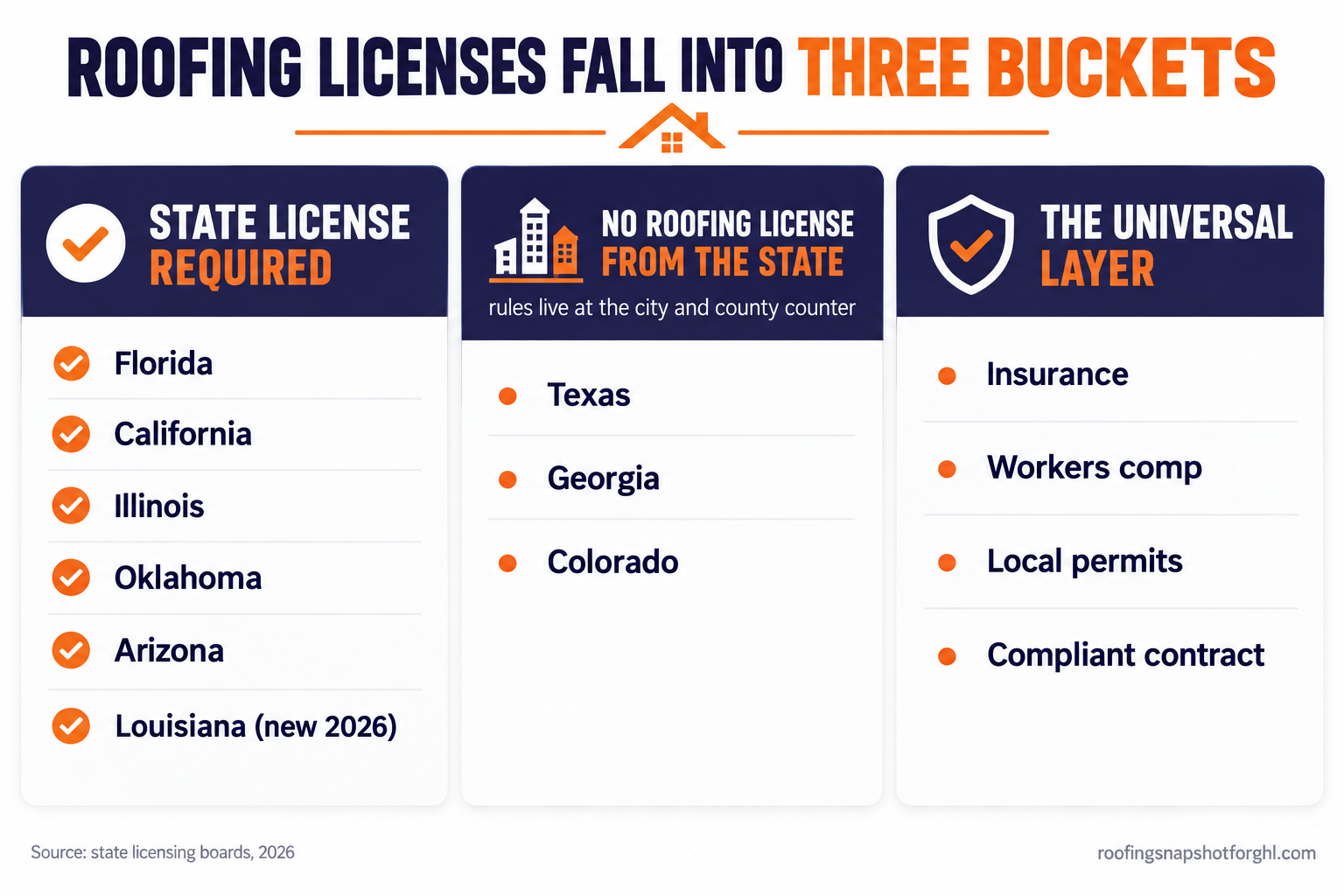
Bucket one: the state issues a license and you need it before you work. The strict group: Florida, California, Illinois, Oklahoma, Arizona, and now Louisiana. Some issue a roofing-specific license, some fold it into a broader contractor license, but the common thread is a state board, an exam, insurance or a bond, and real penalties for skipping the card.
Bucket two: the state issues no roofing license at all. Texas, Georgia, and Colorado are the headliners, and this is where roofers get lulled, because “no state license” gets repeated online as if it means no rules. It does not. The regulation just moved down to the city and county, where you still register, pull permits, and prove insurance.
Bucket three: the universal layer almost everywhere. General liability, workers’ comp, local permits, and a contract that meets your state’s notice rules, none of it optional just because a state skips a license.
What unlicensed roofing actually costs you
The penalties come in layers, and the worst is not the fine. In California, contracting without a license on a job of $500 or more is a misdemeanor, and a first conviction can carry up to six months in county jail and up to $5,000 in fines (CSLB). Illinois fines unlicensed roofing up to $10,000 per violation (IDFPR). Boards run undercover stings and publish the names.
Then comes the part that guts your business: the contract. In many licensing states, a contract signed by an unlicensed contractor is void or unenforceable. You do the tear-off and the reroof and have no legal right to collect a dollar. A fine you can budget for; a $22,000 job you cannot collect on ends a season. And an insurer gets a clean reason to deny a claim on an unlicensed job, while the board can bar you from ever licensing in that state once it catches you.
Maximum statutory fines for unlicensed contracting, California first offense versus Illinois per violation. Neither counts the bigger loss: a contract you cannot collect on. Sources: CSLB, IDFPR.
States that require a license (and bite if you skip it)
Confirm the current rule with each board before you bid.
Florida issues a Certified Roofing Contractor license, valid statewide, and a Registered Roofing Contractor license, limited to the county that endorsed it, both under the DBPR per Florida Statute chapter 489. Certified means two exams and proof of financial responsibility, and it is the card you need to work the whole state after a hurricane.
California classifies roofing under the C-39 Roofing Contractor license from the Contractors State License Board, required for any job where labor and materials total $500 or more (CSLB). That low threshold catches almost every real roof, and the C-39 requires experience, two exams, a bond, and insurance.
Illinois licenses roofing at the state level under the Illinois Roofing Industry Licensing Act, with a limited license for residential work and an unlimited license for everything, each with its own bond, insurance, and exam (IDFPR). Chicago layers its own requirements on top.
Oklahoma requires a roofing registration from the Construction Industries Board, and the rule that trips up storm crews is that it applies to resident and nonresident roofers the same way (Oklahoma CIB). Drive in from Texas and you still need the Oklahoma registration, with its insurance minimums, first.
Arizona licenses roofing through the Registrar of Contractors, commonly under the CR-42 classification, with a trade exam and a statutes-and-rules exam (Arizona ROC). Working above the small-job threshold without the ROC license is what gets Arizona roofers cited.
Louisiana changed under everyone’s feet. Act 422 of 2025, effective January 1, 2026, requires a residential roofing or residential construction license for anyone who advertises, bids, or performs residential roofing valued at $7,500 or more (Adams and Reese). Holders of a residential construction, building construction, or commercial roofing license skip the new trade exam; a home-improvement registration no longer covers roofing (LSLBC memo).
States with no roofing license (where the rule hides)
Texas does not license roofers at the state level; the Texas Department of Licensing and Regulation covers electricians, plumbers, and HVAC, not roofing. The only statewide credential is the voluntary certification from the Roofing Contractors Association of Texas (RCAT), a trust signal, not a requirement. Texas is not open range, though: cities set their own registration and permit rules, insurers require coverage, and a 2019 state law bars waiving a homeowner’s deductible, which we cover in what roofers can and cannot legally say about insurance claims.
Georgia treats roofing as an exempt specialty and issues no roofing-specific state license, even though it licenses general and residential contractors through the Georgia state licensing board. A pure roofing contractor can often work without a state card, but larger or structural jobs can cross into general-contractor territory, so confirm the specific job against the specific county.
Colorado issues no statewide roofing license, which surprises people given how much hail the Front Range eats. Regulation is entirely municipal: Denver runs its own roofing licensing, and a roofer legal in one Colorado city is not automatically legal in the next.
The state-by-state table
A quick reference for common storm states, verified against the board before each campaign.
| State | State roofing license? | Who runs it | The rule that bites |
|---|---|---|---|
| Florida | Yes (Certified statewide, Registered local) | DBPR / CILB | Two exams and financial responsibility for the statewide card (Ch. 489) |
| California | Yes (C-39) | CSLB | Required at $500+; unlicensed work is a misdemeanor (CSLB) |
| Illinois | Yes (limited / unlimited) | IDFPR | Fines up to $10,000 per violation (IDFPR) |
| Oklahoma | Yes (registration) | Construction Industries Board | Applies to nonresidents too (CIB) |
| Arizona | Yes (CR-42) | Registrar of Contractors | Trade plus statutes exam (ROC) |
| Louisiana | Yes, new for 2026 | LSLBC | Required at $7,500+ residential from Jan 1, 2026 (Act 422) |
| Texas | No | Cities / counties | No state license, but local registration and permits apply (RCAT) |
| Georgia | No (roofing exempt) | Cities / counties | Bigger jobs can need a general contractor license (GA board) |
| Colorado | No | Cities (Denver, etc.) | Each municipality licenses separately |
How to actually get licensed
The path differs state to state, but the steps rhyme.
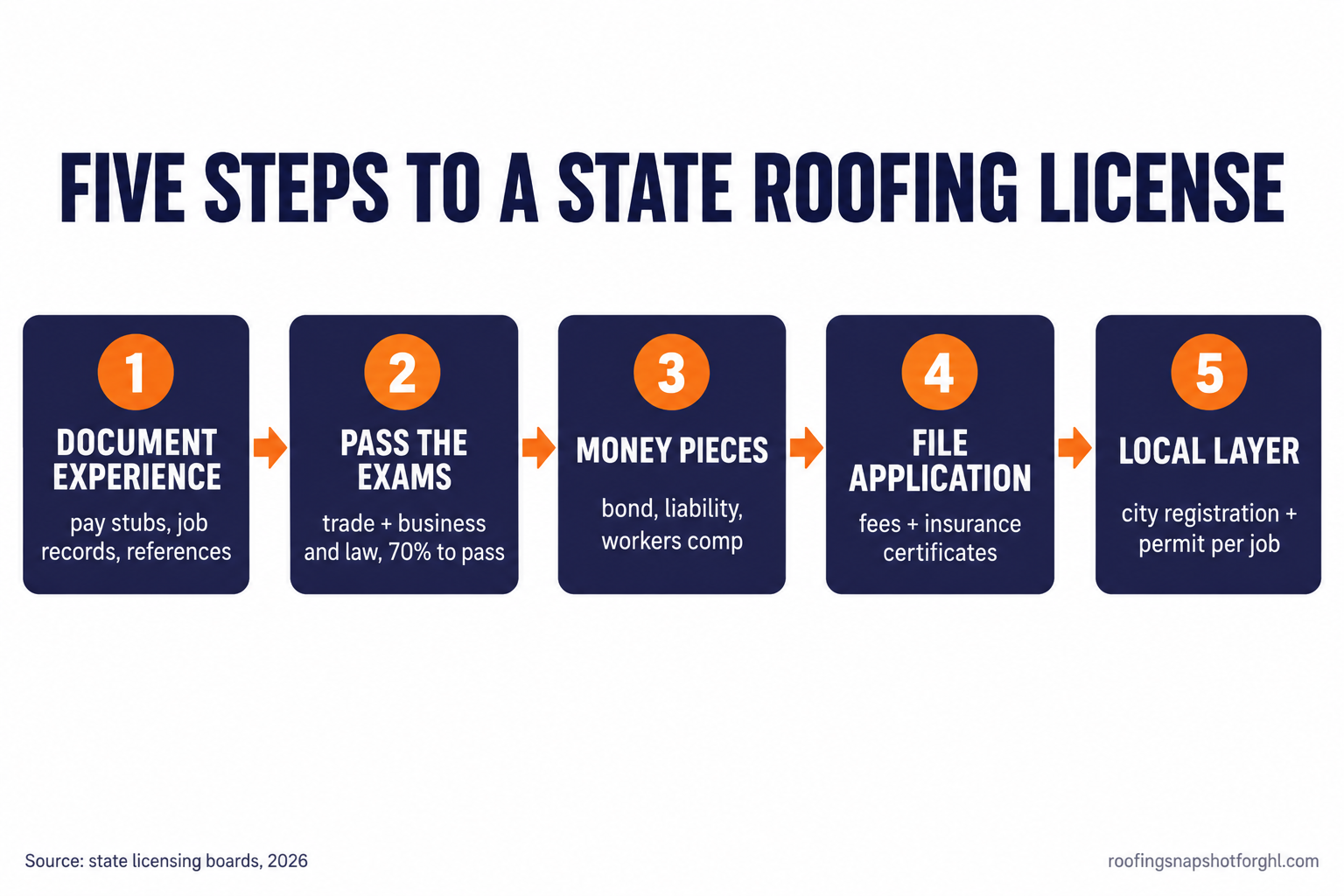
- Document experience. Most licenses require proven years in the trade, often time as a foreman. Start pulling pay stubs, job records, and references now, because this is the part you cannot rush at the last minute.
- Pass the exams. A roofing trade exam plus a separate business and law exam, usually needing 70% through a provider like PSI or Pearson VUE. The business and law half fails more roofers than the trade half.
- Line up the money pieces. A surety bond where required, general liability, and workers’ comp, read against the state’s minimum coverage before you buy.
- File the application and fees with experience proof, exam results, insurance certificates, and a business entity in good standing. Budget weeks, not days.
- Handle the local layer. Even with a state license, the city usually wants its own registration and a permit per job. The state card gets you into the state; the permit gets you onto the roof.
Three scenarios: solo, expanding, multi-state storm chase
The right amount of licensing work depends on how you operate.
The solo operator in one state. The easiest job: learn your one state’s rule, get the license or confirm you need none, register with the cities you work, and keep the card and insurance current. Your only real risk is a lapsed license.
The operator expanding to a neighboring state. Where roofers get burned, because they assume a neighbor works like home. A Texas roofer who never needed a license drives into Oklahoma and now needs a registration covering nonresidents, or into Louisiana and needs a residential roofing license over $7,500. Get licensed before you advertise, because in states like Louisiana the advertising itself can trigger the requirement.
The multi-state storm chaser. If you follow hail across three or four states a season, licensing is a standing system, not a one-time task. Keep a live sheet of every state and city you work, the license each needs, the renewal date, and the insurance minimums, and verify before the trailer leaves.
How licensing breaks (the failure modes)
Knowing the rule is not the same as staying compliant. Here is where it falls apart:
The lapsed renewal. The most common failure. Your card quietly expired because the notice went to an old email, and working expired is unlicensed contracting in most states. The fix is a calendar reminder tied to the license, not the inbox, done 30 days early.
The unlicensed sub. You are licensed; your sub is not. In many states the liability flows up to you as the contractor of record, so verify every sub’s license and insurance before they set foot on your permit.
The wrong license class. You hold a residential license and bid a commercial flat roof, or a registration good for one county and work the next. Match the class to the specific job and location before you sign.
The job-size threshold. Louisiana ($7,500) and California ($500) tie the requirement to job value. Splitting a job into two invoices to duck a threshold is a separate violation, not a dodge.
The advertising trigger. Newer rules, Louisiana’s included, attach the requirement to advertising and bidding, not just work. If you advertise into a state, be licensed to work it.
Steal this: the pre-job licensing checklist and copy
Lift this straight into your business. It keeps a crew legal without a lawyer on retainer.
The pre-bid licensing check (run before every job in a new area):
STATE: __________   CITY/COUNTY: __________   JOB VALUE: $________

[ ] Does the STATE require a roofing/contractor license for this job size?
    - If yes, license # ________  class ________  expires ________
[ ] Does the CITY/COUNTY require its own registration? reg # ________
[ ] Is a PERMIT required, and is it pulled BEFORE work starts? permit # ________
[ ] Does my GENERAL LIABILITY meet this state's minimum? carrier ________
[ ] Is WORKERS' COMP active for this crew in this state?
[ ] Does my CONTRACT include this state's required notice language?
[ ] If using a SUB: is their license + insurance verified and on file?

All boxes checked = cleared to bid. Any blank = do not sign.
The subcontractor verification clause (put it in every sub agreement):
Subcontractor warrants that it holds all state and local licenses and registrations required to perform roofing work at the project location, and current general liability and workers’ compensation coverage. Subcontractor will provide copies before starting work and notify Contractor if any license or policy lapses. Work performed without the required license or coverage is a material breach.
The customer-facing trust line (for your site, estimates, and door scripts):
We are a fully licensed and insured roofing contractor. You can verify our license number [#] and our insurance before we start, and we pull every permit in your name. If a contractor will not show you a license and an insurance certificate, that is your answer.
The renewal SOP: The day a license is issued, put two calendar events on it, one on the expiration date and one 60 days earlier titled “RENEW [state] roofing license,” with the renewal URL attached. Do the same for every policy.
Objections
“I have worked 20 years without a license and never had a problem.” You have been lucky, and probably in Bucket Two states. The moment a storm pushes you into a licensing state, or a homeowner disputes a job and tells the board, the 20 years works against you, because a board treats a long-running unlicensed operator as a bigger target, not a grandfathered one.
“Getting licensed is expensive and slow, and the storm is here now.” The license costs hundreds to low thousands plus prep time. An unenforceable contract on one storm job costs more, and a criminal citation more again. Get licensed before the season, not after the hail falls.
“The out-of-state guys are ignoring all of this and undercutting me.” Some do, and some get cited and vanish. You cannot win by racing them to the bottom. You win by being the licensed, insured, permit-pulling roofer the homeowner can verify, and by responding faster, the combination the fly-by-night crew is built to skip.
Related reading
- What roofers can and can’t legally say about insurance claims
- How out-of-state storm chasers beat local roofers
- The storm lead follow-up sequence that stays legal
- Storm damage roof inspection checklist
- Why your roofing insurance claims stall
Frequently asked questions about roofing contractor licenses
Is there a national roofing license?
No. There is no federal roofing license. Every requirement is set by the state, and often the city or county on top, so a contractor working across state lines meets each state's rule separately.
Which states do not require a state roofing license?
Texas, Georgia, and Colorado are common examples that issue no statewide roofing license. That does not make them unregulated: cities and counties frequently require registration and permits, and insurance applies everywhere.
What happens if I roof without a required license?
It varies by state but can include criminal charges (a California first offense is a misdemeanor carrying up to six months and up to $5,000), fines up to $10,000 per violation in Illinois, a void contract so you cannot collect, denied insurance claims, and a bar from ever getting licensed there.
Do out-of-state roofers need a license to chase storms?
Often yes. Oklahoma's registration applies to nonresident contractors, and Louisiana's 2026 rule attaches to anyone who advertises, bids, or performs residential roofing of $7,500 or more. Check every state you advertise into.
What changed for Louisiana roofers in 2026?
Act 422 of 2025, effective January 1, 2026, requires a residential roofing or residential construction license for residential roof jobs of $7,500 or more. Holders of a residential construction, building, or commercial roofing license skip the new trade exam; a home-improvement registration no longer covers roofing.