
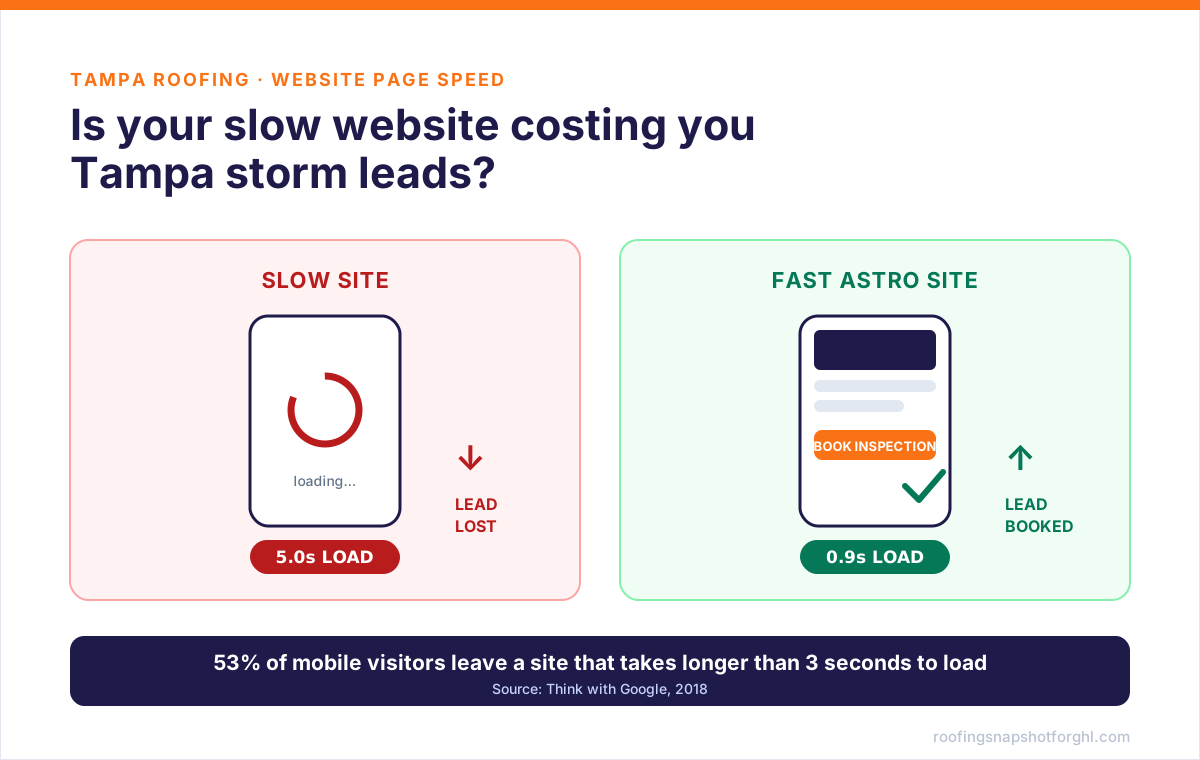
Is a slow website costing your Tampa roofing company storm leads? Yes — and the loss is bigger and quieter than most owners think. When a homeowner in Brandon or Carrollwood pulls out their phone after a summer squall or a hurricane band rolls through, they open two or three roofers at once and start judging on the spot. The site that loads in under a second gets the tap on “Book Inspection.” The one that spins for five seconds gets closed before it ever renders — and you never see the lead you lost, because it never became a lead at all.
This is a data-first playbook for Tampa roofing owners — and the GoHighLevel (GHL) agencies serving them — on why website page speed is now a lead-generation lever, not an IT detail. We’ll put real, sourced numbers on what “slow” actually costs, show you the exact scores Google grades your site against, explain why most roofing websites are slow in the first place, and lay out how a fast site captures the storm lead a slow one leaks. We’re not a roofing contractor — we build the automation and the fast websites that keep your phone ringing.
Table of contents
- The Tampa storm-lead moment your website has to survive
- What a slow website actually costs a Tampa roofer
- Speed is a conversion lever, not a vanity score
- Core Web Vitals: the 3 scores Google grades you on
- Why most Tampa roofing websites are slow
- The cost of inaction, in Tampa dollars
- How to fix a slow roofing website
- Frequently asked questions
The Tampa storm-lead moment your website has to survive
Tampa Bay runs on weather. Afternoon thunderstorms all summer, wind and hail off the Gulf, and the hurricane season every roofer circles on the calendar. Each event ends the same way for homeowners: a wet ceiling, a missing shingle, a scramble to find someone reputable now. And almost none of them start with a phone call. They start with a thumb on a phone screen.
For 73% of consumers, their most recent local-business search started on a mobile phone (BrightLocal, 2025). That means your website is being judged on a 6-inch screen, on cell data, in the exact moment a homeowner is anxious and impatient. They’re not reading — they’re triaging. Three tabs open, three roofers, one question: who can help me fastest?
That decision is brutal and quick, and your website’s load speed is the first thing it tests. Before a homeowner reads a single word of your copy, sees a single review, or notices your “family-owned since 1998” badge, they experience your speed. A fast site feels trustworthy and open for business. A slow one feels broken — and a broken-feeling site during a storm emergency is an instant back-button.
What a slow website actually costs a Tampa roofer
Let’s put numbers on it. Google’s analysis of mobile landing pages found that page-load time and bounce rate move together, and the curve is steep. As a page’s load time climbs, the probability that a visitor gives up and leaves rises fast.
Increase in bounce probability as mobile page load time grows. Source: Think with Google, 2017.
Read that chart the way a storm lead experiences it. A site that loads in three seconds instead of one already raises your bounce probability by 32%. Push it to five seconds — common for an image-heavy WordPress roofing site on cell data — and bounce probability jumps 90%. By the time you’re at ten seconds, it’s up 123% (Google, 2017).
And the single most-cited number in web performance is the cliff at three seconds: 53% of mobile site visits are abandoned if a page takes longer than 3 seconds to load (Google, 2018). More than half your storm traffic, gone, before your hero image even paints.
For a roofer, that’s not an abstract analytics problem — it’s the difference between a booked inspection and a competitor’s truck in your prospect’s driveway. Every one of those bounced visits was a homeowner who wanted a roofer and had money to spend. Speed is the tollbooth they hit before they ever reach your offer.
Speed is a conversion lever, not a vanity score
It’s tempting to file “page speed” under vanity metrics — a score to brag about, not a lever that moves revenue. The conversion data says the opposite. Portent analyzed more than 100 million page views and found that a website that loads in 1 second converts about 3× higher than one that loads in 5 seconds, and conversion rate drops roughly 4.4% with every additional second of load time (Portent, 2022).
Website conversion rate by load time (%). A 1-second site converts nearly 3× the rate of a 5-second site. Source: Portent, 2022.
Even fractions of a second matter. In a landmark study with Google, Deloitte found that a 0.1-second improvement in mobile load time lifted retail conversions by 8.4%, retail average order value by 9.2%, and — most relevant to lead-gen businesses like roofing — page views in lead-generation sites by 21.6% (Deloitte & Google, 2020). One tenth of a second. That’s how sensitive human behavior is to speed on a phone.
Now stack that on top of your ad spend. The average home-services business pays $228.15 for a single Google search lead (LocaliQ, 2025). If your site is slow, you’re paying that $228 to send a click to a landing page that loses half its visitors before it loads. You’re not just losing organic storm traffic — you’re lighting paid clicks on fire at the door. Speed isn’t a nice-to-have on top of your marketing; it’s the multiplier that decides whether the rest of your marketing works at all. (If you want the full picture on lead economics, see our breakdown of how much a roofing lead really costs.)
Core Web Vitals: the 3 scores Google grades you on
Google doesn’t just quietly prefer fast sites — it measures them with a specific, public scorecard called Core Web Vitals, and page experience is a documented ranking signal (Google Search Central). There are three scores, each graded on real visits at the 75th percentile:
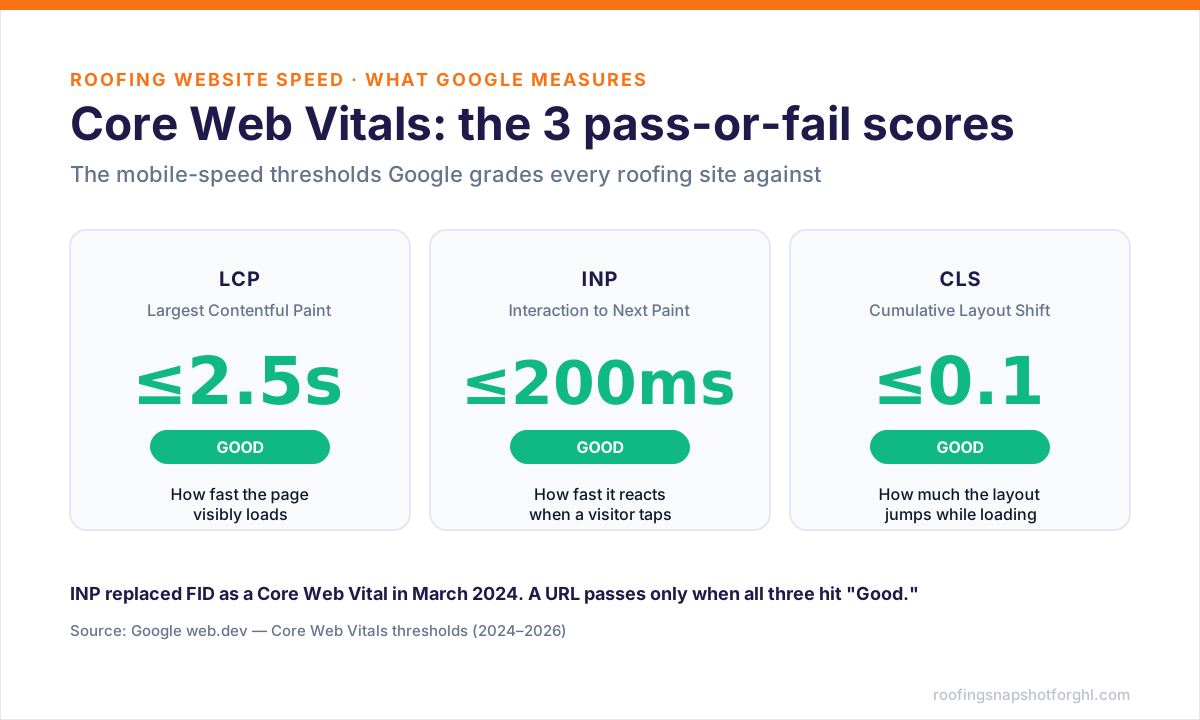
- LCP (Largest Contentful Paint) — how fast your main content visibly loads. Good is 2.5 seconds or less.
- INP (Interaction to Next Paint) — how fast the page responds when someone taps a button or opens your menu. Good is 200 milliseconds or less. INP replaced the older FID metric in March 2024.
- CLS (Cumulative Layout Shift) — how much your layout jumps around while loading (the reason a homeowner taps “call” and hits an ad instead). Good is 0.1 or less.
A page passes only when all three land in “Good” (Google, 2024). Google’s own framing is honest about the weight: page experience is a tie-breaker, not an override of relevance. But in a competitive Tampa market where a dozen roofers are chasing the same “roof repair near me” search, tie-breakers decide who ranks on page one and who ranks on page three. Speed is both the thing that ranks you and the thing that converts the visitor once ranking puts them on your site. (For the search side of this story, see our guide to ranking in AI and local search.)
Why most Tampa roofing websites are slow
Here’s the part that surprises owners: your website probably isn’t slow because of one bad image or a lazy developer. It’s slow because of what it’s built on. Most roofing sites run on WordPress, Wix, or a page-builder inside a CRM — platforms that ship a heavy bundle of JavaScript, plugins, themes, and render-blocking scripts to every visitor’s phone before the page can appear.
The data backs this up. In HTTP Archive’s Web Almanac, WordPress sites pass Core Web Vitals only about 40% of the time — a gap driven by theme weight, oversized images, and plugin bloat, not by responsiveness (HTTP Archive Web Almanac, 2024). Every plugin you add for a contact form, a gallery, a chat box, or a review widget adds more code the phone has to download and run. It compounds until a “quick” homepage is a 4-megabyte download on Gulf Coast cell service.
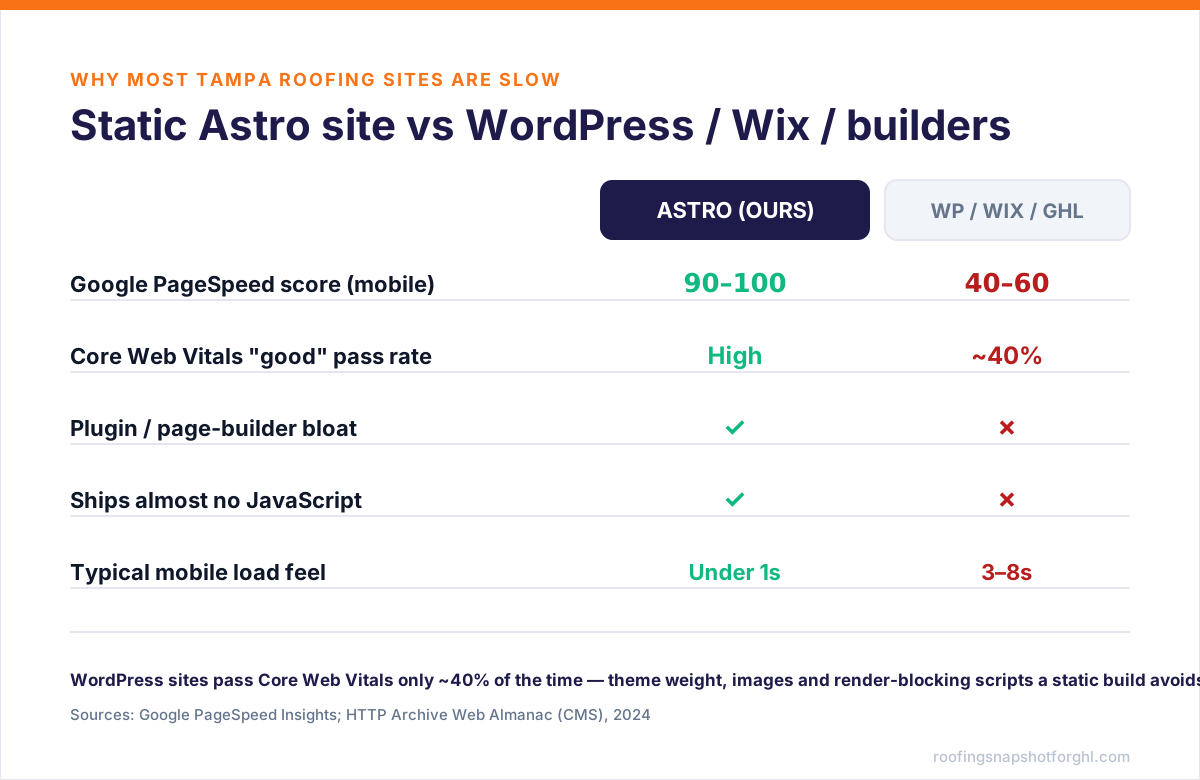
The alternative is a fundamentally different architecture: a static site built on a framework like Astro, which ships almost no JavaScript and serves pre-built pages from a global edge network. There’s no plugin stack to load, no page-builder overhead, no database query on every visit. The page is essentially already built before the homeowner arrives — so it paints in under a second on the same phone that struggled with the WordPress version. This is the same reason we recommend Astro over WordPress in our Astro vs WordPress comparison for roofing sites.
The cost of inaction, in Tampa dollars
Let’s make this concrete for a Tampa roofing company. Say a storm rolls through and drives 500 people to your website over the following week — a mix of organic “roof repair Tampa” searches, Google ads, and Facebook clicks.
If your site is slow enough that half of those mobile visitors bounce before it loads (in line with the 53% abandonment figure), you’ve lost roughly 265 prospects instantly. Of the ~235 who stay, a slow site converts at a fraction of a fast one’s rate. At Portent’s numbers, going from a 5-second site to a 1-second site roughly triples conversion. If a fast site would have turned 8% of stayers into booked inspections and a slow one manages 3%, that’s the difference between ~19 inspections and ~7 from the same storm — before you count the 265 who never made it in the door.
That’s one storm. Multiply it across a Tampa hurricane season and the slow-site tax is a five- or six-figure hole you can’t see, because the leads it costs you never existed in your CRM to be counted. Meanwhile the intent is undeniable: 76% of people who run a local search on their phone visit a related business within a day (Google). The homeowners are ready to act today. The only question is whether your website lets them.
How to fix a slow roofing website
The good news: page speed is one of the most fixable problems in your business, because it’s architectural. You don’t need to write better copy or run more ads — you need a site that loads before the homeowner loses patience. Here’s what a fast roofing website actually requires:
- Build static, not dynamic. Serve pre-built HTML from an edge network instead of assembling every page from a database and a stack of plugins on each visit. This is the single biggest lever.
- Ship almost no JavaScript. Interactive widgets (chat, forms, galleries) should load only when needed, not block the whole page from painting.
- Right-size and modernize images. Roofing sites are image-heavy by nature; compressed, correctly sized, next-gen formats keep LCP under 2.5 seconds.
- Serve from the edge. Hosting on a global CDN like Cloudflare means a Tampa homeowner is served from a nearby node, not a distant origin server.
- Pass all three Core Web Vitals. Verify LCP, INP, and CLS on real mobile data — not just a one-time lab score.
- Wire the fast site to your CRM. A quick site that captures the lead into GoHighLevel and fires a 30-second speed-to-lead follow-up is what turns a fast page view into a signed roof.
You can retrofit some of this onto WordPress, but you’re fighting the platform the whole way. The cleaner path is to build on the right foundation from the start.
A fast website won’t fix a weak offer or a roofing crew that doesn’t show up. But it removes the most expensive, most invisible leak in your funnel — the storm leads you lose in the three seconds before your current site finishes loading. In a Tampa market where every homeowner vets you on their phone in the middle of a downpour, speed isn’t the finish line. It’s the price of getting into the race.
Frequently asked questions
How fast should a roofing website load?
Aim for a Largest Contentful Paint (LCP) of 2.5 seconds or less on mobile, which is Google's 'Good' Core Web Vitals threshold. Practically, a well-built static site loads in under one second — and that matters because 53% of mobile visitors abandon a page that takes longer than 3 seconds to load (Google, 2018). On a slow site you're losing more than half your storm traffic before the page even appears.
Why is my WordPress roofing website so slow?
WordPress assembles each page from a database plus a stack of themes and plugins, and ships a heavy JavaScript bundle to every phone before the page can render. HTTP Archive's Web Almanac found WordPress sites pass Core Web Vitals only about 40% of the time, driven by theme weight, oversized images, and render-blocking scripts. A static Astro site avoids that by serving pre-built pages with almost no JavaScript.
Does website speed actually affect my Google ranking?
Yes. Google's page experience system uses Core Web Vitals (LCP, INP, CLS) as a ranking signal. Google frames it as a tie-breaker rather than an override of relevance, but in a competitive Tampa roofing market, tie-breakers decide who lands on page one. Speed also lifts conversions once you rank, so it works on both sides of the funnel.
Is a fast website worth it if I already spend on Google Ads?
It's arguably more important. The average home-services business pays about $228 for a single Google search lead (LocaliQ, 2025). If your landing page is slow, you're paying that money to send clicks to a page that loses roughly half of them before it loads — and the ones who stay convert at a fraction of the rate. A fast site multiplies the ad spend you're already making.
How long does it take to get a fast roofing website live?
A purpose-built roofing site on the Astro framework can be branded and launched quickly — our Get a Website service builds it for a $497 one-time fee plus $97/month, and you don't pay the build fee until the site is live and you're satisfied. It includes location pages, schema for local and AI search, an AI chat widget, and CRM integration so leads flow straight into GoHighLevel.
About the author
Marcus Ellison runs a GoHighLevel agency on Florida’s Gulf Coast that productizes roofing snapshots and fast websites for contractors across hurricane country. He thinks like an operator first and a marketer second: reviews that compound, Google profiles that rank, and websites that load before a storm-rattled homeowner loses patience. He writes for both the agency owner reselling GHL and the roofer who just wants the phone to ring.