
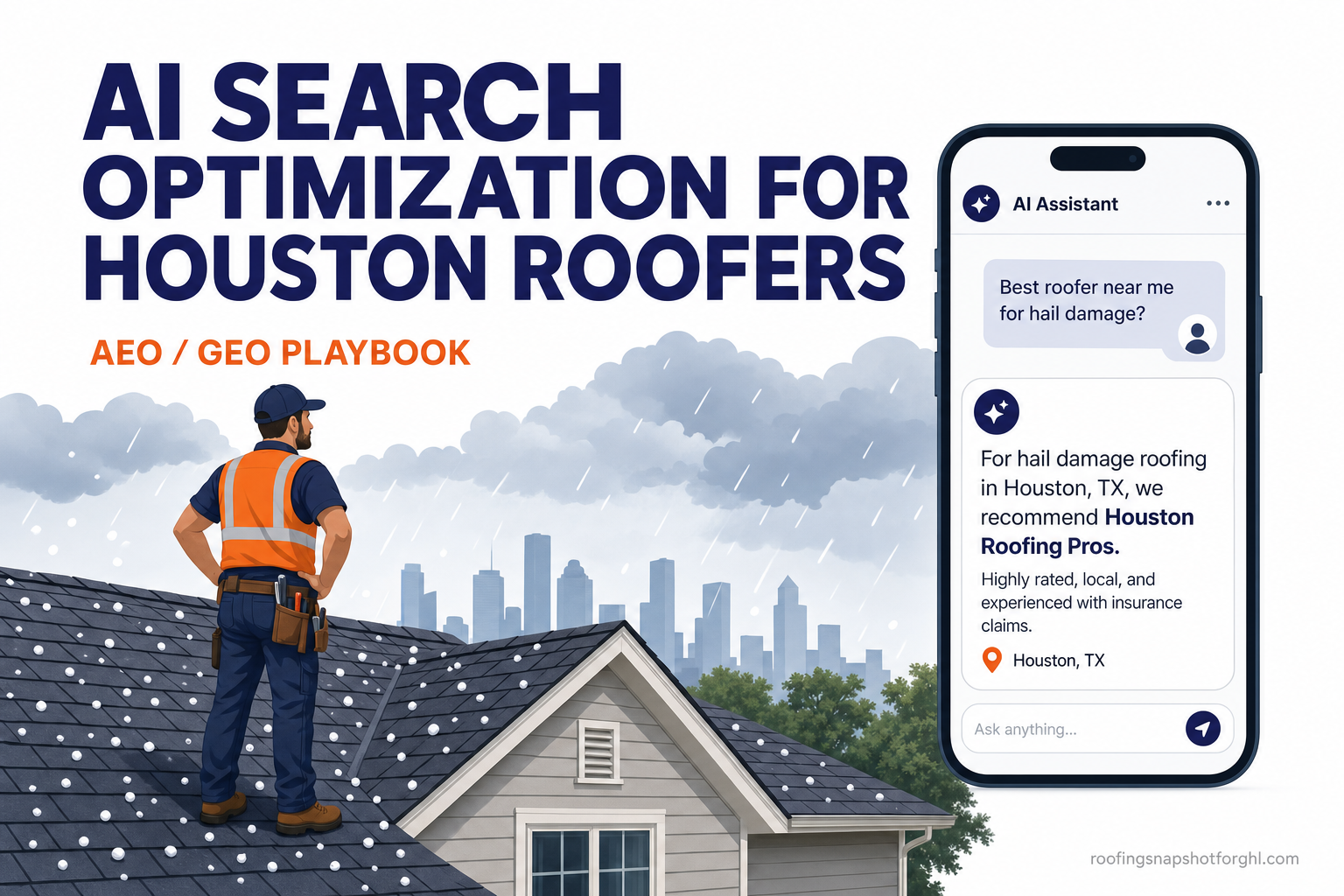
When a Houston homeowner walks outside after a hailstorm and finds their shingles bruised, they don’t always open Google and scroll ten blue links anymore. A growing share of them open ChatGPT, tap Google’s AI Overview, or ask Perplexity: “who’s the best roofer near me for hail damage?” — and they call whoever the AI names. If the machine doesn’t know your roofing company exists, you were never in the running. The homeowner never saw your site, your ad, or your reviews.
That shift has a name: AEO (Answer Engine Optimization) and its local cousin GEO (Generative/Geographic Engine Optimization). This guide is a step-by-step playbook for getting a Houston roofing company surfaced and cited in AI answers — written for the roofing owner who just wants the phone to ring, and for the GHL agency deciding what to build for roofing clients. Every number here is current and sourced.
Key Takeaways
- 34% of U.S. adults say they’ve used ChatGPT — about double the share in 2023 (Pew Research Center, 2025), and ChatGPT has surpassed 800 million weekly users (OpenAI, via reporting, 2025). Your customers are already asking AI who to hire.
- 58.5% of U.S. Google searches now end without a click to the open web (SparkToro / Rand Fishkin, 2024) — increasingly the answer is the AI box, not your homepage.
- AI Overviews now appear on a large and rising share of searches (vendor estimates range from ~14-16% of queries to far higher on informational searches; Semrush / BrightEdge, 2025), and traffic to sites from generative-AI sources jumped ~1,200% year over year (Adobe Analytics, 2025).
- AI engines mostly cite pages that already rank and are cleanly structured: a #1 organic result has roughly a 53% chance of being cited in the AI Overview, versus ~37% at position 10 (Semrush 200,000-AIO study, 2024-25).
- Texas logged 529 major hail events in 2024 — the most of any state (NOAA data via Roofing Contractor, 2024). In Houston, every storm sends a surge of homeowners to search — and now to AI — for a roofer.
Table of contents
- The short answer: how to get a Houston roofer cited by AI
- Why AI search now decides who a Houston homeowner calls
- How AI answer engines actually pick who to cite
- The 7-step AEO/GEO playbook for Houston roofers
- What structured data is worth (Google’s own data)
- A Houston example: what “cited by AI” looks like
- Done-for-you: a Houston-ready AEO website
- FAQ
The short answer: how to get a Houston roofer cited by AI
To get your Houston roofing company cited by ChatGPT, Google AI Overviews, and Perplexity, you win classic local search first, then make every page machine-readable: real Houston and neighborhood location pages, valid schema (LocalBusiness, Service, FAQ), answer-first content that directly answers homeowner questions, an llms.txt file and clean crawlability, plus third-party citations and a steady stream of Google reviews. AI answer engines don’t invent contractors — they summarize the web they can read and trust. Your job is to be the clearest, best-structured, most-cited roofer in Houston so the machine picks you.
There’s no secret prompt and no paid “get into ChatGPT” button. AEO is mostly SEO fundamentals done cleanly, plus structure the machines can parse. The rest of this article is the exact playbook — and the data behind why it now matters more than a Google Ads budget.
Why AI search now decides who a Houston homeowner calls
For twenty years, the search game was: rank in the top few blue links, get the click, win the call. That game is quietly changing. People are asking AI directly, and the AI answers in-line — often without ever sending a click.
Three currents are converging on your Houston roofing business at once:
- AI usage went mainstream. A third of U.S. adults have used ChatGPT, and the share is far higher among younger homeowners — 58% of adults under 30 have used it (Pew Research Center, 2025). These are exactly the homeowners buying their first or second roof.
- Search is going zero-click. SparkToro’s study of U.S. Google searches found 58.5% end without a click to the open web (SparkToro, 2024), and their 2026 update estimates less than a third of searches still send a click to the open web (SparkToro, 2026). The answer box increasingly is the destination.
- AI is sending real traffic — to whoever it cites. Adobe Analytics measured traffic from generative-AI sources to U.S. retail sites jumping about 1,200% year over year (Adobe, 2025). It’s small today and compounding fast — the roofers who get cited now build a lead before their competitors notice the channel exists.
Now layer Houston’s reality on top. Texas leads the nation in major hail events — 529 in 2024 alone (NOAA via Roofing Contractor, 2024) — and the Gulf Coast adds hurricane and wind season on top of that. Every major storm sends a spike of anxious Houston homeowners searching and asking AI for a roofer, in a hurry, on their phones. Whoever the answer names first gets the inspection.
How AI answer engines actually pick who to cite
Here’s the part most “AI SEO gurus” get wrong: AI Overviews, ChatGPT, and Perplexity don’t pull names from thin air. They summarize sources they retrieve from the web — and the research shows those sources skew heavily toward pages that already rank and are cleanly structured.
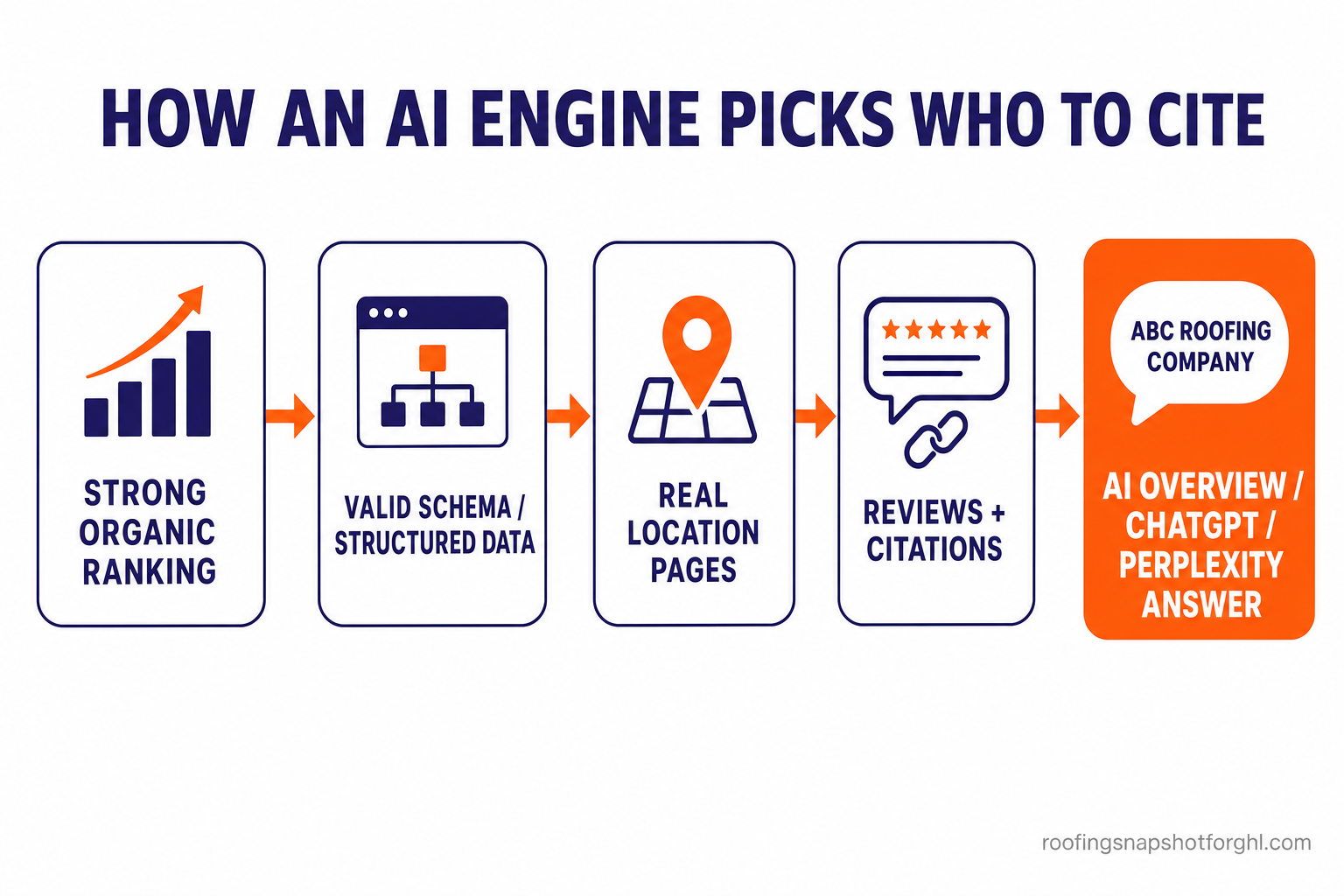
Semrush studied 200,000 AI Overviews and found a clear link between classic ranking and AI citation: a page ranking #1 organically has about a 53% chance of being cited in that query’s AI Overview, sliding to roughly 37% at position 10 (Semrush, 2024-25). At the same time, AI Overviews cite a mix of sources — many pulled from outside the top 10 — which means well-structured, tightly-focused pages (a dedicated “hail damage roof repair in Houston” page, say) can punch above their raw ranking. In practice, AI engines reward the same signals a good local roofer should already be building:
- Relevance and rank. Do you already show up for “roof repair Houston” and “hail damage roofer near me”? Ranking is the strongest single predictor of being cited.
- Machine-readable structure. Valid schema (LocalBusiness, Service, FAQPage) tells the engine exactly who you are, what you do, and where you work — no guessing.
- Answer-first content. Pages that directly answer a homeowner’s question in the first sentence are easy for an AI to lift and quote.
- Trust signals off your site. Reviews, directory listings, and mentions on other reputable sites tell the engine you’re a real, reputable Houston contractor — not a fly-by-night storm chaser.
Get those right and you’re not gaming the AI — you’re feeding it exactly what it needs to confidently name you.
The 7-step AEO/GEO playbook for Houston roofers
This is the actual work, in order. Do it top to bottom; the early steps make the later ones pay off.
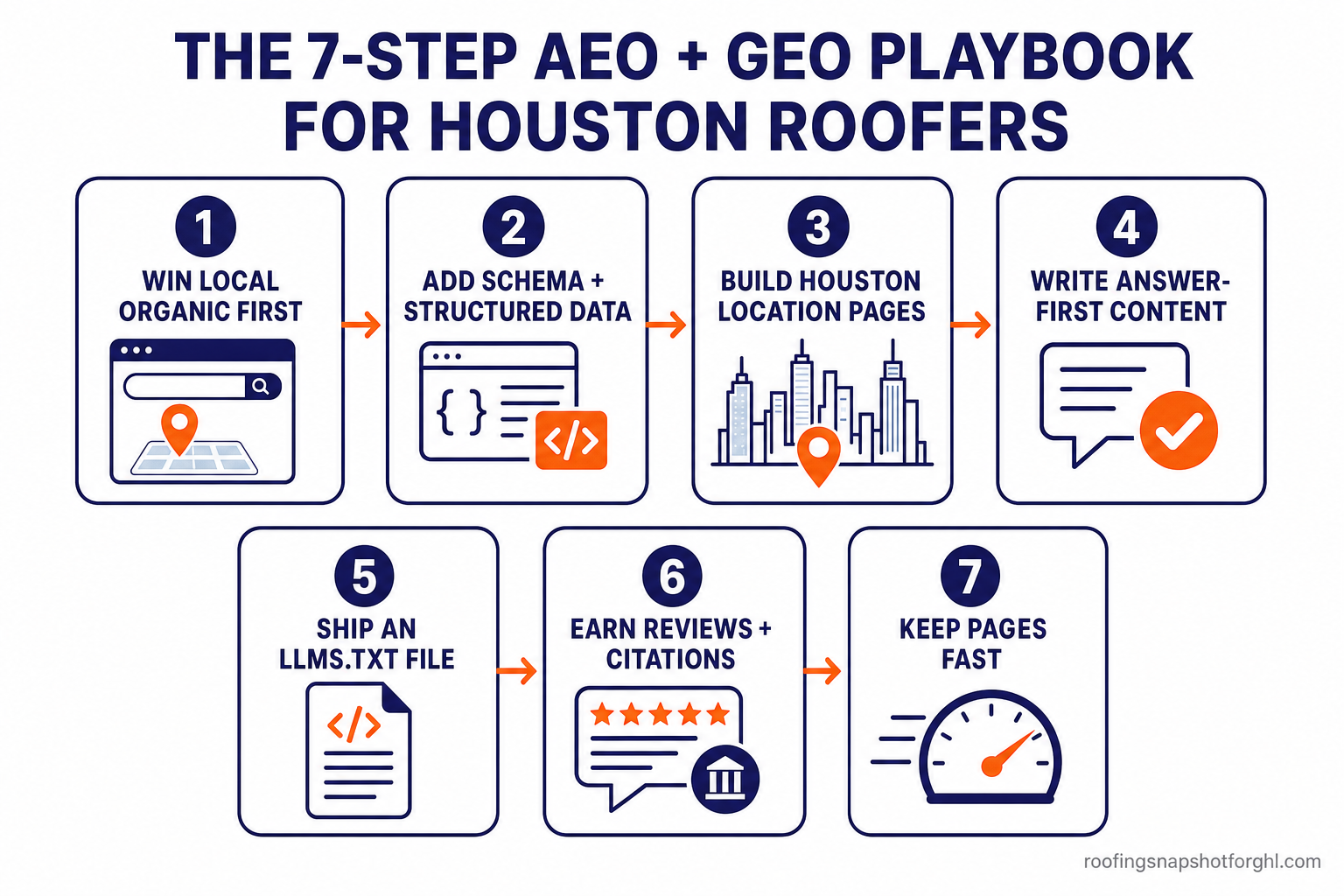
1. Win local organic search first
Because ranking is the top predictor of AI citation, classic local SEO is step one, not an afterthought. Claim and complete your Google Business Profile, nail your name-address-phone consistency, and target the searches Houston homeowners actually type — “roof replacement Houston,” “storm damage roof repair Cypress,” “metal roofer Katy.” Our full local walkthrough is in Local SEO for roofing contractors.
2. Add structured data (schema) to every page
Schema markup is the language AI and search engines read to understand your page without guessing. For a roofer, the essentials are LocalBusiness (or the more specific RoofingContractor type), Service for each offering, and FAQPage for your Q&A sections. This is exactly the kind of clean, labeled data an answer engine prefers to cite — and, as we’ll see in the next section, Google’s own case studies show it lifts click-through too.
3. Build real Houston + neighborhood location pages (GEO)
One generic “Service Areas” page listing thirty suburbs won’t cut it. GEO rewards individual, genuinely-useful pages: a real page for Houston, and separate ones for Katy, Cypress, Sugar Land, The Woodlands, Pearland, Spring, Pasadena, and the neighborhoods you actually serve — each with local detail, local schema, and its own reviews and photos. This is the single biggest lever for winning the map pack and AI answers after a storm, because “near me” questions resolve to a place.
4. Write answer-first, question-shaped content
AI engines quote passages that answer a question cleanly. Structure content the way homeowners ask: headings like “How much does a roof replacement cost in Houston?” or “Does my insurance cover hail damage?”, each followed by a direct, one-or-two-sentence answer before the detail. That format is quotable by an AI and skimmable by a homeowner — you win both.
5. Ship an llms.txt file and keep crawlers welcome
An llms.txt file is a simple, emerging standard that gives AI crawlers a clean map of your most important pages. Pair it with a correct robots.txt, an up-to-date XML sitemap, and no accidental blocks on AI user-agents. Most Houston roofing sites — especially heavy WordPress or page-builder sites — never ship an llms.txt at all, which is exactly why this is a cheap edge right now.
6. Earn reviews and third-party citations
AI engines lean on off-site trust signals, and homeowners do too: 93% of consumers read online reviews before choosing a local business (BrightLocal, 2024). A steady flow of recent Google reviews, consistent listings in reputable directories, and mentions on local sites all tell the machine you’re the real, trusted Houston roofer to name. Automating review requests after every job is the highest-leverage version of this — see How to get more Google reviews for your roofing company.
7. Keep pages fast and clean
None of the above matters if your site is slow or broken. Fast, cleanly-built pages are the foundation both Google’s rankings and AI retrieval sit on — a bloated site undermines every other step. We covered the speed side in depth in Astro vs WordPress for roofing websites; the short version is that lean, static-first pages are easiest for both people and machines to read.
What structured data is worth (Google’s own data)
You don’t have to take AEO on faith. Google publishes case studies on what structured data does to real-world performance — and the numbers are why step 2 above earns its place near the top of the list:
Google’s documented examples include Rotten Tomatoes seeing a 25% higher click-through rate on pages with structured data, Food Network a 35% increase in visits after enabling search features, and Nestlé finding pages shown as rich results had an 82% higher click-through rate (Google Search Central, 2025). Those are content brands, not roofers — but the mechanism is identical: label your data so machines understand it, and you get surfaced more and clicked more. For a Houston roofer, that’s more inspection requests off the same pages.
And the audience for AI search keeps growing. Here’s how fast ChatGPT adoption alone has moved among U.S. adults:
A Houston example: what “cited by AI” looks like
Picture two Houston roofing companies the morning after a spring hailstorm rolls through Katy and Cypress.
Roofer A has a fast site with a dedicated page: “Hail Damage Roof Repair in Katy, TX.” It opens with a direct answer to “what should I do after hail damage?”, carries LocalBusiness and Service schema, links to 40 recent Google reviews, and ships an llms.txt. When a homeowner asks ChatGPT or taps Google’s AI Overview for “roofer for hail damage in Katy,” the engine has clean, trusted, location-specific material to pull — and it names Roofer A, with a link.
Roofer B has a slow, generic WordPress site with one “Services” page, no city pages, no schema, and three reviews from 2021. The AI has almost nothing structured to work with, so it cites the directories and competitors it can read. Roofer B never appears. Same storm, same neighborhood, opposite outcome — decided months earlier by which company’s website was built to be read by machines.
That’s the whole game. AEO isn’t a trick you run the day of the storm; it’s structure you put in place beforehand so that when demand spikes, the answer engines already know your name. And once the lead does come in, speed still wins it — our take on that is in Roofing lead response time: why 5 minutes changes everything, and an AI chat widget that answers homeowners 24/7 makes sure a 2 a.m. storm question still becomes a booked inspection.
Done-for-you: a Houston-ready AEO website
Here’s where “optimize for AI search” becomes something you can actually buy instead of a months-long project. Our Get a Website service builds your Houston roofing company a blazing-fast Astro site engineered for AEO and GEO from day one: a guaranteed 90+ Google PageSpeed score, up to 60 pages including individually-optimized Houston and neighborhood location pages, schema/AEO/GEO baked into every page, a correct sitemap, robots, and llms.txt, plus an AI chat widget that answers homeowner questions and books inspections 24/7 — all for $497 one-time + $97/month (which covers a free domain, managed Cloudflare hosting, SSL, and ongoing updates, with no per-edit agency fees).
We even guarantee your site starts ranking in your area within 3-5 months — because fast, structured, location-aware pages are exactly what both Google and the AI answer engines reward. You pay only the monthly invoice up front; the one-time build fee isn’t charged until the site is live and you’re happy.
Prefer to see the full menu — websites, automation snapshot, done-for-you social, and VAs — before you decide? Everything is laid out on our pricing page, or you can just talk to a real person.
Frequently asked questions: AI search for Houston roofers
What is AEO, and how is it different from SEO for my roofing company?
SEO (Search Engine Optimization) is about ranking in Google's traditional blue links. AEO (Answer Engine Optimization) is about being cited in AI-generated answers — Google's AI Overviews, ChatGPT, Perplexity. They overlap heavily: AI engines mostly cite pages that already rank and are cleanly structured, so strong local SEO is step one of AEO. AEO adds structured data (schema), answer-first content, location pages, and an llms.txt file so machines can read and quote your Houston roofing site.
Can I really get my roofing company to show up in ChatGPT or Google's AI Overview?
Yes, but there's no button to buy your way in. You earn it: rank well for Houston roofing searches, add valid LocalBusiness/Service/FAQ schema, build genuine location pages for Houston and its suburbs, write answer-first content, ship an llms.txt, and keep a steady flow of Google reviews. AI engines summarize the trusted, well-structured web they can read — the cleaner and more authoritative your site, the more likely they name you.
Is AI search actually big enough in Houston to matter yet?
It's early but growing fast. 34% of U.S. adults have used ChatGPT (58% of under-30s), per Pew Research 2025, and Adobe measured traffic from generative-AI sources to retail sites jumping about 1,200% year over year in 2025. Meanwhile 58.5% of U.S. Google searches already end without a click. For a Houston roofer, getting cited now is cheap because most local competitors aren't structured for it — you build a lead before the channel gets crowded.
Does schema markup really help a roofing website?
Yes. Schema is how machines understand your page without guessing, and Google's own case studies show real lift: Rotten Tomatoes reported a 25% higher click-through rate on pages with structured data, and Nestlé found pages shown as rich results had an 82% higher CTR. For a roofer, LocalBusiness, Service, and FAQPage schema help both Google rankings and AI answer engines correctly identify who you are, what you do, and that you serve Houston.
Why do location pages matter so much for AI and local search?
Because 'near me' and city-specific questions resolve to a place. A single generic service-area page listing suburbs gives an AI engine nothing specific to cite. Individual, genuinely-useful pages for Houston, Katy, Cypress, Sugar Land, The Woodlands, and the neighborhoods you serve — each with local detail, schema, reviews, and photos — are the biggest lever for winning both the map pack and AI answers after a storm.
How much does a Houston roofing website built for AI search cost?
Our Get a Website plan is $497 one-time plus $97/month. It includes a guaranteed 90+ PageSpeed Astro build, up to 60 pages with Houston and neighborhood location pages, schema/AEO/GEO on every page, sitemap/robots/llms.txt, an AI chat widget, and review automation. The monthly covers a free domain, managed hosting, SSL, and updates — no per-edit fees. You pay the one-time build fee only after the site is live, and we guarantee ranking in your area within 3-5 months.
The bottom line
The Houston homeowner staring at a hail-dented roof is still looking for the same thing they always were: a roofer they can trust, fast. What’s changed is where they look. More of them now ask an AI — and the AI names whoever the web has told it is the clear, trusted, well-structured local choice. That’s not luck. It’s rank, schema, location pages, answer-first content, an llms.txt, reviews, and speed — put in place before the storm so the answer engines already know you.
You can build that yourself with the 7-step playbook above, or you can have it built for you. Either way, the roofers who structure for AI search now will be the names Houston homeowners’ AI assistants recommend for years — while the ones who wait keep wondering why the phone went quiet.
About the author
Marcus Ellison runs a small GoHighLevel agency on Florida’s Gulf Coast that productizes roofing snapshots and websites for contractors across hurricane and hail country. He thinks like an operator first and a marketer second — fast sites that rank, Google profiles that win the map pack, and structure that gets roofers cited in AI answers. He writes for both the agency owner reselling GHL and the roofer who just wants the phone to ring. Have a question about your roofing website? Talk to a real person.