
When a Dallas homeowner walks out to a driveway full of hail-dented cars and a roof full of bruised shingles, the first thing they do is pull out their phone and search “roof repair near me.” They tap two or three contractors, and whichever site loads first and looks trustworthy gets the call. If your roofing website takes five seconds to paint on a phone, more than half of those storm-panicked homeowners are already gone — back to Google, tapping the next roofer.
That’s the real stakes behind a nerdy-sounding question: should your Dallas roofing company run its website on Astro or WordPress? This guide compares the two head-to-head on the things that actually decide whether a search turns into a signed roof — page speed, Google’s Core Web Vitals, conversion rate, and local search visibility — using current, sourced data. It’s written for the roofing owner who just wants the phone to ring, and for the GHL agency deciding what to build for roofing clients.
Key Takeaways
- 53% of mobile visits are abandoned if a page takes longer than 3 seconds to load (Google, via Marketing Dive, 2016) — and storm-lead searches happen on phones, in a hurry.
- When mobile load time goes from 1s to 3s, the probability of a bounce jumps 32%; by 5 seconds it’s up 90% (Google / SOASTA Research, 2017).
- A 0.1-second speed improvement lifted retail conversions 8.4% and travel conversions 10.1% across 37 brands (Deloitte “Milliseconds Make Millions”, 2020).
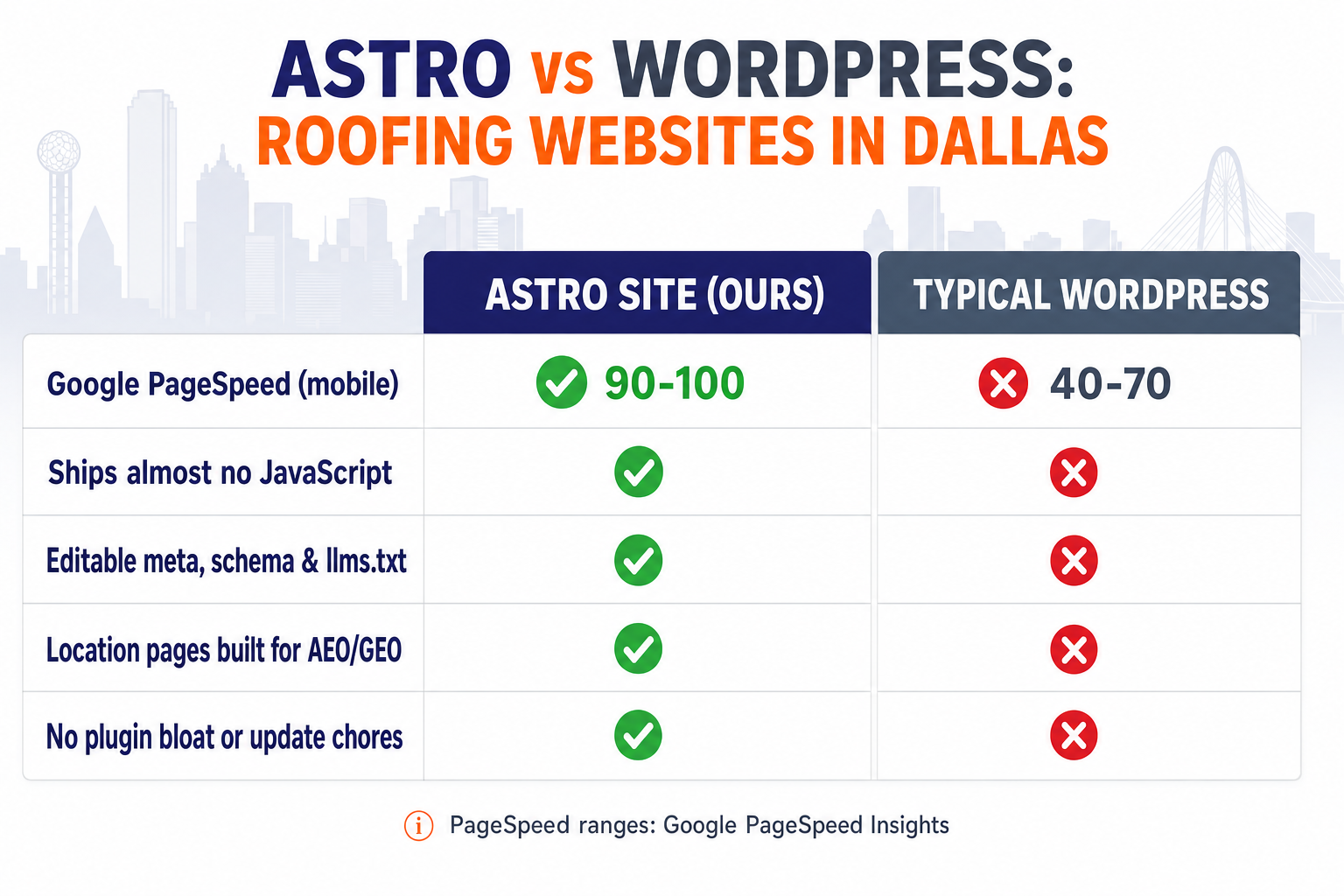
- Astro ships almost no JavaScript by default and serves static pages from the edge, which is why our roofing sites hit a guaranteed 90+ Google PageSpeed — where a typical plugin-heavy WordPress site often lands at 40–70 on mobile.
- WordPress powers ~43% of all websites (W3Techs, 2026) and is enormously flexible — but that flexibility is exactly what makes most roofing WordPress sites slow, bloated, and a chore to keep updated and secure.
Table of contents
- Astro vs WordPress for roofing websites: the short answer
- Why site speed decides who signs the storm roof in Dallas
- What Google actually measures: Core Web Vitals
- Astro vs WordPress, feature by feature
- The conversion math: what a faster site is worth
- SEO, AEO & GEO: how a fast site wins Dallas search
- When WordPress still makes sense
- What a done-for-you Astro roofing site includes
- FAQ
Astro vs WordPress for roofing websites: the short answer
For a Dallas roofing company, an Astro-built website is the better choice because it is dramatically faster on mobile, passes Google’s Core Web Vitals more easily, and is built lean for local and AI search — while WordPress, though far more common and flexible, tends to become slow, plugin-heavy, and high-maintenance for a service business that just needs the phone to ring.
Astro is a modern web framework that ships static-first HTML with almost no JavaScript unless a page truly needs it (its “islands” architecture). WordPress is a content-management system that renders pages through a theme, usually a page-builder, and a stack of plugins — every one of which can add scripts, database queries, and load time. For a blog with dozens of editors, WordPress’s flexibility is a feature. For a roofing site whose whole job is to load instantly and book an inspection, that flexibility is mostly overhead.
The rest of this article backs that up with numbers — and the numbers all point the same way: on a phone, in a Texas hailstorm, speed is the difference between the call and the bounce.
Why site speed decides who signs the storm roof in Dallas
Dallas–Fort Worth sits in the heart of the country’s worst hail country. Texas consistently leads the nation in major hail events (Insurance Information Institute, 2025), which means every spring your website gets hit with a surge of homeowners searching, comparing, and calling — almost all of them on mobile, almost all of them impatient.
Here’s what the data says about that impatience. Google’s research with SOASTA found that as a mobile page’s load time grows, the probability that the visitor bounces climbs fast — and a small speed edge translates straight into conversions:
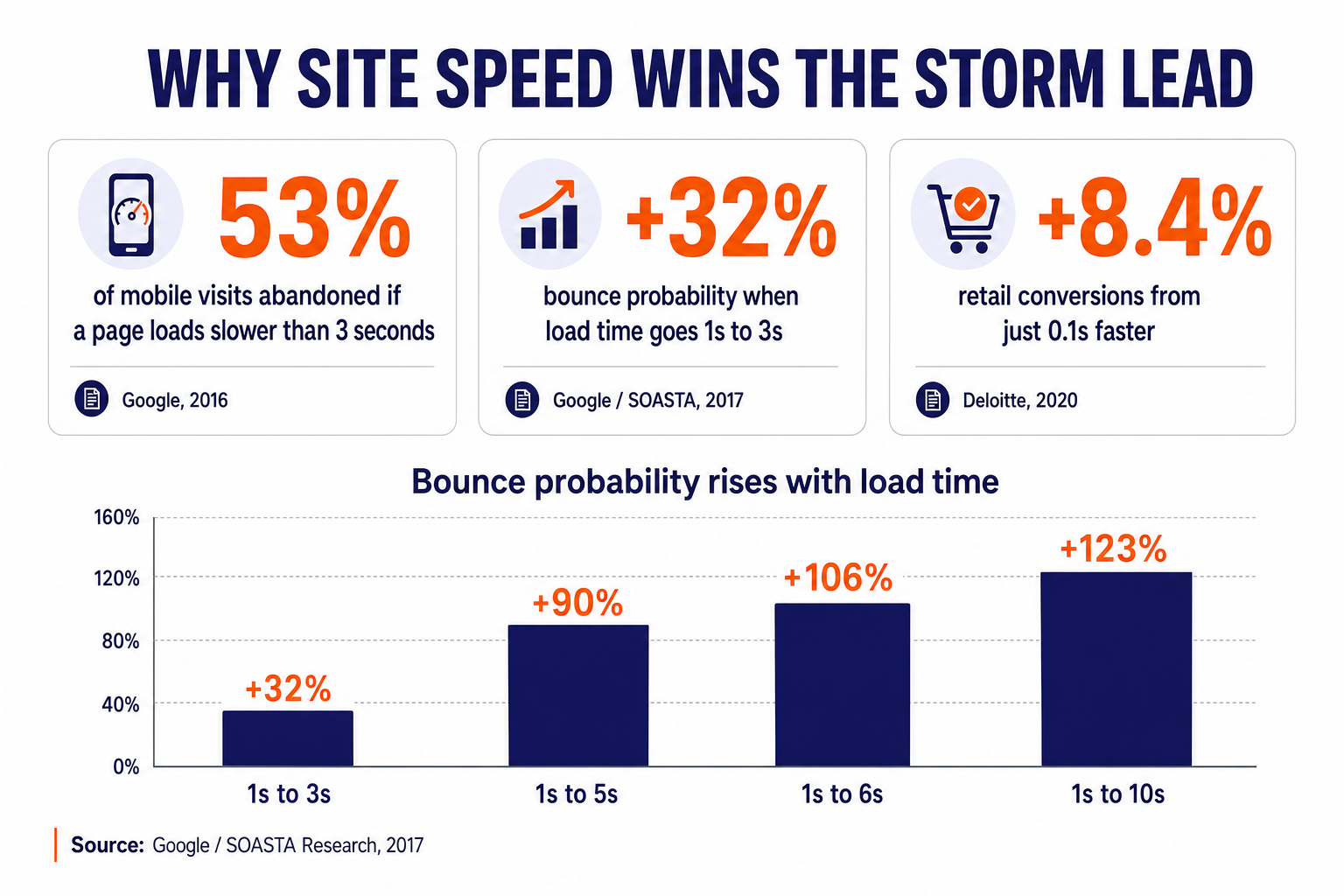
And the bluntest number of all: 53% of mobile site visits are abandoned if a page takes longer than 3 seconds to load (Google, via Marketing Dive, 2016). Half your storm traffic, gone, before your homepage even finishes drawing.
This is where architecture matters. A typical WordPress roofing site loads a theme, a page-builder (Elementor, Divi, WPBakery), a slider plugin, a forms plugin, an SEO plugin, analytics, and a chat widget — each adding JavaScript and requests. An Astro site ships the HTML for the page and little else, served from a global edge network. That’s not a small tuning difference; it’s the difference between a site that opens in under a second and one that’s still assembling itself while the homeowner taps “back.”
What Google actually measures: Core Web Vitals
“Page speed” isn’t a vibe — Google measures it with three specific metrics called Core Web Vitals, and it uses them as part of how it ranks pages. To land in the “good” bucket (measured at the 75th percentile of real visits), a page needs (Google / web.dev, 2024):
A note that trips up a lot of agencies: Interaction to Next Paint (INP) replaced First Input Delay (FID) as an official Core Web Vital on March 12, 2024 (web.dev, 2024). INP is stricter — it measures responsiveness across the whole visit, and it punishes exactly the thing WordPress page-builders pile on: heavy JavaScript that blocks the main thread when a homeowner taps your “Get a Free Inspection” button.
Because an Astro site ships almost no JavaScript, LCP and INP are easy to keep green — there’s simply less to download, parse, and execute. On a plugin-heavy WordPress site, hitting those thresholds on mobile usually takes ongoing caching, image-optimization, and script-deferral work — an endless tuning treadmill. Google confirms Core Web Vitals and page experience feed its ranking systems (Google Search Central, 2024), so this isn’t just about not losing visitors — it’s about whether you rank to get them at all.
Astro vs WordPress, feature by feature
Here’s the head-to-head on what matters for a roofing website specifically — not a general CMS bake-off, but the things that decide whether a Dallas homeowner’s search becomes an inspection on your calendar.
| What matters for a roofing site | Astro site (ours) | Typical WordPress site |
|---|---|---|
| Google PageSpeed (mobile) | 90–100 (we guarantee 90+) | Often 40–70 without dedicated tuning |
| JavaScript shipped by default | Almost none — static-first, islands only where needed | Theme + page-builder + plugin JS on nearly every page |
| Page-weight pressure | Lean, edge-served static HTML | Fights the trend of a 2.56 MB median mobile page¹ |
| Editable title / meta / schema | Structured per page, built in | Often locked behind an SEO plugin and theme options |
| Location & service pages for AEO/GEO | Built in and individually optimized | Manual, plugin-dependent, easy to get wrong |
| Hosting, SSL & maintenance | Managed Cloudflare, flat $97/mo | Hosting + SSL + plugin renewals, variable and recurring |
| Security surface | Static — no plugin or database attack surface | ~43% of the web² means a much bigger target |
| Time to change a page | Support ticket, most done within 24h | DIY plugin wrangling or a per-edit agency invoice |
¹ Median mobile web page weight, HTTP Archive Web Almanac 2025. ² W3Techs, 2026.
The pattern is consistent: WordPress can be made fast, secure, and SEO-clean — but only with continuous expert effort. Astro starts there by default. For a roofing company that would rather think about squares and supplements than caching plugins, “fast by default” is worth a lot.
The conversion math: what a faster site is worth
Speed doesn’t just keep visitors from bouncing — it directly moves your conversion rate. Deloitte’s “Milliseconds Make Millions” study measured 37 brands over four weeks and found that a mere 0.1-second improvement in mobile load time produced measurable jumps in revenue behavior:
Independent research from Portent points the same direction: analyzing millions of visits, they found that each additional second of load time (in the crucial 0–5 second range) drops the average conversion rate by about 4.42%, and a site that loads in one second converts roughly three times higher than one that loads in five (Portent, 2022).
Run that against roofing economics. If your site draws, say, 800 mobile visits a month from ads and local search, and a faster site converts even a few percentage points more of them into inspection requests, that’s several extra roofs a year off the same traffic — no additional ad spend. Fast pages are the highest-ROI thing on this list precisely because you already paid to get the click. And once the lead does come in, speed still matters: our take on that is in Roofing lead response time: why 5 minutes changes everything.
SEO, AEO & GEO: how a fast site wins Dallas search
Ranking in Dallas isn’t only about speed — but speed is the foundation everything else sits on. A fast, cleanly-structured Astro site makes three kinds of search work in your favor:
- Classic SEO. Google confirms page experience and Core Web Vitals are ranking inputs (Google Search Central, 2024). A fast site with a real page for each service and each service area gives Google clean, crawlable signals for “metal roof installer Plano” or “storm damage roof repair Dallas.” (The full local playbook is in Local SEO for roofing contractors.)
- AEO (Answer Engine Optimization). AI answer engines — Google’s AI Overviews, ChatGPT, Perplexity — pull from pages with clean structure and valid schema. An Astro site ships correct titles, meta, JSON-LD schema, and an
llms.txtfile so those engines can actually read and cite you. Most WordPress roofing sites never get anllms.txtat all. - GEO (Generative/Geographic). Individually-optimized location pages — Dallas, Fort Worth, Arlington, Plano, Frisco, McKinney — with local schema tell both Google and AI which neighborhoods you serve. This is the single biggest lever for a local roofer trying to win the map pack and AI answers after a storm.
The uncomfortable truth is that a slow, plugin-bloated site undermines all three. If Google is measuring your mobile experience and finding it poor, no amount of keyword stuffing fixes it. Fast, structured, location-aware pages are what rank — and what get quoted in AI answers.
When WordPress still makes sense
To be fair: WordPress is the most popular CMS on earth for good reasons, and it isn’t the wrong tool for everyone. It genuinely shines when you have a large in-house team publishing content daily, when you need a specific plugin ecosystem (complex membership, LMS, or e-commerce), or when you already have a developer on staff who keeps it fast and patched. Its flexibility is unmatched.
But for the typical roofing company, none of those conditions apply. You don’t have a full-time web developer. You publish a few pages a year, not a few a day. You don’t need a membership portal — you need a phone that rings during hail season. In that reality, WordPress’s flexibility mostly shows up as slowness, plugin-update chores, and surprise invoices, while its strengths go unused. The right tool is the one that’s fast by default and off your plate. For most roofers, that’s Astro.
What a done-for-you Astro roofing site includes
This is the part where “Astro is faster” becomes something you can actually buy. Our Get a Website service builds your roofing company a blazing-fast Astro site — a guaranteed 90+ Google PageSpeed score, up to 60 pages, individually-optimized location pages, schema/AEO/GEO baked in, an AI chat widget that books inspections 24/7, and review-collection automation — for $497 one-time + $97/month (which covers a free domain, managed Cloudflare hosting, SSL, and ongoing updates, with no per-edit agency fees). Here’s how the build works:
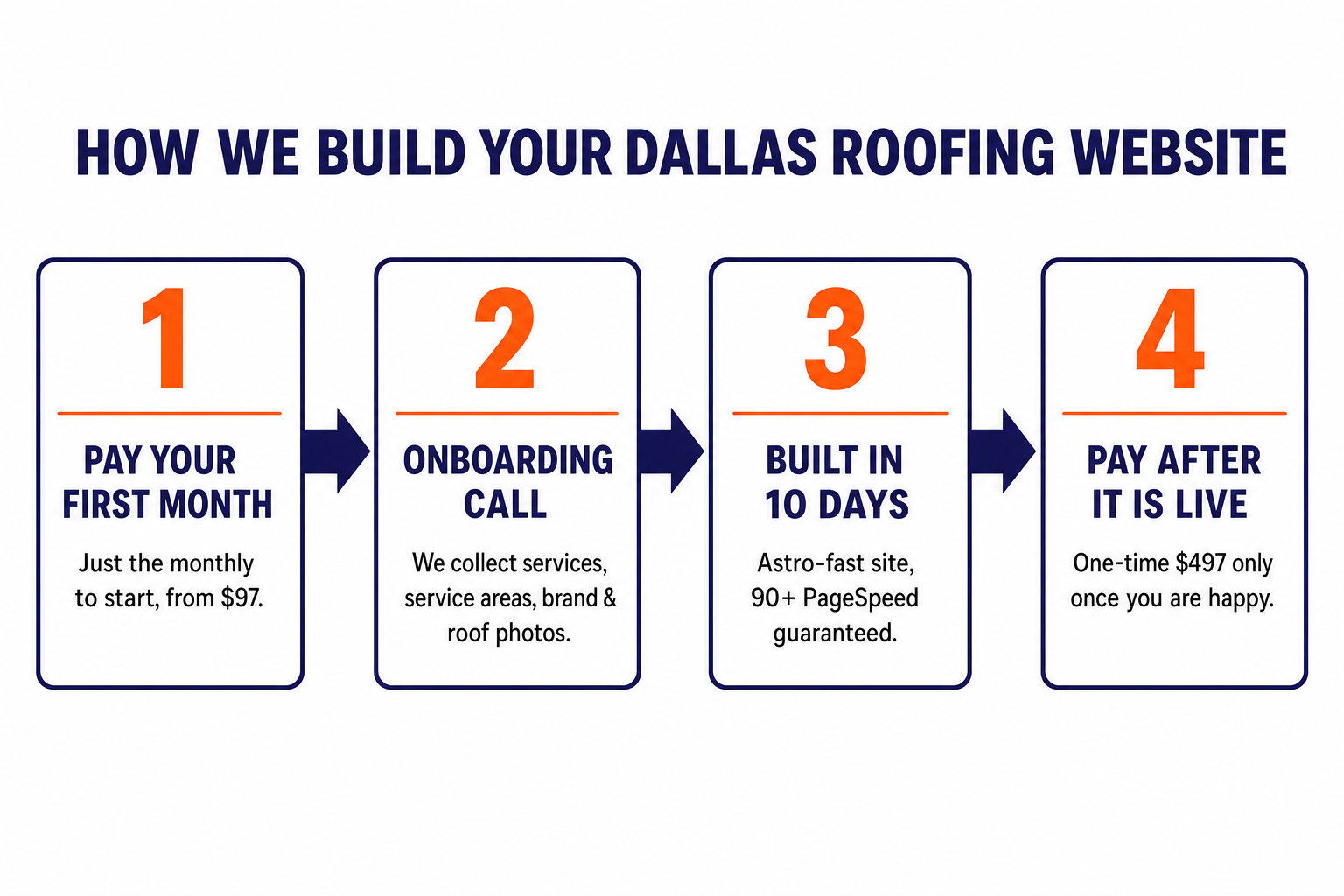
You start by paying only the first monthly invoice; the one-time build fee isn’t charged until after the site is live and you’re happy. It’s the reverse of the usual “big deposit, then wait” agency deal — because when the site is fast and it’s booking inspections, the value is obvious.
And if your priority right now is booking more of the visitors you already get, pair the site with an AI chat widget that qualifies homeowners and books inspections around the clock — no missed leads at 11 p.m. during a storm.
Frequently asked questions: Astro vs WordPress for roofers
Is an Astro website really faster than WordPress for a roofing company?
In the overwhelming majority of real-world cases, yes. Astro ships static-first HTML with almost no JavaScript and serves it from a global edge network, so it typically scores 90–100 on Google PageSpeed. A typical roofing WordPress site loads a theme, a page-builder, and a stack of plugins on every page, which commonly lands it at 40–70 on mobile without ongoing expert tuning. A skilled developer can make WordPress fast, but it takes continuous effort that Astro doesn't require.
Does website speed actually affect how many roofing jobs I get?
Directly. Google found 53% of mobile visits are abandoned if a page takes over 3 seconds to load, and Deloitte measured an 8.4% lift in retail conversions from just a 0.1-second speed improvement. For a roofer, faster pages mean more of your existing ad and search traffic turns into booked inspections — extra jobs with zero extra ad spend.
What are Core Web Vitals and why do they matter for my roofing site?
Core Web Vitals are Google's three page-experience metrics: Largest Contentful Paint (should be ≤ 2.5s), Interaction to Next Paint (≤ 200ms, which replaced First Input Delay in March 2024), and Cumulative Layout Shift (≤ 0.1). Google uses them as ranking inputs, so a site that fails them on mobile is harder to rank. Lean Astro sites pass them easily; heavy WordPress sites often struggle.
Can I still edit my website if it's built on Astro instead of WordPress?
Yes. With our Get a Website service you open a support ticket for any change — a new service page, a seasonal storm banner, updated content — and our team handles it, most within 24 hours. You never wrestle with plugins or a page-builder. Leads still flow into your CRM, and you get your own login to see every booked inspection.
How much does a fast Astro roofing website cost?
Our Get a Website plan is $497 one-time plus $97/month. The monthly covers a free domain, managed Cloudflare hosting, SSL, and ongoing updates — no hosting fees, no SSL fees, no per-edit agency invoices. You only pay the one-time build fee after the site is live and you're satisfied. Add automatic blogging for $197/month total, or ask about the multi-brand bulk plan.
Will a new website help me rank in Dallas after a hailstorm?
It's the foundation. Fast, cleanly-structured pages with a dedicated page per service and per city — Dallas, Fort Worth, Plano, Frisco — plus proper schema and an llms.txt file give both Google and AI answer engines what they need to surface you. Ranking takes a few months, but a slow, bloated site actively works against you; a fast, structured one works for you.
The bottom line
For a Dallas roofing company, the Astro-vs-WordPress decision comes down to one question: do you want a website that’s fast, structured, and off your plate by default — or one that’s endlessly flexible but needs constant care to stay fast and secure? The data is one-sided on what your customers do. A homeowner comparing roofers on their phone during hail season abandons a slow site in three seconds, and every extra second of load time compounds the loss — in bounces, in lost conversions, and in rankings you never earn.
WordPress isn’t bad. It’s just the wrong default for a service business whose website has exactly one job: load instantly and book the inspection. Astro does that job by default. If you want that speed without becoming a part-time webmaster, we’ll build it for you — and you only pay the build fee once it’s live and winning you jobs.
About the author
Marcus Ellison runs a small GoHighLevel agency on Florida’s Gulf Coast that productizes roofing snapshots and websites for contractors across hurricane and hail country. He thinks like an operator first and a marketer second — fast sites that rank, Google profiles that win the map pack, and automation that turns storm traffic into signed roofs. He writes for both the agency owner reselling GHL and the roofer who just wants the phone to ring. Have a question about your roofing website? Talk to a real person.