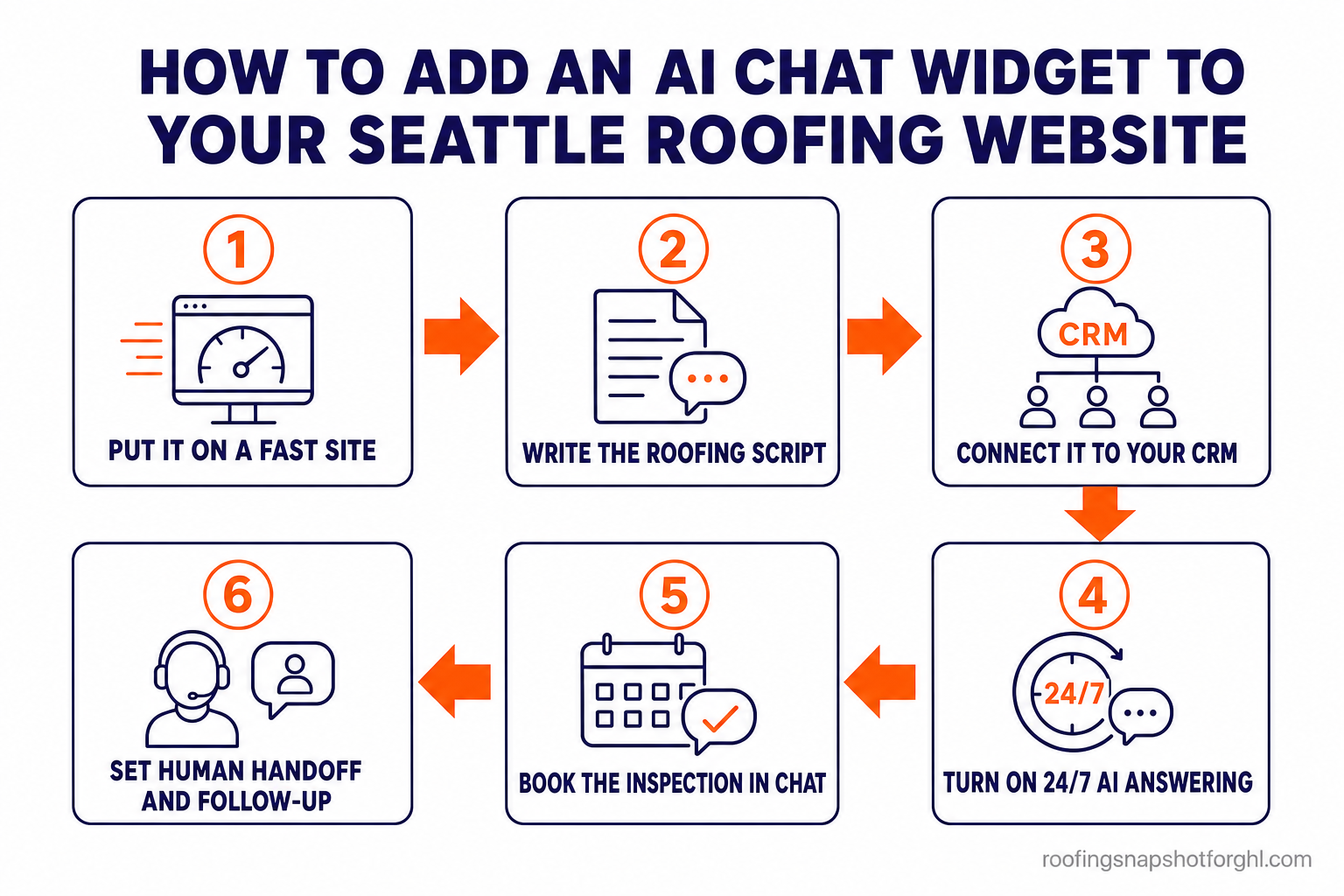
How do you add an AI chat widget to your Seattle roofing website? In six steps: put the widget on a fast website, write a roofing-specific qualification script, connect it to your CRM so every chat becomes a contact, turn on 24/7 AI answering, let it book the inspection inside the chat, then set a human-handoff rule for hot leads. Done right, a homeowner who messages your site at 11 PM after a windstorm gets an instant, useful reply, answers a few questions, and lands on your calendar — before your competitor’s contact form has even emailed anyone back.
This guide is written for the Seattle roofing owner who already has a website (or is about to build one) and keeps losing after-hours and rainy-season leads to slow follow-up. It’s also for the GoHighLevel agency deciding what to wire up for roofing clients. Every number below is tied to a real, cited source — no “78% of customers buy from the first responder” folklore, because that stat has no verifiable origin. The research that does hold up tells the same story, and it’s more convincing.
Key Takeaways
- Responding to a web lead in 5 minutes instead of 30 makes you ~100× more likely to reach that lead and 21× more likely to qualify them (Lead Response Management Study, Oldroyd / InsideSales, 2007). An AI chat widget replies in seconds, every time.
- Most companies are painfully slow: across 2,241 U.S. companies audited, 23% never responded to a web lead at all, and the average response time was 42 hours (Harvard Business Review, 2011). Speed is a wide-open gap in most Seattle roofing markets.
- 42% of consumers expect an immediate response from a chatbot, and 24-hour service is the single feature people rate highest about them (Drift + SurveyMonkey, State of Conversational Marketing, 2019).
- Seattle gets rain on roughly 150 days a year (NOAA / NWS Seattle) and periodic damaging windstorms — the November 2024 bomb cyclone knocked out power to ~650,000 western Washington customers (KOMO News, 2024) — so roof-leak searches spike at the worst possible hours.
- A chat widget is only as good as what it’s wired into. Connected to GoHighLevel, every conversation becomes a tracked contact, a pipeline stage, and a booked inspection — not a lost DM.
Table of contents
- The short answer for Seattle roofers
- Why a Seattle roofing website needs an AI chat widget
- AI chat widget vs. live chat vs. a contact form
- How to add an AI chat widget: the 6 steps
- Mistakes that make a roofing chat widget useless
- What it costs and who should build it
- FAQ
The short answer for Seattle roofers
Add the widget to a fast website, give it a roofing-specific script, and connect it to your CRM — that combination is what turns a late-night message into a booked inspection. The AI part matters, but the wiring matters more. A clever bot that dumps leads into an inbox nobody checks is worse than no bot at all; a plain one that instantly qualifies a homeowner and drops them onto your calendar will out-earn a fancier competitor every storm.
Here’s why speed is the whole game. The most rigorous study on lead response — three years of data, more than 15,000 leads and 100,000 call attempts — found that reaching out within five minutes instead of thirty made a business about 100× more likely to make contact and 21× more likely to qualify the lead (Lead Response Management Study, 2007).
Advantage of responding to a web lead in 5 minutes vs. 30 minutes (multiplier). Source: Lead Response Management Study, Oldroyd / InsideSales, 2007.
No human roofing team can hit five minutes at 11 PM on a Saturday during a windstorm. An AI chat widget hits five seconds, every time, forever. That’s the entire pitch.
Why a Seattle roofing website needs an AI chat widget
Seattle is a roofing market defined by water. The region sees measurable precipitation on roughly 150 days a year and averages around 37 inches of rain annually (NOAA / NWS Seattle). Constant damp drives the moss, algae, and slow leaks that send homeowners searching for a roofer — and it does it year-round, not just in one hail season.
Then come the storms. The November 2024 “bomb cyclone” left roughly 650,000 western Washington customers without power (KOMO News, 2024) — the largest regional outage since the 2006 Hanukkah Eve Windstorm, which cut power to about 1.8 million and was blamed for 18 deaths (HistoryLink). Every one of those events dumps a surge of leaking-roof searches into your website at night, on weekends, in the middle of the chaos — exactly when no one is sitting at the office phone.
The problem isn’t demand — it’s what happens to demand after hours. And the data on how businesses actually handle inbound leads is bleak. When researchers audited 2,241 U.S. companies, only 37% responded to a web lead within an hour, 23% never responded at all, and the average response time was 42 hours (Harvard Business Review, 2011).
How fast 2,241 U.S. companies responded to inbound web leads (share of companies, %). Source: Harvard Business Review, “The Short Life of Online Sales Leads,” 2011.
That gap is your opportunity. In most Seattle neighborhoods, the roofer who simply answers first — instantly, at any hour — wins a disproportionate share of storm and leak jobs. An AI chat widget is the cheapest way to be that roofer, because it never sleeps, never takes a lunch, and never lets a 2 AM leak message rot in an inbox until Monday.
AI chat widget vs. live chat vs. a contact form
Three tools claim to “capture leads on your website.” They are not the same thing, and the difference decides whether a Seattle homeowner books or bounces.
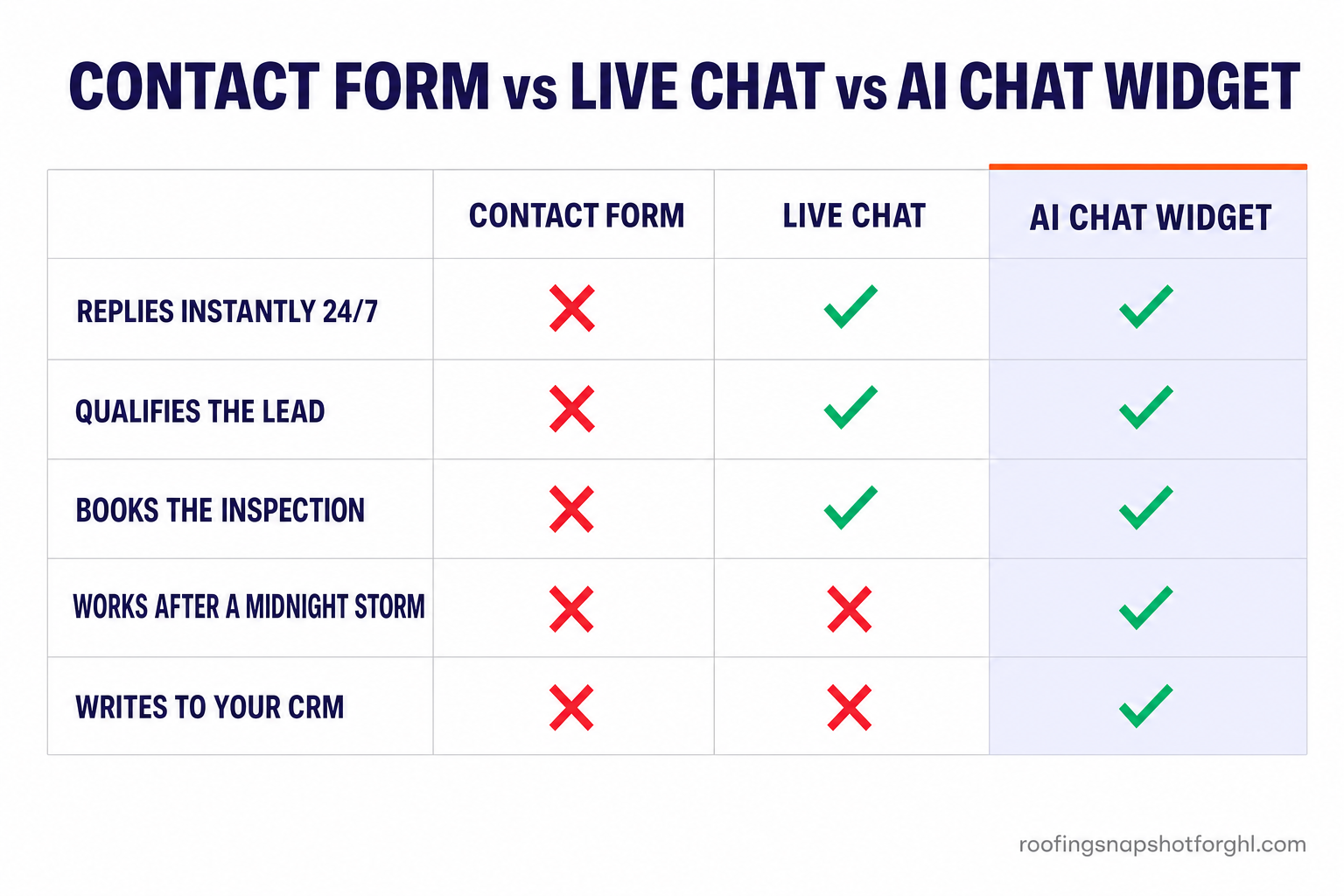
- A contact form is a mailbox with extra steps. The homeowner types their problem, hits submit, and hopes. Nothing happens instantly; the lead sits until a human opens the inbox — which, per the HBR audit above, averages 42 hours. After a midnight storm, that’s a dead lead.
- Live chat is only as available as the person behind it. During Seattle business hours with someone watching the dashboard, it’s great. At 11 PM during a bomb cyclone — when the leaking-roof messages actually arrive — it’s an “we’re offline, leave a message” box, which is just a slower contact form.
- An AI chat widget replies in seconds, 24/7, using a script you control. It asks roofing questions, qualifies the homeowner, books the inspection, and writes everything to your CRM — then hands off to a human when the situation calls for one.
That last part is why the AI approach converts. 42% of consumers expect an immediate response from a chatbot, and the feature people rate most valuable about them is 24-hour service (Drift + SurveyMonkey, 2019). Only 14% of people said they’d rather fill out a form than talk to a chatbot. Homeowners want the instant conversation — most roofing sites just don’t offer one.
How to add an AI chat widget: the 6 steps
Here’s the build, in the order that actually matters. You can do this yourself inside GoHighLevel, or have it done for you — either way, the sequence is the same.
Step 1 — Put the widget on a fast website
A chat widget adds JavaScript to your site. If it’s bolted onto a slow, plugin-heavy page, the widget shows up late — sometimes after the impatient homeowner has already tapped “back.” Start from a fast foundation: a lean, statically-served site that paints in about a second on a phone, so the chat bubble is there the instant the page is. If your current site crawls on mobile, fix that first — it’s covered in Astro vs WordPress for roofing websites, and it’s exactly what our done-for-you roofing websites are built to solve.
Step 2 — Write the roofing qualification script
A generic “How can I help you?” bot wastes the conversation. Script it like your best intake rep. For a Seattle roofer, the questions that qualify a lead are: What’s going on with the roof — leak, storm damage, moss, age? What’s your ZIP code (so it can confirm you serve that area)? How old is the roof? Is this an insurance claim or out of pocket? How urgent is it — active leak or planning ahead? Those five answers tell you whether this is a same-week inspection or a spring nurture — before a human spends a minute on it.
Step 3 — Connect it to your CRM (GoHighLevel)
This is the step that separates a lead-generating widget from a novelty. Every chat should create a contact record, drop the person into the right pipeline stage, and tag them by damage type and urgency — automatically. Wired into GoHighLevel, the conversation isn’t a disposable chat log; it’s a tracked lead your follow-up automations can work for weeks. A widget that writes to nothing is just a fancier way to lose leads.
Step 4 — Turn on 24/7 AI answering
Switch the widget from “collect a message” to “hold a real conversation, any hour.” This is the whole point: the AI answers instantly at 2 AM during a windstorm, runs the qualification script, and keeps the homeowner engaged instead of sending them back to Google to message the next roofer. Given that the average company takes 42 hours to reply, instant and always-on is a genuine competitive weapon in the Seattle market.
Step 5 — Book the inspection inside the chat
Don’t make a qualified homeowner wait for a callback to schedule. The widget should check your live calendar, offer real inspection slots, book the appointment, and send a confirmation — all inside the chat. The gap between “interested” and “booked” is where most roofing leads die; closing it in the same conversation is how you convert the midnight-storm searcher into a Tuesday-morning inspection.
Step 6 — Set human handoff and follow-up
The AI handles the first mile; you decide when a human takes over. Set rules: a hot lead — active leak, storm damage, insurance claim — pings your closer’s phone immediately for a live handoff. Everyone else drops into an automated follow-up sequence (SMS + email) so no lead goes cold. Homeowners can always type “talk to a person” and get a clean transfer. This is the same speed-to-lead logic behind never missing a storm call — the widget just extends it to text.
Mistakes that make a roofing chat widget useless
- It’s not connected to a CRM. The single most common failure. Chats land in an inbox nobody watches and the “automation” quietly loses leads. Wire it to GoHighLevel (step 3) or don’t bother.
- It only works during business hours. If your “AI” goes to an offline message at night, you’ve built a contact form and lost the after-storm surge that makes Seattle roofing seasonal.
- The script is generic. A bot that can’t tell a leak from a full replacement can’t qualify anyone. Roofing questions, roofing decision tree.
- No human escape hatch. Some homeowners — especially older ones with an emergency — want a person now. No visible “talk to someone” path means a frustrated lead and a bad review.
- It’s stapled to a slow site. If the widget loads five seconds late, the fast-bounce visitor never sees it. Speed first, then chat.
What it costs and who should build it
You have three realistic paths. DIY inside GoHighLevel: the platform includes a conversation AI and web-chat widget, so a hands-on owner can wire a basic version themselves — real work, but doable. Hire it out to a GHL specialist: a GoHighLevel VA or agency configures the script, CRM connection, and booking flow for you. Get a custom build: a fully branded AI agent trained on your process, with live calendar booking and deep GHL integration, built as part of a snapshot or a custom GHL development engagement.
For most Seattle roofers, the fastest payback is a done-for-you build wired into the same CRM that already runs your speed-to-lead SMS, claim tracking, and review requests — one system, not a pile of disconnected tools. Given that reaching a lead five minutes faster can make you 21× more likely to qualify it, a widget that answers instantly and books automatically tends to pay for itself inside a single storm week.
Frequently asked questions
AI chat widgets for Seattle roofing websites
What is an AI chat widget for a roofing website?
It's a chat bubble on your website powered by conversational AI. Instead of just collecting a message like a contact form, it holds a real conversation 24/7 — asking roofing-specific questions (leak vs. storm damage, roof age, insurance status, ZIP code, urgency), qualifying the homeowner, booking an inspection on your calendar, and writing the whole conversation to your CRM as a tracked lead.
How is it different from live chat?
Live chat needs a human watching the dashboard, so it's only available when someone's online — which usually isn't 11 PM during a windstorm, exactly when leaking-roof messages arrive. An AI chat widget replies instantly at any hour, then hands off to a human for hot leads. Since 42% of consumers expect an immediate chatbot response and rate 24-hour service as the top benefit (Drift, 2019), always-on wins.
Why does response speed matter so much for roofing leads?
Because homeowners message several roofers at once and go with whoever answers first. The Lead Response Management Study found that responding in 5 minutes instead of 30 made a business ~100× more likely to reach the lead and 21× more likely to qualify them (2007). An AI widget replies in seconds, so it beats slower competitors on the metric that decides the deal.
Do I need GoHighLevel to run an AI chat widget?
No, but it's the easiest path if you want the widget to actually generate revenue rather than just chat. GoHighLevel includes conversation AI and a web-chat widget, and connecting the widget to GHL means every conversation becomes a contact, a pipeline stage, and a booked appointment your follow-up automations can work — instead of a disposable chat log.
Is a chat widget worth it for a Seattle roofer specifically?
Seattle's ~150 rainy days a year and periodic damaging windstorms (like the November 2024 bomb cyclone that left ~650,000 without power) drive constant, often after-hours, roof-leak and storm-damage searches. A 24/7 AI widget captures that demand when your office is closed — which is when a lot of it happens.
Can it slow down my website?
A poorly built widget on an already-slow site can hurt load time, and a late-loading chat bubble misses fast-bouncing mobile visitors. The fix is to run it on a fast, lean site so the widget appears the instant the page does. Start from a quick foundation, then add chat — not the other way around.
About the author — Dale Rourke. Dale spent eleven years running crews and the sales board for a storm-restoration outfit in Tornado Alley before moving full-time into GoHighLevel automation. He has lived the 2 a.m. hail-event scramble, the deductible conversation on a homeowner’s porch, and the chaos of a 300-lead week — and he builds snapshots that tame exactly that. He writes about speed-to-lead, storm-chase capture, and the workflows that decide who signs the roof first.
Related posts
- How much does a roofing lead cost? — what you’re really paying to get the click a chat widget protects.
- Roofing lead response time: the speed that wins jobs — the data behind answering first.
- Never miss a storm call — the same speed-to-lead logic, applied to phones.
- The roofing chatbot playbook — why homeowners chat before they call.
- Astro vs WordPress for roofing websites — get the fast foundation your widget needs.