
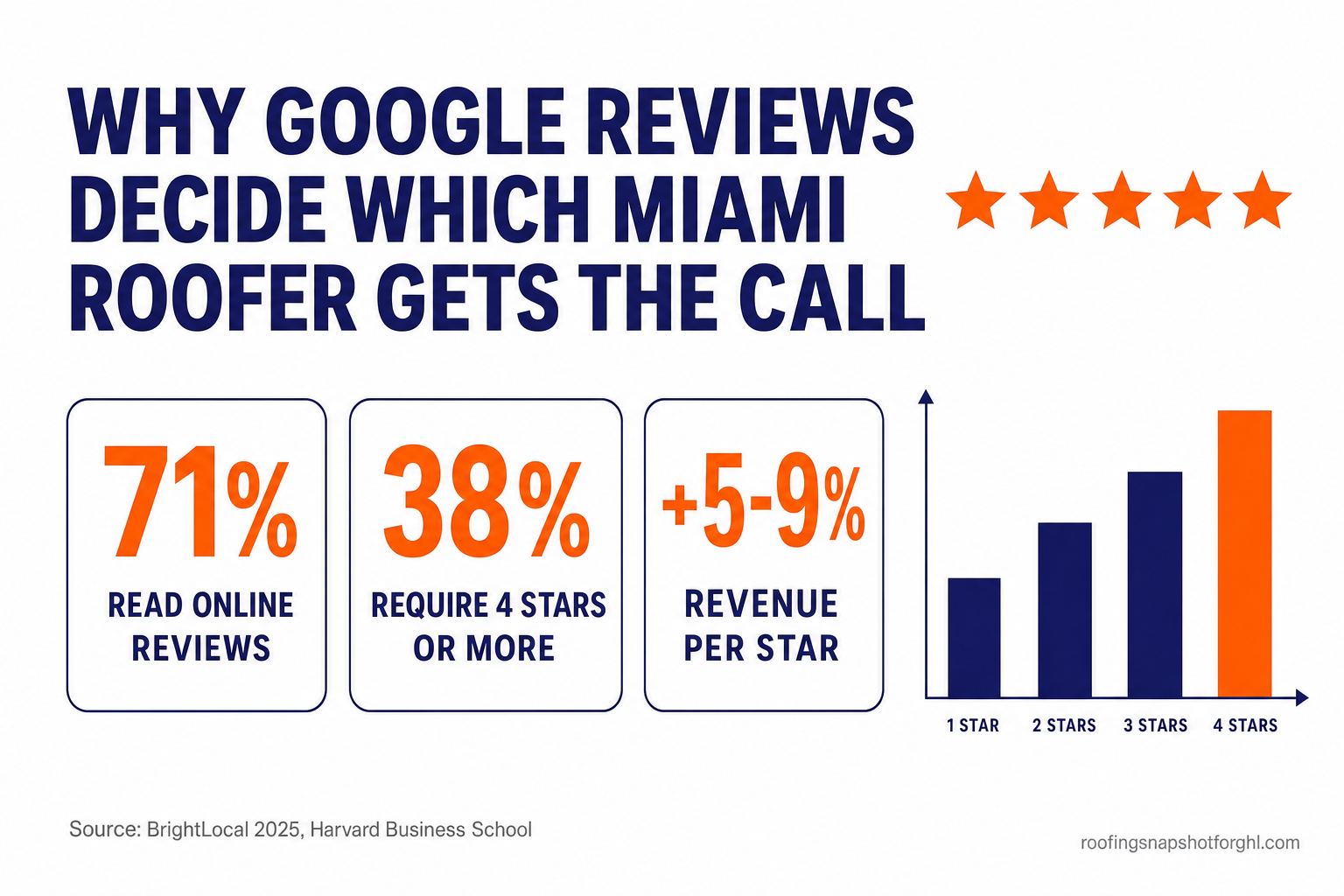
How does a Miami homeowner actually choose a roofer after a storm? Long before they call anyone, they open Google, read the reviews, and rule out every roofer who doesn’t have enough recent 5-star proof. Roughly 71% of consumers read online reviews regularly when browsing local businesses, and 83% use Google to do it (BrightLocal 2025). In a market with hundreds of roofing companies competing for the same wind-damage and re-roof jobs, your review profile is your first sales pitch — and if it’s thin, stale, or below four stars, you’re eliminated before the phone ever rings.
This is an informational guide for Miami roofing owners and the GHL agencies serving them. It covers the 2026 data on why reviews decide the job, what Miami’s insurance-and-storm reality does to that math, and how automated review harvesting turns every completed roof into fresh, ranked, 5-star social proof — without you or your crew ever having to remember to ask.
Key Takeaways
- 71% of consumers read online reviews regularly and 83% read them on Google (BrightLocal 2025) — your Google profile is the shortlist, and roofers who aren’t on it don’t get called.
- 38% of consumers say a business needs at least a 4-star average to be trustworthy (BrightLocal 2025) — one string of unanswered 1-stars can quietly cost you a season of storm leads.
- A one-star increase in rating lifts revenue by 5–9% (Harvard Business School / Luca) — reviews aren’t vanity, they’re a revenue lever with a measured dollar value.
- 74% of consumers prioritize reviews from the last three months (BrightLocal 2025) — a wall of great reviews from two years ago reads as a business that’s slowing down. Freshness is the whole game.
- Most roofers know they should ask for reviews and still don’t do it consistently. That discipline problem is exactly what automated review harvesting — built into the Roofing Snapshot — is designed to remove.
Table of contents
- The short answer for Miami roofers
- Why reviews decide the job before you do
- What one star is actually worth
- The Miami problem: storm demand meets a review gap
- Why most roofers never ask (and what it costs)
- How review harvesting automation works
- What homeowners actually weigh in a review
- How reviews plug into the rest of your pipeline
- FAQ
The short answer for Miami roofers
In Miami, the roofer who signs the job is rarely the one who’s best on the roof — it’s the one the homeowner trusts fastest. And trust, for a stranger spending five figures on a re-roof, is manufactured almost entirely by your Google reviews: how many you have, what they average, how recent they are, and whether you bothered to respond. The winning move isn’t to hope happy customers remember to write one. It’s to make the review request an automatic, timed step in every single job — so no earned review ever slips away.
That’s the entire idea behind review harvesting. The moment a job hits “complete” in your CRM, the homeowner gets a short, friendly text while the new roof is still the best thing that happened to them all month. If they’re thrilled, they’re handed a one-tap Google review link. If something’s off, that feedback routes privately to you before it becomes a public 1-star. You capture the good, catch the bad, and do it on every job without relying on anyone’s memory.
Why reviews decide the job before you do
Here’s the sequence almost every Miami homeowner runs after a hailstorm or a hurricane band peels back some shingles: search “roofer near me” or “roof repair Miami,” look at the map pack, and scan the star ratings and review counts. The ones who clear the bar get a click. The ones who don’t get skipped — silently, permanently, and without ever knowing it happened.
The data backs up how load-bearing that step is. 71% of consumers read online reviews regularly as they browse for local businesses, and among the platforms they use, 83% read those reviews on Google — far ahead of Yelp (44%), Facebook (40%), or YouTube (34%) (BrightLocal 2025). For a roofer, that means your Google Business Profile isn’t one marketing channel among many; it’s the storefront where the buying decision actually gets made.
Where consumers read reviews for local businesses (% of consumers using each platform). Google dominates. Source: BrightLocal Local Consumer Review Survey, 2025.
And this behavior converts fast. 78% of local mobile searches result in an offline purchase within 24 hours (OnTheMap, 2025). A homeowner searching “roof leak repair Miami” on their phone is not doing idle research — they have water coming through the ceiling and they’re picking someone today. Your reviews are the deciding factor in a decision that’s already in motion.
What one star is actually worth
If reviews still feel like a “soft” metric, the most-cited study in the field puts a hard number on them. Harvard Business School’s Michael Luca analyzed rating data against actual revenue and found that a one-star increase in a business’s rating leads to a 5–9% increase in revenue (Harvard Business School / Luca). Crucially, the effect was strongest for independent businesses — exactly the position most local roofers are in against national brands.
Run that through a roofing P&L. If your company does $2M a year and sits at 3.9 stars, pushing to a solid 4.5 isn’t a feel-good exercise — it’s plausibly a six-figure swing in revenue, from the same crews doing the same work. The roof doesn’t change. The number of homeowners willing to trust you with it does.
There’s a threshold effect too. 38% of consumers say a business must average at least 4 stars to be considered trustworthy (BrightLocal 2025). That’s the tripwire: dip below four stars and you don’t lose a percentage of leads, you lose a whole segment of homeowners who filter you out on sight. A couple of angry, unanswered reviews can drag your average under that line — which is why catching an unhappy customer before they post publicly is as valuable as earning a new 5-star.
The Miami problem: storm demand meets a review gap
Miami is one of the most demanding roofing markets in the country, and its particular reality makes reviews matter more, not less.
First, the demand is storm-driven and spiky. Hurricane season, tropical bands, and brutal summer sun-and-rain cycles push waves of homeowners into “I need a roofer now” mode all at once. When demand spikes, so does competition — and homeowners under stress lean even harder on reviews to sort a crowded field of contractors they’ve never heard of.
Second, Florida’s rules keep roofs in the buying cycle. Under the state’s building code and the 25%-rule framework (as revised by SB 4-D in 2022), significant damage on older roofs can trigger a full replacement, and insurers routinely scrutinize or decline coverage on roofs that are 15–20 years old (RoofingCalc). Miami-Dade’s High-Velocity Hurricane Zone standards add another layer, requiring specially approved materials and licensed, credible installers. Translation: there’s a constant, regulation-fed stream of homeowners who must re-roof — and they’re vetting who’s credible enough to do a code-critical job in hurricane country. Reviews are how they judge that credibility.
Third — and this is where most Miami roofers leave money on the table — storm-driven demand produces a review gap. After a big event, a crew might close 20 jobs in three weeks. In the chaos of tarps, supplements, and material orders, exactly zero of those 20 homeowners get asked for a review. Six months later, when the next storm sends the next wave to Google, your profile still shows the same handful of old reviews — and you look like you’ve been standing still while a competitor who automated the ask now has 40 fresh ones.
Why most roofers never ask (and what it costs)
Ask any roofing owner and they’ll tell you reviews matter. Ask how many they collected last month and the honest answer is usually “a couple, maybe.” The gap between knowing and doing is almost never about intent — it’s about discipline under load.
The crew finishes the roof, cleans up the nails, and drives to the next job. The office is chasing the adjuster, ordering material, and fielding three new storm calls. Asking for a review is the easiest thing in the world to skip, and it gets skipped on nearly every job. Three days later the homeowner has moved on; the moment of maximum gratitude — the day the leak stopped and the new roof went on — is gone and won’t come back.
That’s the real cost: not that you can’t get reviews, but that you’re earning them and letting them evaporate. Every happy customer you don’t ask is a 5-star review sitting on the table, a notch of trust your competitor will collect instead, and a small permanent tax on next season’s cost per lead. Do that across a storm season and the compounding is brutal — the roofer who asks every time pulls away, review by review, until their profile is simply the obvious choice.
Two ways to collect reviews after a storm
Crew forgets to ask; the office is buried in storm work. The ask happens days late, if at all — gratitude has faded. You get a few reviews a month, clustered and then stale, and unhappy customers post publicly before you ever hear about it. Your profile decays between storm waves, so recency drops right when the next surge arrives.
The request fires the moment the job is marked complete — asked same-day at peak goodwill, one tap to Google. You get a steady stream of fresh reviews on every job, unhappy replies route privately to you first, and your profile stays fresh through every storm cycle so you're always the credible choice.
How review harvesting automation works
Review harvesting removes the discipline problem by making the ask a workflow step instead of a human chore. Here’s the flow, start to finish:
- Job marked complete. When a job moves to “complete” in your GoHighLevel pipeline, it triggers the automation — no sticky note, no reminder, no reliance on a busy crew lead.
- The same-day text. The homeowner gets a short, friendly message in your company’s voice: “How’d we do on your roof?” Timing is deliberate — asked the day the crew packs up, while the new roof is still front-of-mind.
- Happy path → Google. If the homeowner responds positively, they’re handed a one-tap link straight to your Google review form. No hunting for your profile, no friction — the easier you make it, the more of them actually post.
- Unhappy path → private alert. If the feedback is negative, it routes privately to you instead of to the public internet, so you can call, fix it, and often turn a would-be 1-star into a save.
- Respond and rank. Responding matters on its own — 89% of consumers expect a business to respond to reviews, and consumers are meaningfully more likely to choose a business that replies to all of its reviews than one that ignores them (BrightLocal 2025). Automated review harvesting can pair with automated GBP replies so no review — good or bad — sits unanswered.
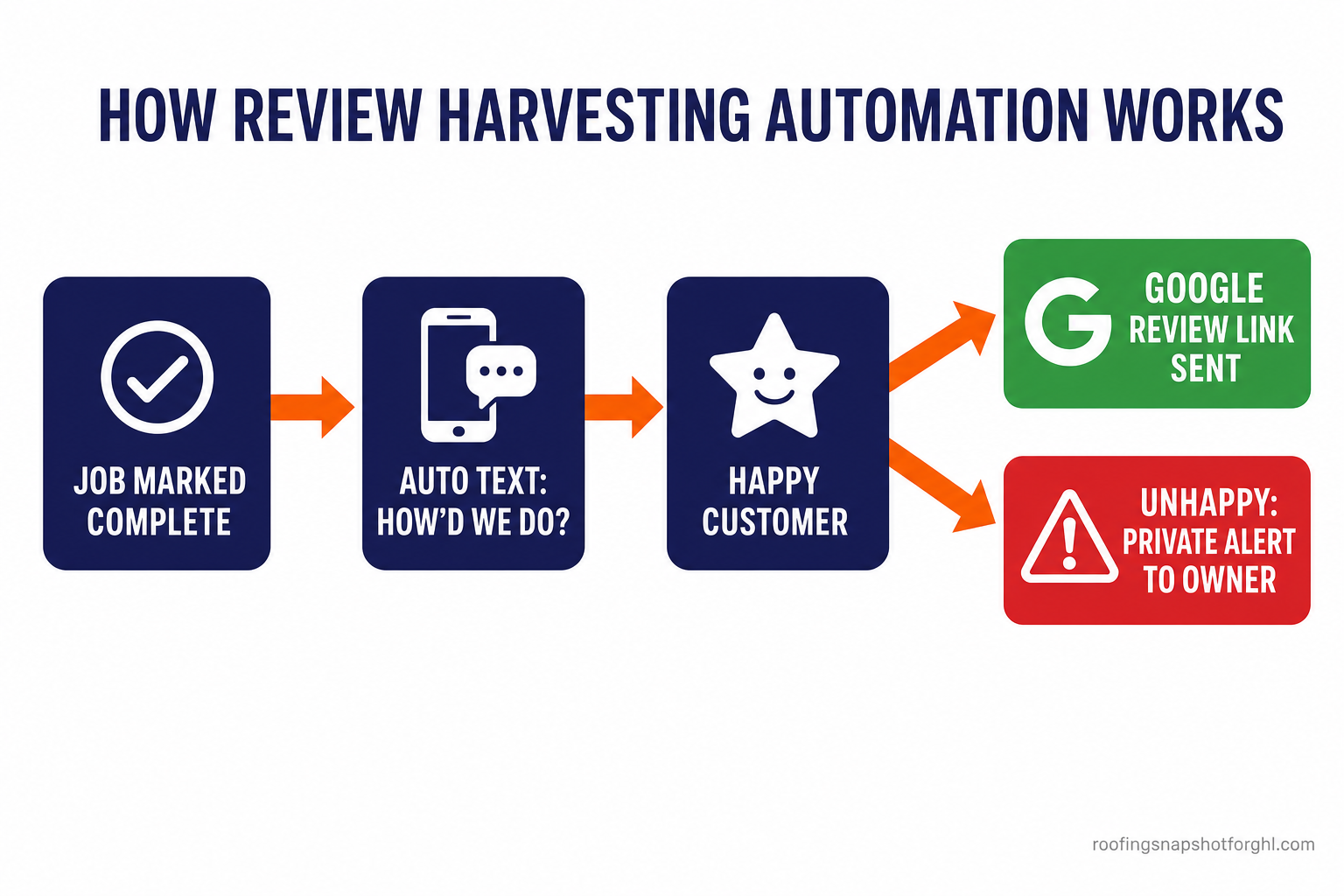
The net effect is simple: you stop hoping for reviews and start manufacturing them, predictably, on every job — while protecting your average by intercepting unhappy customers before they go public. This is a core piece of the Roofing Snapshot, which wires this workflow into a blank GoHighLevel account so it runs from day one.
What homeowners actually weigh in a review
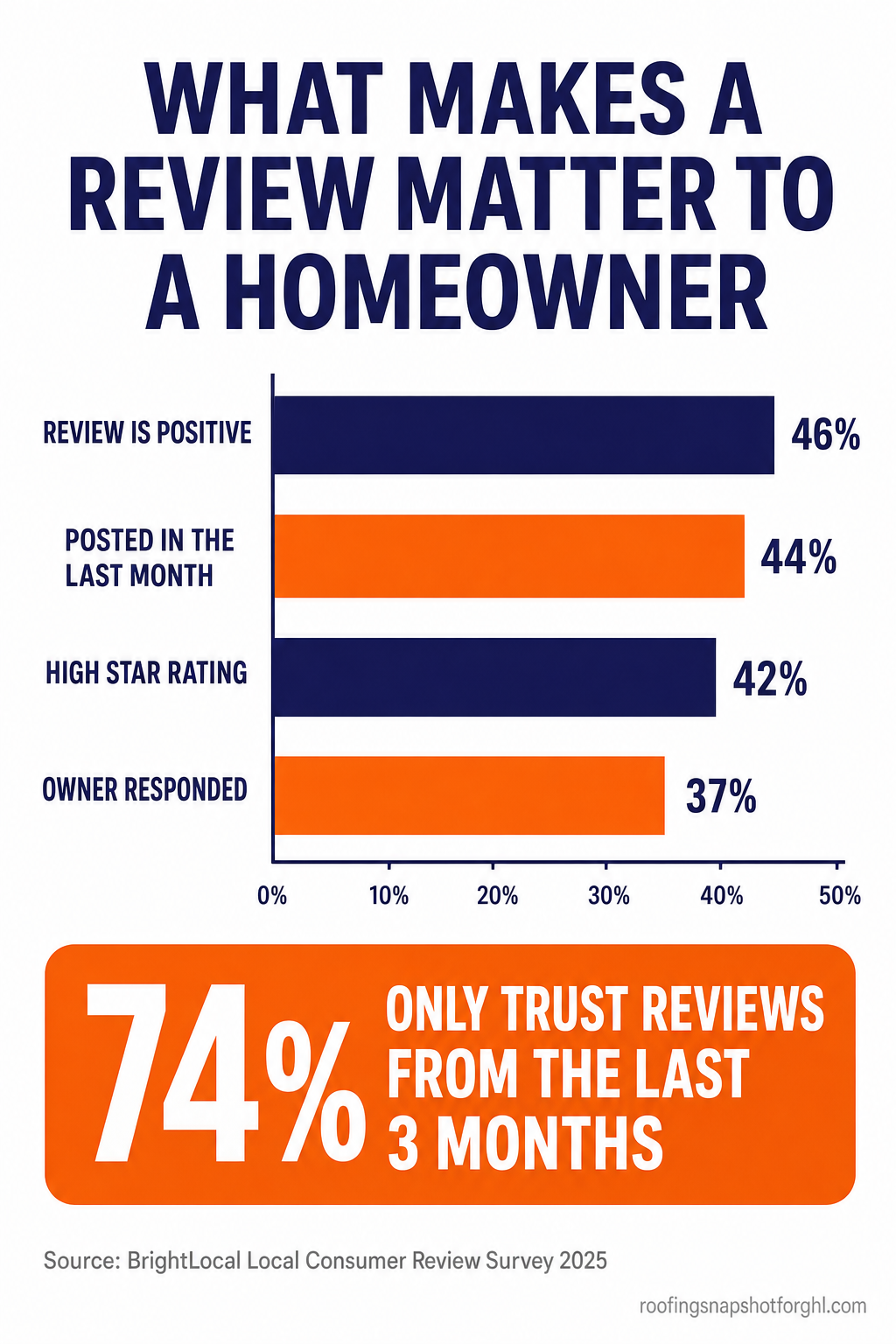
Not all reviews carry equal weight, and knowing what homeowners actually look at tells you what to optimize for. When BrightLocal asked which review factors matter most, the answers were clear: the review being positive (46%), posted in the last month (44%), carrying a high star rating (42%), and having an owner response (37%) (BrightLocal 2025).
Most important review factors to consumers (% ranking each as important). Source: BrightLocal Local Consumer Review Survey, 2025.
Read those four factors together and they describe exactly what a good review-harvesting system produces: a steady flow of recent, positive reviews that you respond to. That’s not luck — it’s the direct output of asking every customer, at the right moment, and closing the loop with a reply. The roofers who dominate Miami’s map pack aren’t getting lucky with reviews; they’ve made review generation a machine.
How reviews plug into the rest of your pipeline
Reviews don’t work in isolation — they’re the trust layer on top of everything else your CRM is already doing. A homeowner reads your reviews, then clicks to call or fills out a form; from there, speed-to-lead response time decides whether you actually book the inspection, and local SEO fundamentals decide whether you showed up in the map pack in the first place. Reviews feed the top of that funnel by getting you seen and shortlisted; the rest of the pipeline converts the trust into a signed job.
That’s why review harvesting isn’t a bolt-on tool — it’s one workflow inside a single connected system. When your reviews, your Google review responses, your speed-to-lead follow-up, and your pipeline all live in one GoHighLevel account, every earned review compounds: it lifts your ranking, converts the next searcher, and lowers what you pay for the leads you’re already buying. Done for you and live in about a day, that’s the difference between a roofing business that hopes for word of mouth and one that engineers it.
Google reviews & review harvesting for Miami roofers — FAQ
How many Google reviews does a Miami roofing company need?
There's no fixed magic number, but the bar is set by your local competitors, not an absolute. In a dense market like Miami, homeowners compare you against roofers with dozens or hundreds of reviews, so the practical goal is to have more recent, higher-rated reviews than the companies you show up next to. Because 74% of consumers prioritize reviews from the last three months (BrightLocal 2025), a steady stream of fresh reviews matters more than a large but stale pile. Automating the ask on every job is how you keep that stream flowing.
What star rating do I actually need?
Aim to stay clearly above 4.0. 38% of consumers say a business needs at least a 4-star average to be trustworthy (BrightLocal 2025), so dropping below four stars filters you out of a large segment of homeowners on sight. Since a one-star increase can lift revenue 5–9% (Harvard Business School / Luca), protecting and improving your average is one of the highest-ROI things a roofing owner can do — and intercepting unhappy customers privately before they post is a big part of it.
Is it against Google's rules to automate review requests?
No — asking customers for honest reviews is explicitly allowed; what's prohibited is 'review gating' (only routing happy customers to Google while blocking unhappy ones) and incentivizing or faking reviews. A well-built review-harvesting workflow asks every customer, sends everyone who wants to review a genuine Google link, and simply routes negative feedback to you privately so you can resolve it — it doesn't prevent anyone from posting publicly. Keep the ask honest and unincentivized and you stay well within Google's policies.
When is the best time to ask a roofing customer for a review?
The same day the crew finishes and cleans up. Gratitude peaks the moment the leak stops and the new roof is on; wait a few days and the homeowner has moved on, and your response rate collapses. That's exactly why automating the trigger off your pipeline's 'job complete' status beats relying on anyone to remember — it fires the ask at the single best moment, every time, on every job.
What happens when a customer is unhappy?
A good review-harvesting setup catches that before it goes public. When the homeowner's initial response is negative, the message routes privately to you instead of to a review link, so you get a chance to call, make it right, and often turn the situation around. You protect your public average and, done well, save the relationship — instead of finding out about the problem from a 1-star review that's already costing you leads.
How do I get review harvesting set up for my roofing company?
It's built into the Roofing Snapshot — a done-for-you GoHighLevel install that wires review harvesting (plus speed-to-lead follow-up, insurance-claim tracking, and more) into a blank account and goes live in about 24 hours. You can see what's included on the pricing page or book a walkthrough. If you'd rather have someone run the whole GHL system day to day, a dedicated GoHighLevel VA can operate it for you.
Related posts
- How to Get More Google Reviews for Your Roofing Company
- Auto-Respond to Google Reviews: A Chicago Roofing Playbook
- Local SEO for Roofing Contractors
- Why a 30-Second Response Wins Storm Jobs
- Never Miss a Storm Call
Written by Marcus Ellison, GHL Agency Partner & Growth Advisor (Tampa, FL). Marcus runs a small GoHighLevel agency on the Gulf Coast that productizes roofing snapshots for contractors across hurricane country — reviews that compound, Google profiles that rank, and reactivation campaigns that turn last season’s dead leads into this season’s deposits. He writes for both the agency owner reselling GHL and the roofer who just wants the phone to ring.