When a Naperville homeowner walks out to a driveway full of hail-dented cars after a Chicago-metro storm, they don’t call the roofer with the prettiest truck wrap. They open Google, tap the map pack, and read your reviews — and, increasingly, they read how you replied to them. In July 2024, Google permanently retired Business Profile chat and messaging (Invoca, 2024), which means the review thread is now the only live, public conversation happening on your profile. If half your reviews sit there with no owner response — or worse, a 1-star complaint sits unanswered all weekend — that silence is doing your selling for you.
This is a step-by-step playbook for Chicago and Illinois roofing companies to auto-respond to every Google review — 5-star and 1-star — within minutes, in your voice, without touching your phone. It’s written for the owner who’s on a roof all day and the GHL agency that wants a repeatable reputation system to install. Every number below is sourced.
Key Takeaways
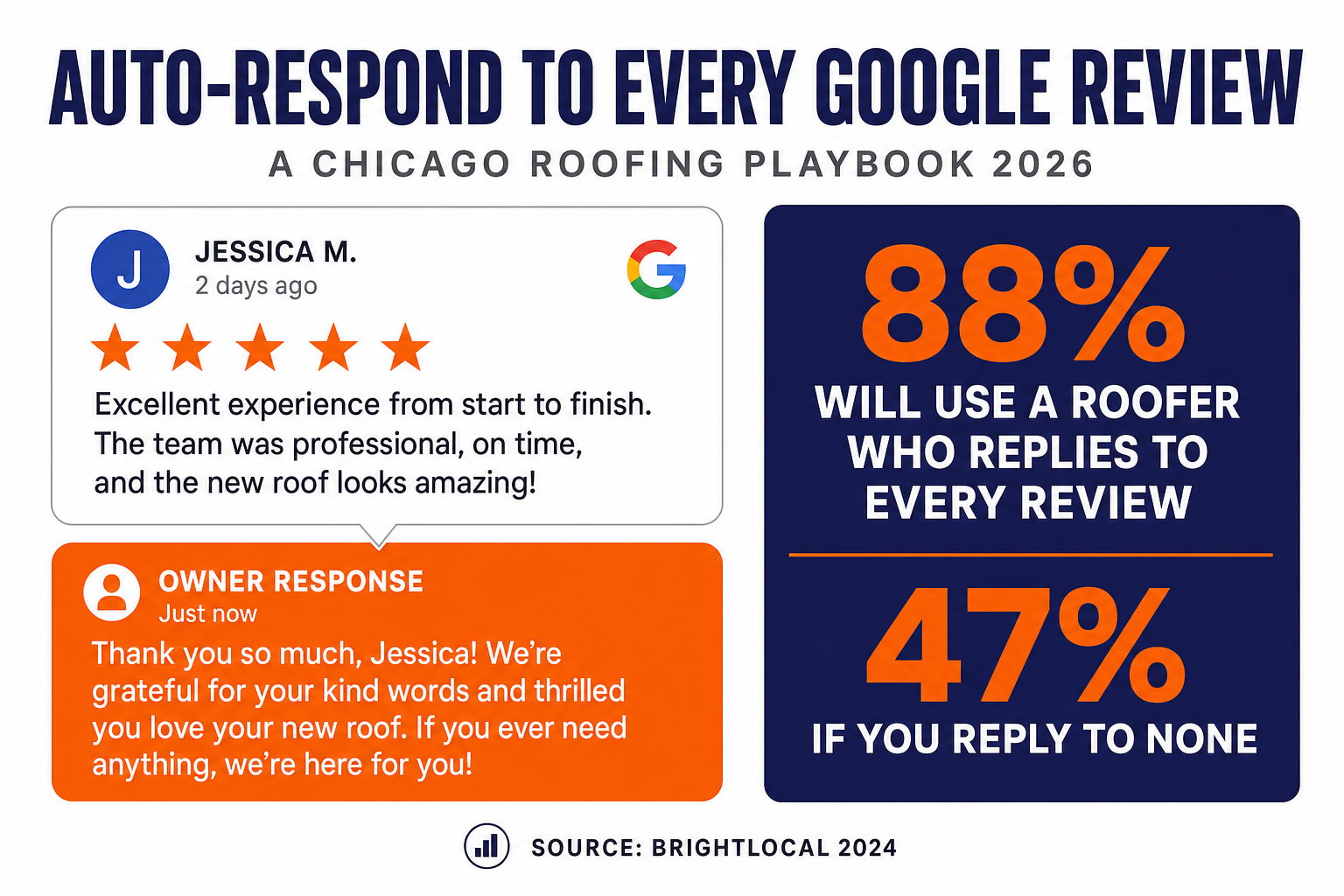
- 88% of consumers say they’d use a business that responds to all of its reviews — versus just 47% for a business that responds to none (BrightLocal Local Consumer Review Survey 2024). Replying is now table stakes, not a nicety.
- 89% of consumers read the business’s responses to reviews, and 56% say a thoughtful reply to a negative review improved their perception of the company (BrightLocal, 2024).
- A Harvard Business Review study of hotels found that when a business simply starts responding to reviews, it earns 12% more reviews and a 0.12-star higher average rating (HBR, 2018).
- Google’s own guidance lists managing and responding to reviews among the ways to improve your local ranking, and says positive reviews and helpful replies help your business stand out (Google Business Profile Help).
- Illinois logged a record 142 tornadoes in 2024 against a long-term average of 54 (State Farm, 2025) — every storm dumps a wave of reviews on your profile faster than any owner can answer by hand.
Table of contents
- The short answer: why auto-respond to reviews
- Why 2024 changed the game for Chicago roofers
- What the data says about responding to reviews
- Does responding actually help you rank in Chicago?
- The 5-step auto-respond playbook
- What a good auto-response actually looks like
- The Chicago storm reality
- What it costs vs. one lost roof
- FAQ
The short answer: why auto-respond to every review
A Chicago roofing company should auto-respond to every Google review because responding is now the single biggest reputation signal a homeowner sees — 88% of consumers will use a business that replies to all its reviews versus 47% that replies to none — and because after a storm the reviews arrive faster than any owner buried on a roof can answer them by hand. Automation makes sure every review, good or bad, gets a fast, on-brand, roofing-specific response within minutes, so your profile always looks active, responsive, and trustworthy to the next storm-panicked homeowner comparing three roofers on their phone.
The rest of this playbook shows the exact system — but that’s the whole thesis in one paragraph: the review reply is your storefront now, and a storefront you only visit on Mondays is losing you jobs Tuesday through Sunday.
Why 2024 changed the game for Chicago roofers
For years, roofers had two live channels on their Google Business Profile: the Messages tab (homeowners could chat your profile directly) and reviews. That changed. Google shut down Business Profile chat, messaging, and call history permanently on July 31, 2024 (Invoca, 2024). The DM-your-profile button is gone.
What’s left standing — and now carries all the weight — is the review thread. It’s the only place on your profile where a prospective customer can watch you interact with real homeowners in public. And they’re watching closely: 89% of consumers read businesses’ responses to reviews (BrightLocal, 2024). Your reply to a 1-star review is being read by the next ten homeowners deciding whether to call you — not just the one who left it.
This is exactly why “get more reviews” advice only solves half the problem. Collecting fresh 5-star reviews is essential — we cover that system in How roofers get more Google reviews on autopilot — but a pile of reviews with no owner responses reads as an absentee business. Getting the review is step one. Answering it, fast and well, is where the trust actually gets built.
What the data says about responding to reviews
Responding to reviews isn’t a soft, feel-good activity — it’s one of the most consistently measured levers in local consumer behavior. Here’s what the current research shows.
Sources: BrightLocal Local Consumer Review Survey 2024 (89%, 56%); Womply, via Search Engine Land (2020 analysis of 200,000+ U.S. businesses; correlational).
Start with the headline number. BrightLocal’s 2024 survey found a stark split in intent based on one behavior: 88% of consumers said they’d use a business that responds to all of its reviews, but only 47% would use one that responds to none (BrightLocal, 2024). That’s not a rounding error — it’s nearly half your potential customers deciding based on whether you bother to reply.
And it compounds over time. A Harvard Business Review study analyzing hotel reviews on TripAdvisor found that when a business simply starts responding to reviews, it goes on to receive 12% more reviews and sees its average star rating rise by 0.12 stars (HBR, 2018). The likely mechanism: once customers see the owner is listening, more of them bother to leave feedback, and unhappy ones are more often satisfied privately than blasting you publicly. Responding literally improves the average rating that sells for you.
There’s a recency angle too, and it’s the one most roofers underrate. 74% of consumers look for reviews written within the last three months (BrightLocal, 2024) — an old, stale thread reads as a business that’s slowed down. A profile with fresh reviews and fresh owner responses is the one that looks busy, alive, and safe to hire.
Does responding actually help you rank in Chicago?
Short answer: it’s part of the picture, and Google says so in its own words. Google’s Business Profile guidance lists managing and responding to your reviews among the ways to improve your local ranking, and states that when you reply to reviews it shows you value your customers, while positive reviews and helpful responses help your business stand out (Google Business Profile Help). Google’s ranking for the local map pack weighs relevance, distance, and prominence — and review activity, including your engagement, feeds prominence.
Be careful how you read that, though: Google credits positive reviews with improving visibility and recommends responding as good practice — it doesn’t publish a dial that says “each reply = +1 rank.” So treat responding as one durable input into a bigger local-SEO system, not a magic ranking hack. The full map-pack playbook — categories, citations, GBP optimization, and the rest — is in Local SEO for roofing contractors. Fast, consistent review responses are one of the cheapest, most-controllable inputs in that system, which is exactly why they’re worth automating.
The 5-step auto-respond playbook
Here’s the system the Roofing Snapshot ships pre-wired, and the one you’d want to build in GoHighLevel either way. The goal: every new review gets an on-brand, roofing-specific response within minutes — automatically — with a human pulled in only when it actually matters.
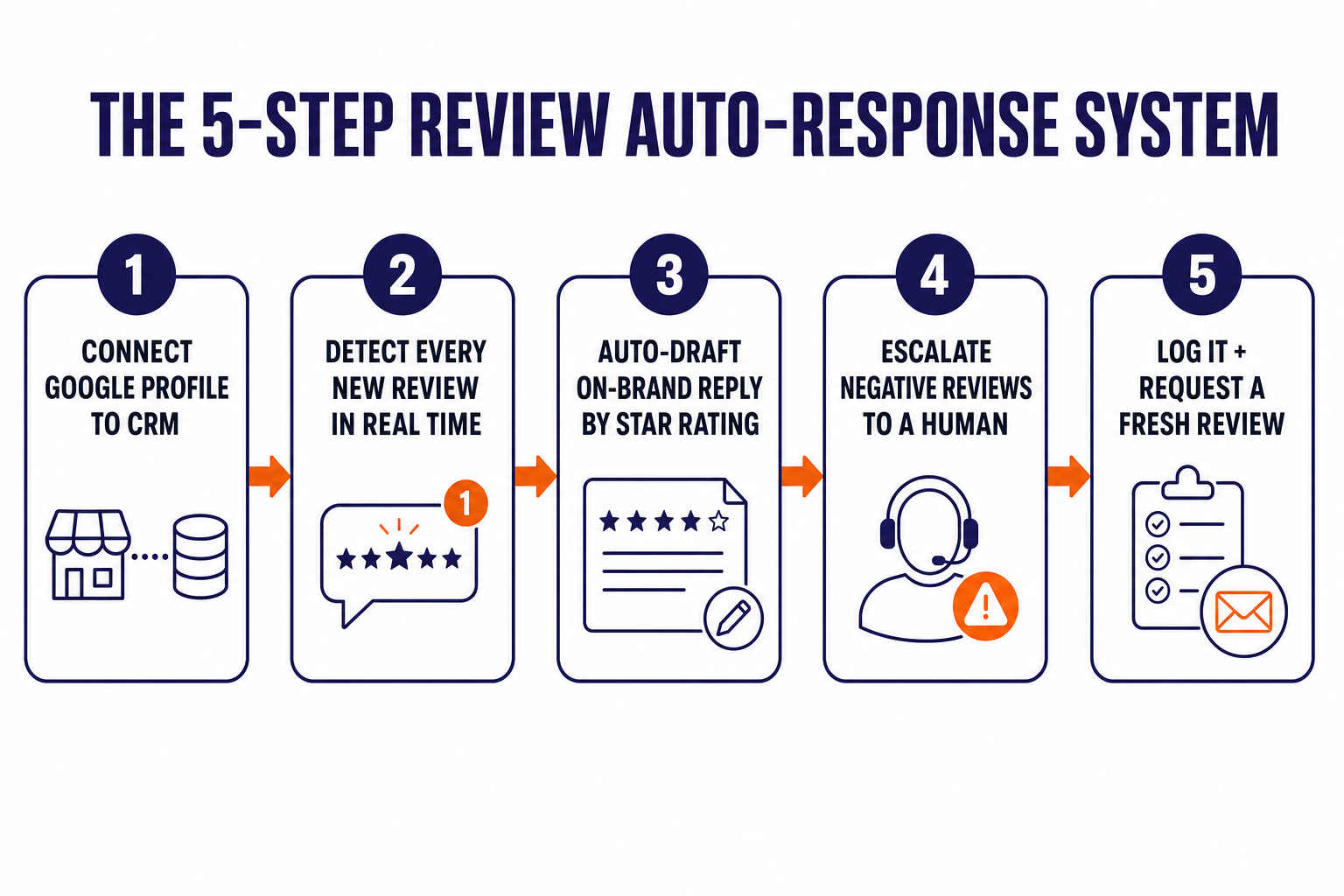
1. Connect your Google Business Profile to your CRM. In GoHighLevel, link your GBP so reviews flow into one inbox. Now every star rating lands in a system that can act on it instantly, day or night — instead of an owner remembering to log into Google between roofs.
2. Detect every new review in real time. The automation watches your profile and fires the moment a review posts — 5-star at 9 a.m. or 1-star at 11 p.m. Saturday. No more discovering a bad review three days late. Speed is the whole point: more than half of consumers expect a review response within two to three days (BrightLocal, 2024), and automation gets you there in minutes.
3. Auto-draft an on-brand response by star rating. The system picks the right response template based on the rating and the review’s content — warm and specific for 5-star, calm and solution-oriented for anything lower — written in your roofing voice (squares, storms, insurance, crews), never robotic. It can pull the customer’s name and job details so the reply reads human, because generic “Thank you for your feedback!” copy fools no one.
4. Escalate negative reviews to a human — fast. This is the guardrail. Any review below a threshold (say, 3 stars) or containing red-flag language triggers an instant SMS alert to the owner’s phone and posts a holding response that de-escalates (“I’m sorry to hear this — I’m looking into your job right now and will call you personally within the hour”). The homeowner feels heard immediately, and you get the chance to fix it before frustration hardens into a permanent 1-star.
5. Log it and keep the profile fresh. Every response is logged on the contact record, and the system loops back into review collection — because responding and harvesting are two halves of the same engine. That’s what keeps you inside that 74% recency window. (The collection side is detailed in get more Google reviews on autopilot, and both live in the snapshot’s Review Harvesting Automation and Google My Business Reply Automation.)
What a good auto-response actually looks like
The difference between a response that builds trust and one that reads like a bot is specificity. Here’s the contrast:
| Review | Weak, robotic reply | Strong, on-brand reply |
|---|---|---|
| ⭐⭐⭐⭐⭐ “Crew replaced our roof after the May hail. Fast and clean.” | “Thank you for your feedback!” | “Thanks, {name} — that May hail did a number on the whole block. Glad our crew got you buttoned up fast and left the yard clean. Enjoy the new roof, and tell the neighbors we’re around.” |
| ⭐ “Nobody showed up for my estimate.” | “We’re sorry for any inconvenience.” | “{name}, I’m sorry — that’s not how we run. I have you down for Saturday 2 PM and I’m pulling our crew log right now. Can I call you in 10 minutes to make this right? — Marcus, owner” |
The strong replies do three things a homeowner-shopper notices: they use the person’s name, they reference real roofing context (the storm, the job, the crew), and on the negative one they take ownership and move to a phone call in public. Remember, 56% of consumers say a good response to a negative review improved their opinion of the business (BrightLocal, 2024) — that reply isn’t for the angry customer, it’s for the next ten readers.
The Chicago storm reality
Why does automation matter more in Chicago than in a sleepy market? Volume and timing. Illinois recorded a state-record 142 tornadoes in 2024 against a long-term average of 54 (State Farm, 2025), and nationally, severe convective storms — hail, wind, and thunderstorms — drove more than $50 billion in insured losses in 2024, the third straight year over that mark (Insurance Information Institute, 2024).
For a Chicago-metro roofer, that’s not abstract weather data — it’s a demand pattern. A single spring hail event across Naperville, Aurora, Schaumburg, and the northwest suburbs can put dozens of jobs on your board in a week, and dozens of reviews on your profile a few weeks later as those jobs close. That’s precisely when you’re too slammed to answer them by hand — and precisely when the most homeowners are shopping your profile. The busier the storm season, the more a machine that responds at 11 p.m. earns its keep. If you’re also missing the calls those storms generate, pair this with never miss a storm call.
What it costs vs. one lost roof
Here’s the math that makes this a non-decision. An average roof replacement is worth thousands of dollars in revenue. If a stale, unanswered profile costs you even one job a season — one homeowner who read your silent 1-star and tapped the next roofer — the automation has paid for itself many times over. And this isn’t a standalone tool you have to bolt on: auto-response to reviews is built into the Roofing Snapshot, the same done-for-you GoHighLevel system that also runs your speed-to-lead SMS, insurance-claim pipeline, and review collection — installed and live in about 24 hours.
Prefer to see exactly how the review module fits with the rest of the automations before you buy? Walk through the Google My Business Reply Automation feature, or if your bigger problem is getting enough web leads to review in the first place, an AI chat widget that books inspections 24/7 is the front-door piece.
Frequently asked questions: auto-responding to Google reviews
Can you really auto-respond to Google reviews, or is that against the rules?
You can absolutely automate the workflow — detecting a new review, drafting an on-brand reply, and posting it — and that does not violate Google's policies. What Google prohibits is fake reviews, paying for positive reviews, and review gating that manipulates ratings. Auto-responding is just being fast and consistent. The best setups keep a human in the loop for negative reviews so the response is genuine, then automate the rest.
Should I respond to positive 5-star reviews too, or just the bad ones?
Both. 89% of consumers read businesses' responses to reviews, and they're reading the 5-star threads as much as the 1-star ones. A warm, specific reply to a happy customer signals an engaged, human business and often prompts a referral. Ignoring your 5-star reviews leaves the single easiest trust-building win on the table. Automate the 5-star replies and reserve your personal time for the negatives.
How fast do I need to respond to a Google review?
As fast as you can — more than half of consumers expect a response within two to three days, and a negative review left unanswered over a weekend is read by every homeowner shopping your profile in the meantime. Automation gets your response time down to minutes instead of days, which is exactly why it matters more during a busy Chicago storm season when reviews pile up faster than you can answer them by hand.
Does responding to reviews help my roofing company rank higher in Google's map pack?
It's one input, not a magic switch. Google's own guidance lists managing and responding to reviews among the ways to improve local ranking, and credits positive reviews with improving visibility. It works alongside the rest of local SEO — accurate categories, citations, a complete Google Business Profile, and steady fresh reviews. Fast, consistent responses are one of the cheapest and most controllable of those inputs.
What happened to Google Business Profile messaging?
Google permanently retired Business Profile chat, messaging, and call history on July 31, 2024. Homeowners can no longer DM your profile directly. That's a big reason review responses matter more now — the review thread is the only live, public conversation left on your profile, so it carries the trust-building weight that messaging used to share. Speed-to-lead now happens on your phone, your website chat, and your forms instead.
Is review-response automation included in the Roofing Snapshot, or is it extra?
It's included. The Roofing Snapshot is a done-for-you GoHighLevel system that installs your review-response automation, review collection, speed-to-lead SMS, insurance-claim pipeline, and more — wired together and branded to your company in about 24 hours — for a one-time $997. You don't buy the review piece separately; it's one module of the complete storm-to-deposit system.
The bottom line
Google took your Business Profile messaging away in 2024, and handed all the public-trust weight to your review thread. For a Chicago roofing company staring down a record storm season, that’s not a problem — it’s an opportunity most competitors are ignoring. The data is one-sided: homeowners overwhelmingly favor the business that replies to every review, they read those replies, and a good response to a bad review changes minds. The only thing standing between you and that advantage is being fast and consistent enough to answer every review, at every hour, during the exact weeks you’re too busy to.
That’s a machine’s job. Wire it up once, keep a human on the negatives, and let your profile sell the responsive, on-the-ball version of your business around the clock — storm after storm.
About the author
Marcus Ellison runs a small GoHighLevel agency on Florida’s Gulf Coast that productizes roofing snapshots for contractors across hurricane and hail country. He thinks like an operator first and a marketer second — reviews that compound, Google profiles that win the map pack, and reputation automation that turns storm traffic into signed roofs. He writes for both the agency owner reselling GHL and the roofer who just wants the phone to ring. Have a question about your Google profile? Talk to a real person.