
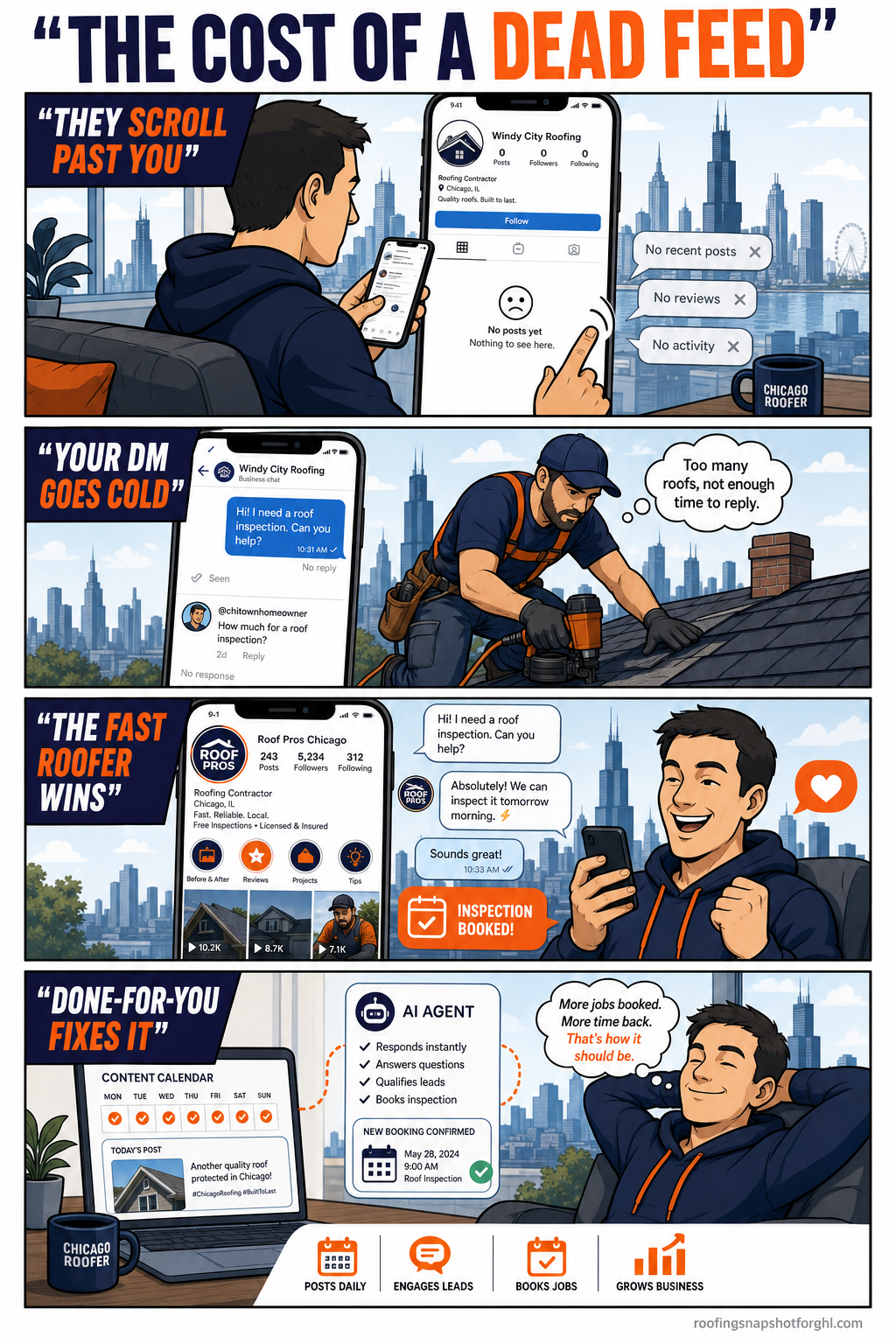
What does a quiet, out-of-date social media feed actually cost a Chicago roofing company? Jobs — quietly and constantly. After a hailstorm rolls through the suburbs, homeowners don’t just Google “roofer near me.” They open Facebook, Instagram, and TikTok, scroll your profile, and judge whether you’re active, credible, and worth a call — all before they ever dial. If your last post is from last spring, or a homeowner’s “do you handle hail damage?” comment sits unanswered for two days, that job books with the competitor who showed up in the feed and replied in minutes.
This is a plain-spoken breakdown for Chicago-area roofing owners and the GoHighLevel agencies serving them. It covers the 2026 data on how homeowners vet roofers on social, why a slow reply hands the storm job to someone else, why photos-only feeds get buried while video wins reach — and, given Chicago’s storm reality and a $228 average cost per paid roofing lead, exactly what a dead feed is costing you every month.
Key Takeaways
- 73% of consumers will buy from a competitor if a brand doesn’t respond to them on social media, and 73% expect a reply within 24 hours (Sprout Social, 2025) — every ignored roofing comment or DM is a job leaking to a faster contractor.
- Homeowners actively use social to vet local businesses: 40% use Facebook, 34% YouTube, 34% Instagram, and 23% TikTok to find and check them out (BrightLocal, 2025) — your feed is a sales pitch, and a stale one reads as “not busy” or “not around.”
- Instagram Reels reach about 2.25x more people than single-image posts, and TikTok video earns 77% more engagement than photos (Socialinsider, 2026) — a photo-only roofing feed is invisible to the homeowners who don’t already follow you.
- Illinois logged a record 142 tornadoes in 2024 (against a 54-year average of 54) and ranked 2nd nationally in hail claims at over $899 million (State Farm, 2025) — Chicago’s storm demand is real and spiky, which makes being visible first worth more here than almost anywhere.
- A single paid roofing/gutters search lead now averages $228.15 (LocaliQ, 2025); an active, owned social feed produces discovery at near-zero marginal cost. A dead feed isn’t neutral — it pushes you toward the most expensive leads you can buy. That’s the gap done-for-you social media is built to close.
Table of contents
- The short answer for Chicago roofers
- Pain 1: Homeowners vet you on social before they call
- Pain 2: Silence loses the job — slow replies hand storm jobs to competitors
- Pain 3: A photo-only feed is invisible — video is where the reach is
- The Chicago storm reality makes the gap expensive
- What a dead feed actually costs you
- The fix: a done-for-you content engine plus AI agents
- How social plugs into the rest of your pipeline
- FAQ
The short answer for Chicago roofers
In Chicago’s storm-driven roofing market, the company that gets the job is rarely the best on the roof — it’s the one the homeowner trusts fastest, and a huge part of that trust is manufactured on social media before you ever speak. A homeowner scrolls a handful of contractor profiles after a storm and books the one that looks active, answers instantly, and shows real work. If your feed is empty, off-brand, or hasn’t moved in months, you’re filtered out silently — no lost-lead notification, no bounced call, just a job you were never in the running for.
The costly part is that a dead feed doesn’t just lose the free jobs — it forces you toward the expensive ones. When you’re invisible in the places homeowners already scroll, you make up the difference by buying leads, and roofing leads are now among the most expensive in all of home services. The fix isn’t “post more when you have time.” It’s making content and instant replies an automatic, done-for-you system that runs while you’re on the roof.
Pain 1: Homeowners vet you on social before they call
A Chicago homeowner’s first impression of your roofing company is your social feed, not your truck. Before a stranger hands you five figures for a re-roof, they want proof you’re real, active, and trusted — and social is where they look. According to BrightLocal’s 2025 survey, consumers routinely use social platforms to find and vet local businesses: 40% use Facebook, 34% YouTube, 34% Instagram, and 23% TikTok for exactly that (BrightLocal, 2025). Those aren’t idle scrollers; they’re buyers checking whether you’re worth contacting.
The problem is what a neglected feed communicates. An empty grid, a profile that hasn’t posted since last season, or a page full of stock images tells a homeowner one thing: this company isn’t busy, isn’t current, or isn’t around anymore. In a market where they can scroll five more roofers in thirty seconds, that’s disqualifying. Recency signals matter — in the same body of BrightLocal research, consumers weight fresh activity heavily, with many only trusting the most recent proof and rating “sort by newest” as highly useful (BrightLocal, 2024). A wall of great work from two years ago reads as a business that’s slowing down.
And this isn’t a niche channel. The typical internet user spends 2 hours 21 minutes per day on social media (DataReportal, 2025) — your Chicago homeowners are on these apps every single day. The question is whether they see you there consistently, or see a competitor instead.
Pain 2: Silence loses the job
On social, a slow reply is a lost roof. Homeowners treat a comment or DM like a text to a friend — they expect a fast answer, and they move on if they don’t get one. Sprout Social’s 2025 Index found that 73% of consumers expect a brand to respond on social within 24 hours, and — more brutally — 73% say that if a brand doesn’t respond to them on social, they’ll simply buy from a competitor (Sprout Social, 2025). After a storm, when a dozen homeowners are messaging roofers at once, whoever answers first books the inspection.
This is speed-to-lead, just moved to the comment section and the DM inbox. The same discipline that wins the phone race — responding in seconds, not hours — decides who wins the roofs that start with “hey, do you come out to Berwyn?” under a Facebook post. And it’s exactly the thing a busy roofing operation can’t do by hand: your crew is on a roof, your office is chasing an adjuster, and three “can you look at my roof?” DMs are going cold while the algorithm quietly rewards the competitor who replied in two minutes.
Pain 3: A photo-only feed is invisible
If your roofing feed is all photos and no video, most local homeowners will never see it. The platforms now distribute short-form video far more aggressively than static posts, and the numbers aren’t close. Instagram Reels reach about 2.25x more people than single-image posts, and on TikTok, video earns 77% more engagement than photos and carousels (a 3.39% median engagement rate versus 1.92%) (Socialinsider, 2026).
Median engagement rate by content format on TikTok (%). Video earns 77% more engagement than static posts. Source: Socialinsider, 2026 (69M videos analyzed).
Homeowners prefer it, too. When Wyzowl asked how people most want to learn about a product or service, 63% chose a short video — versus just 12% for text and 7% for an infographic (Wyzowl, 2025). And marketers agree on the payoff: 21% say short-form video delivers the highest ROI of any content format they use (HubSpot, 2025).
For a roofer, this is a gift, because roofing is inherently visual and video-friendly: a drone flyover of hail-bruised shingles, a satisfying tear-off time-lapse, a 20-second “here’s what a real hail hit looks like” explainer. The content that reaches new Chicago homeowners is exactly the content your crews are standing on top of every day. The Reels playbook that wins storm jobs isn’t complicated — but it does require consistently producing and posting video, which is precisely where in-house roofing social falls apart.
The Chicago storm reality makes the gap expensive
Chicago is a spiky, storm-driven roofing market, and that makes being visible first worth more here than in a calmer one. Illinois severe weather is accelerating, not easing. State Farm’s 2025 data shows Illinois recorded a record 142 confirmed tornadoes in 2024 — nearly triple the long-term average of 54 — along with 716 severe wind reports and 216 severe hail reports, and the state ranked 2nd in the nation for hail claims, paying out more than $899 million (State Farm, 2025). The Insurance Information Institute likewise ranked Illinois among the top states for hail events in 2024 (Triple-I, 2025).
Confirmed tornadoes in Illinois: 2024 vs the long-term average. Severe weather is accelerating across the state. Source: State Farm, 2025.
Now layer in the demand base: Illinois has roughly 5.45 million owner-occupied housing units, and the Chicago metro homeownership rate sits around 65.5% (U.S. Census Bureau). Every severe-weather event pushes a fresh wave of those homeowners into “I need a roofer now” mode all at once — and when they surge to social to vet contractors, the roofer with a live, active, video-forward feed and instant replies is the obvious choice. The one who went quiet between storms looks like they left the market.
What a dead feed actually costs you
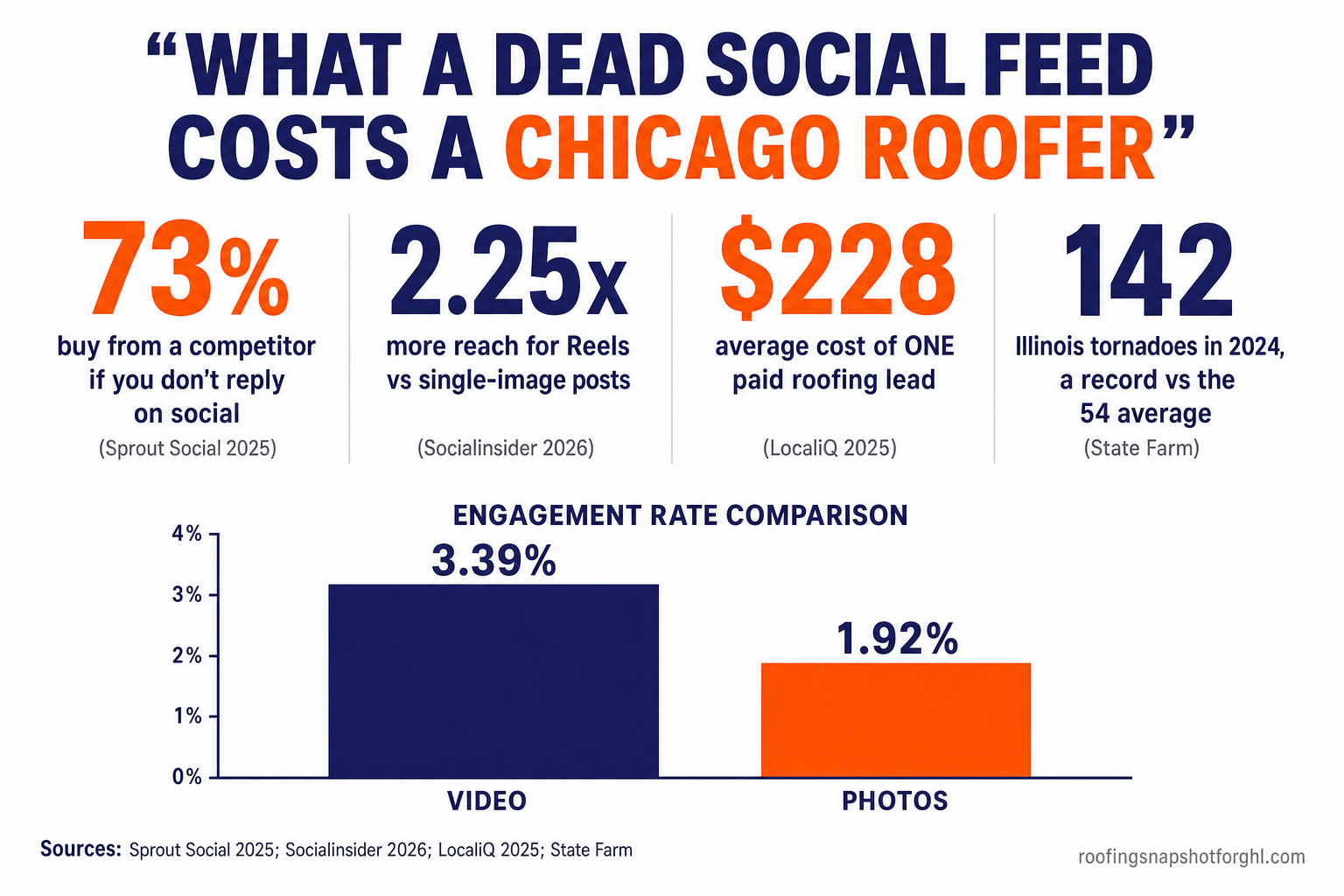
A dead feed isn’t free — it pushes you toward the most expensive leads in home services. When you’re not being discovered organically, you make up the shortfall by buying leads, and roofing is now the priciest home-services category to buy into. LocaliQ’s 2025 benchmarks put the average cost per lead for roofing and gutters at $228.15, on an average cost per click of $10.70 (LocaliQ, 2025). And it’s getting worse: cost per lead rose for 69% of home-services businesses, up an average of 10.51% year over year (LocaliQ, 2025).
Put those side by side. Every homeowner who would have discovered you through an active social feed — for essentially the marginal cost of one more post — is a homeowner you now have to buy at $228 a lead instead. Across a Chicago storm season, that swing is enormous: a company earning, say, 15 organic social inquiries a month is offsetting roughly $3,400 in paid-lead cost every month, and building an owned audience that compounds instead of resetting to zero when the ad budget stops.
Two ways to run roofing social in Chicago
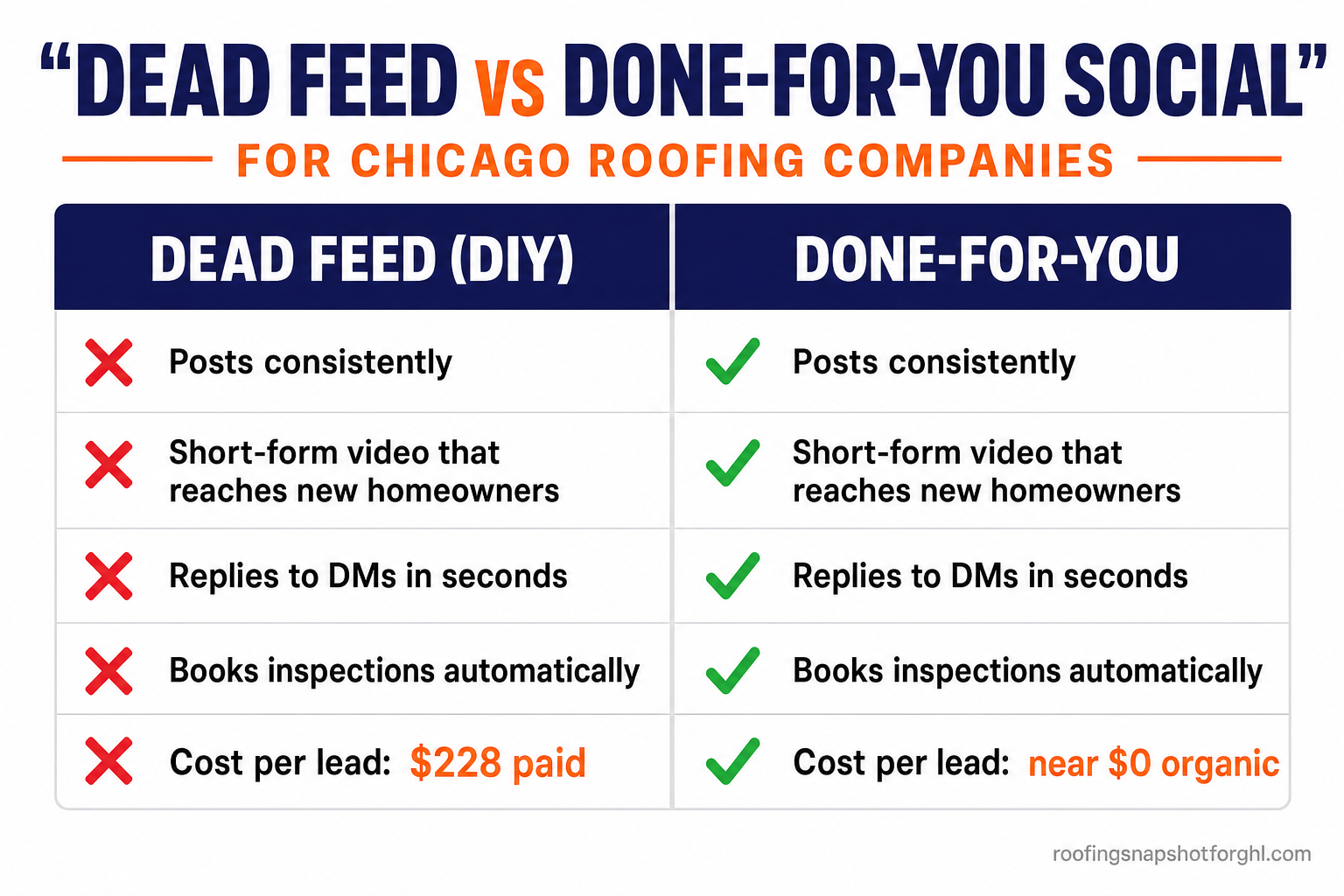
Posting happens in bursts — a flurry after a storm, then silence for weeks. It's photos, no video, so reach stays flat and only existing followers see it. Comments and DMs sit for days while you're on a roof, and hot storm leads book with the competitor who answered first. Between events the feed decays, and you make up the gap buying $228 leads.
Fresh, on-brand content posts 5 days a week across every channel — including the video that actually reaches new homeowners. AI agents answer comments and DMs in your voice within seconds, qualify the homeowner, and book the inspection straight to your calendar. Your feed stays alive between storms, so when hail hits you already own the local audience and the trust.
The fix: a done-for-you content engine plus AI agents
The reason in-house roofing social fails isn’t a lack of ideas — it’s that consistent posting, video editing, and instant replies are a full-time job nobody on a roofing crew has time for. Posting to nine apps by hand, each with its own size and caption, editing a reel, and monitoring comments all day is a second job. That’s exactly the work a done-for-you social media system removes.
Here’s what a proper roofing content operation looks like, running without you touching it:
- Content that gets made for you, 5 days a week. Per brand, every week: roofing-specific text posts, branded image graphics, swipeable carousels, and a short vertical reel — written in your company’s voice and published across all 9 channels (Facebook, Instagram, Google Business Profile, LinkedIn, TikTok, YouTube, Pinterest, Threads, and Bluesky), cropped and captioned per platform. You send raw job photos and storm updates, or nothing at all.
- An AI Comment agent that replies to comments on your TikTok, Instagram, and Facebook posts — so no “do you do metal roofs?” ever goes cold, and the engagement that earns reach keeps flowing.
- An AI DM agent that answers Facebook and Instagram messages 24/7, qualifies the homeowner, collects their name, address, and roof issue, and books a free inspection straight onto your calendar — the speed-to-lead win, automated.
- An AI Web Chat agent on your website that turns anonymous storm-season traffic into booked jobs, capturing name, phone, and roof problem the moment a visitor lands.
Every lead and every booked appointment lands in one CRM you log into, so you watch the pipeline fill in real time instead of digging through five app inboxes. It’s white-label, needs no account passwords, and starts at a flat monthly rate — a fraction of the $4K–$8K a month a designer, video editor, and social manager would cost to replicate in-house.
How social plugs into the rest of your pipeline
Social media doesn’t work in a vacuum — it’s the top-of-funnel trust layer feeding the same system that closes the job. A homeowner discovers you in a reel, checks your Google reviews and local search presence to confirm you’re legit, then DMs or clicks to call. From there, your speed-to-lead response and follow-up cadence decide whether you actually book the inspection and — after a storm — whether you never miss the call that turns into a claim.
When your content, your comment and DM replies, your web chat, your reviews, and your pipeline all live inside one connected GoHighLevel system, every post compounds: it earns reach, the reach becomes conversations, the AI agents book those conversations, and the pipeline converts them into signed roofs. That’s the difference between a roofing company that hopes someone remembers to post and one that has an always-on presence engineering inbound jobs — done for you, so your only job is the roof.
Social media for Chicago roofing companies — FAQ
Do Chicago homeowners really check a roofer's social media before calling?
Yes. Consumers routinely use social platforms to find and vet local businesses — 40% use Facebook, 34% YouTube, 34% Instagram, and 23% TikTok for exactly that (BrightLocal, 2025). For a five-figure roof decision, a homeowner wants proof you're active, real, and trusted before they call, and your feed is where they look first. A stale or empty profile reads as 'not busy' or 'not around' and gets skipped silently in favor of a roofer whose feed looks alive.
How fast do I need to respond to comments and DMs?
Fast — same-day at the outside, and ideally within minutes after a storm. 73% of consumers expect a brand to respond on social within 24 hours, and 73% say they'll buy from a competitor if a brand doesn't respond at all (Sprout Social, 2025). On social, a slow reply is a lost roof: whoever answers the 'can you look at my roof?' DM first usually books the inspection. That's why automating replies with an AI agent that answers in your voice 24/7 matters so much for a busy roofing operation.
Is short-form video really worth it for a roofing company?
It's the single biggest reach lever you have. Instagram Reels reach about 2.25x more people than single-image posts, and TikTok video earns 77% more engagement than photos and carousels (Socialinsider, 2026). 63% of consumers say they'd most prefer to watch a short video to learn about a product or service (Wyzowl, 2025). Roofing is inherently visual — drone flyovers, tear-off time-lapses, and hail-damage explainers are exactly the content that reaches new homeowners who don't already follow you.
How much does done-for-you roofing social media cost, and what's included?
It's flat monthly pricing that replaces a whole content team. You get a full weekly content set per brand (text, image, carousels, and a reel) published 5 days a week across all 9 channels, plus three AI agents — a Comment agent, a DM agent, and a Web Chat agent — that answer engagement and book inspections into your CRM calendar. It's white-label, needs no social passwords, and costs a fraction of the $4K–$8K a month a designer, editor, and social manager would run. See the /social-media page for current pricing or book a walkthrough.
Do you need my social media account passwords?
No. During onboarding you create your own accounts (or use existing ones) and connect them to the social planner platform through a secure connection — that's all that's needed to publish for you. You stay in full control and can disconnect anytime. Your leads and conversations live in a CRM you own and log into.
How is this different from just boosting posts or running Facebook ads?
Boosting and ads rent attention — the moment you stop paying, discovery stops, and roofing paid leads now average $228.15 each (LocaliQ, 2025). An owned, active content feed builds a local audience that compounds and produces discovery at near-zero marginal cost, then the AI agents convert that attention into booked jobs. Organic social and paid ads can work together, but a dead organic feed forces you to buy every single lead — the most expensive way to grow a roofing company.
When will I actually see leads from social?
Organic growth compounds — expect meaningful reach and steady inbound in roughly 3–5 months as the algorithms start surfacing your content to new local homeowners. Because content posts 5 days a week across 9 channels, a single roofing reel can go viral and drive inspection requests much sooner. Anyone promising overnight results isn't being honest; the goal is a durable presence that owns your Chicago service area storm after storm.
Related posts
- Social Media Marketing for Orlando Roofing Contractors: Why Reels Win Storm Jobs
- Instagram Reels for Raleigh Roofing Companies: A How-To Playbook
- Facebook & Instagram DM Automation for Los Angeles Roofing Companies
- Auto-Respond to Google Reviews: A Chicago Roofing Playbook
- Why a 30-Second Response Wins Storm Jobs
Written by Marcus Ellison, GHL Agency Partner & Growth Advisor (Tampa, FL). Marcus runs a small GoHighLevel agency on the Gulf Coast that productizes roofing snapshots for contractors across storm country — reviews that compound, Google profiles that rank, and content engines that turn last season’s silence into this season’s booked inspections. He writes for both the agency owner reselling GHL and the roofer who just wants the phone to ring.