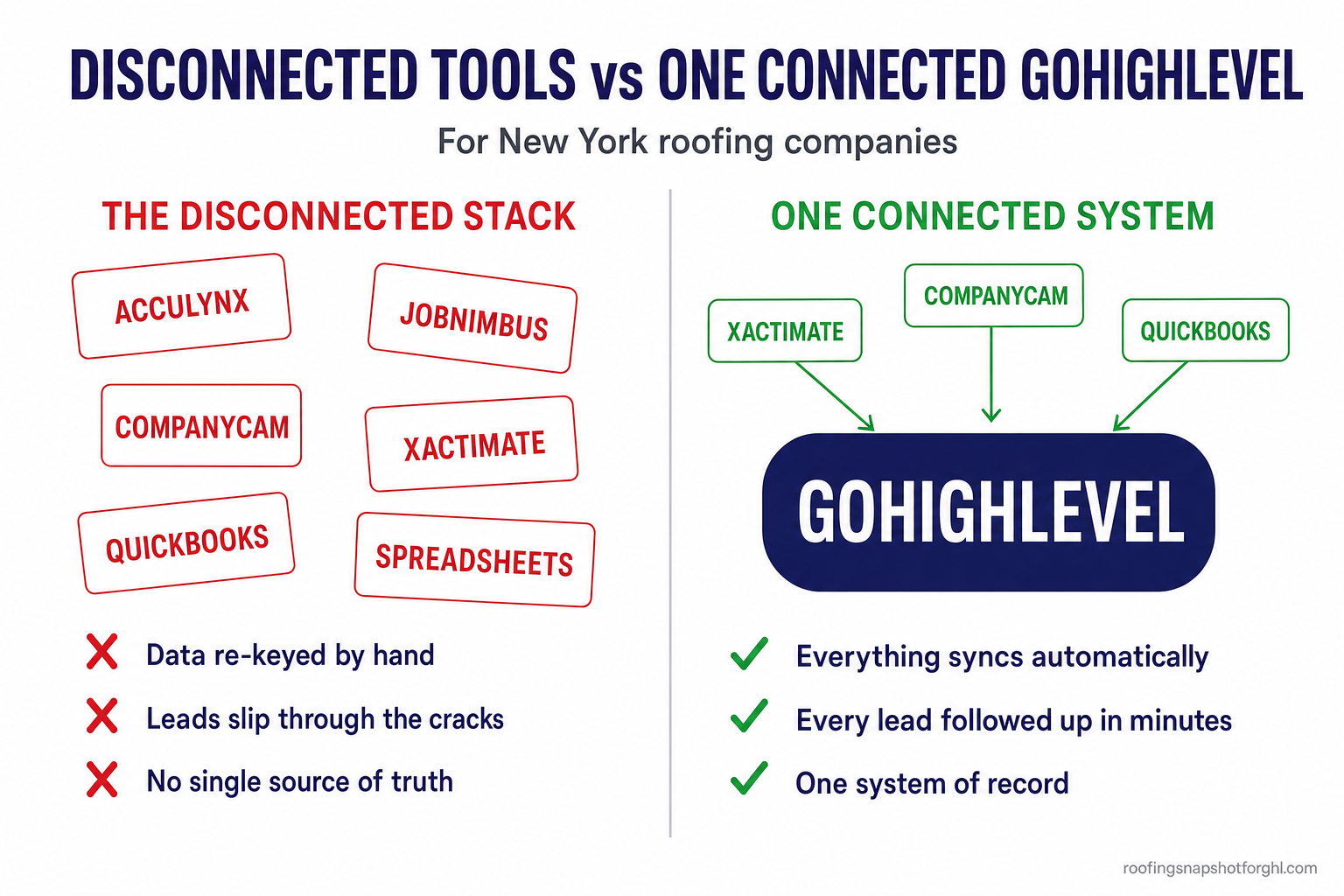
A New York roofing company doesn’t lose a storm job because the crew is bad. It loses the job because the lead came in through a Facebook form, got copied into a spreadsheet, never made it into AccuLynx, and nobody called back until the homeowner had already signed with the roofer down the block. The work was fine. The handoff between disconnected tools is where the money leaked out.
If you run a roofing company in New York — Long Island reroofs, NYC flat-roof jobs, Hudson Valley and Finger Lakes storm restoration — you’re probably paying for five, six, or seven separate systems that don’t talk to each other: a CRM, a photo app, an estimating tool, accounting, a form builder, and a group text or two holding it all together with duct tape. This guide compares that disconnected stack against one connected GoHighLevel (GHL) system on the things that actually decide whether a lead becomes a signed roof, using current, sourced data — and shows exactly what it takes to wire your existing tools together instead of re-keying everything by hand.
Key Takeaways
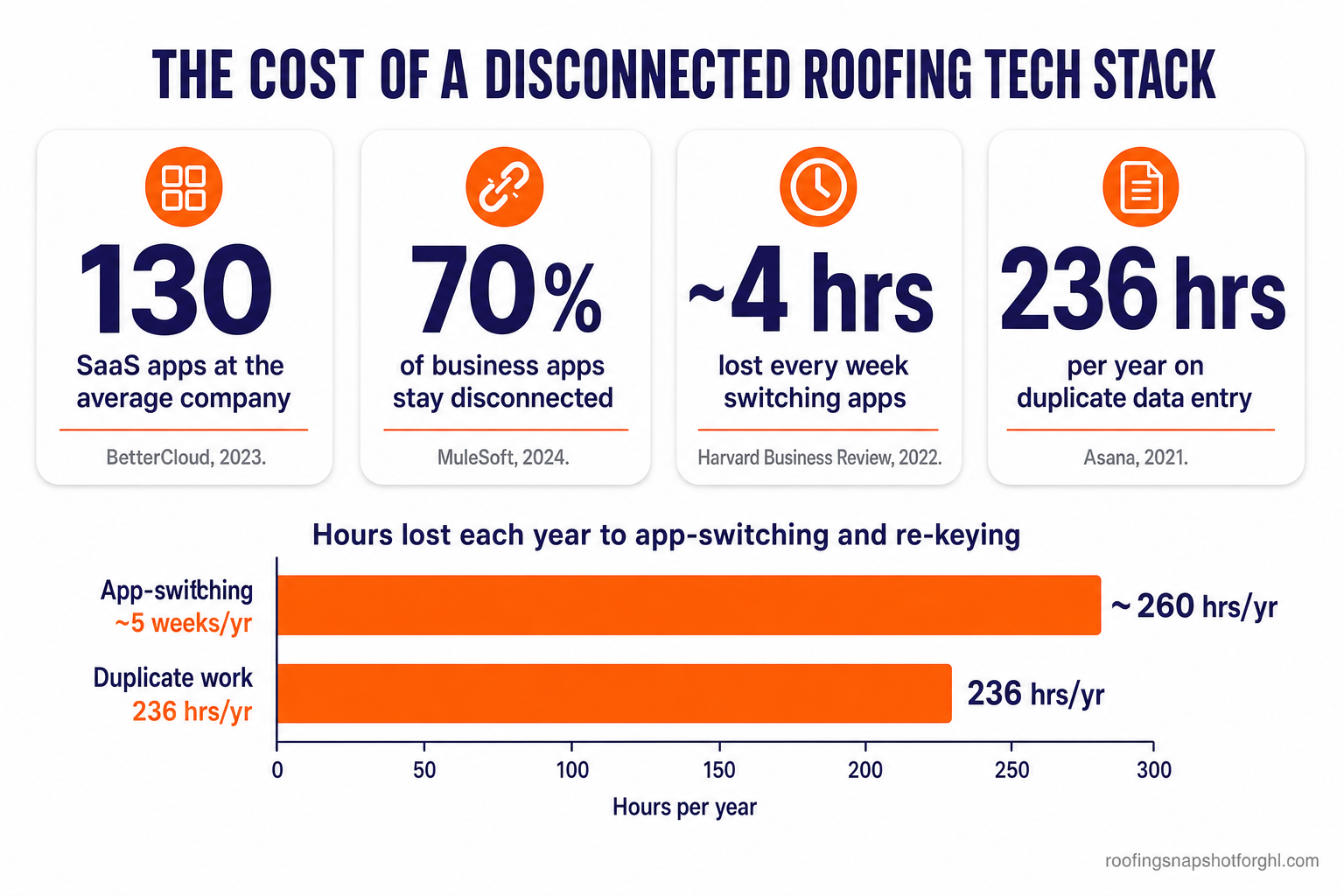
- The average company now runs about 130 SaaS apps (BetterCloud, 2023) — and roughly 70% of a typical organization’s applications are not integrated with one another (Salesforce / MuleSoft Connectivity Benchmark, 2023).
- Workers toggle between apps about 1,200 times a day, losing close to 4 hours a week — around 9% of their time — just reorienting after each switch (Harvard Business Review, 2022).
- The average knowledge worker spends 236 hours a year on duplicative work — the re-keying and double entry disconnected tools create (Asana Anatomy of Work Index, 2021).
- Contacting a lead within 5 minutes makes you 21× more likely to qualify it than waiting 30 minutes (MIT / InsideSales Lead Response Management Study, 2007) — and disconnected handoffs are exactly what add those minutes.
- New York averaged just 2.1 billion-dollar weather disasters a year from 1980–2024, but 6.2 a year from 2020–2024 (NOAA NCEI, 2025) — storm volume is rising, and your intake has to keep up.
Table of contents
- The short answer
- Why New York roofers end up with a disconnected stack
- The hidden tax of tools that don’t talk
- Where disconnected handoffs actually cost you jobs
- Disconnected stack vs connected GoHighLevel, side by side
- What “connecting” your stack actually means
- When you need custom GHL development (and when you don’t)
- How we wire your roofing tools into GoHighLevel
- FAQ
The short answer
For a New York roofing company, connecting your tools into one GoHighLevel system beats juggling a stack of disconnected apps because it kills the manual re-keying that eats hours every week, closes the handoff gaps where storm leads go cold, and gives you one place to see every job from first inspection to final deposit — instead of five systems that each hold a piece of the truth.
You don’t necessarily have to throw out AccuLynx, JobNimbus, CompanyCam, Xactimate, or QuickBooks to do it. If a tool has an API, a webhook, or even just an export, it can be wired into GoHighLevel so data flows automatically. The goal isn’t “one more app” — it’s making the apps you already pay for behave like a single system. The rest of this article shows what the disconnected stack really costs, and what a connected one looks like.
Why New York roofers end up with a disconnected stack
Nobody sits down and designs a disconnected mess. It accumulates. You start with a CRM. Then a storm season hits and you add a photo-documentation app so adjusters stop arguing. Then you bolt on an estimating tool, a form builder for the website, a review app, QuickBooks for the books, and a couple of group texts to keep crews in the loop. Each tool solved a real problem the day you bought it. Together, they became the problem.
This isn’t a New York quirk — it’s the default state of modern business software. The average company runs about 130 SaaS applications (BetterCloud, 2023), and across organizations of every size, roughly 70% of those applications aren’t integrated with each other (Salesforce / MuleSoft, 2023). MuleSoft’s benchmark research goes further: about 80% of IT decision-makers say integration issues create data silos that hold the business back (MuleSoft Connectivity Benchmark, 2024). A roofing company running seven tools is living that statistic every single day.
And in New York, the pressure on your intake is climbing, not easing. The state averaged 2.1 billion-dollar weather disasters per year from 1980 through 2024 — but 6.2 per year over just 2020–2024 (NOAA NCEI, 2025). The New York State Comptroller’s 2025 report counted 2,268 severe weather events in 2024 alone and roughly $958.6 million a year in federal disaster aid flowing into the state (Office of the NY State Comptroller, Oct 2025). More storms mean more surges of leads hitting your website, your phone, and your Facebook page in the same 48 hours — and a disconnected stack can’t absorb a surge without dropping some of it.
The hidden tax of tools that don’t talk
The cost of a disconnected stack isn’t a line item — that’s why it’s so easy to ignore. It shows up as your office manager’s afternoon, your sales rep’s Monday, and the lead nobody called. Three research-backed numbers make it concrete.
Re-keying is a part-time job you’re already paying for. Every time a lead’s details are typed from the form into the CRM, then into the estimating tool, then into QuickBooks, that’s the same information entered three times — and a chance to fat-finger a phone number three times. The Asana Anatomy of Work Index put a number on it: the average knowledge worker burns 236 hours a year on duplicative work (Asana, 2021). For a two-person roofing office, that’s the better part of three months of labor spent copying data between systems that could sync themselves.
App-switching drains focus all day. Harvard Business Review’s study of workers at three Fortune 500 companies found people toggle between applications about 1,200 times a day, and all that flipping adds up to nearly 4 hours a week — about 9% of work time — spent just reorienting after each switch (HBR, 2022). In the same research, a single business transaction sometimes required 350 toggles across 22 different applications. Your team feels this as “I’m slammed” without ever being able to point at why.
Where disconnected handoffs actually cost you jobs
The most expensive gap in a disconnected stack is the one between a lead arriving and someone contacting it. When a storm lead lands in a form tool that doesn’t push to your CRM, the clock starts running while the lead sits in an inbox nobody’s watching.
The data on that gap is brutal. The MIT / InsideSales Lead Response Management Study — six companies, more than 15,000 leads, over 100,000 call attempts — found that contacting a lead within 5 minutes makes you 21× more likely to qualify it than waiting just 30 minutes, and 100× more likely to even reach the person (Lead Response Management, 2007). Yet Harvard Business Review’s audit of 2,241 US companies found the average first response took 42 hours, and 23% of companies never responded at all (HBR, 2011). Disconnected handoffs are how a company ends up in that 42-hour crowd without meaning to.
When your tools are connected, a form submission can trigger an automatic text within seconds, drop the lead into the right pipeline stage, and ping the on-call rep — before a human touches anything. When they’re not, that same lead waits for someone to notice it, copy it over, and remember to follow up. In a New York hailstorm surge, “someone will get to it” is how the competition signs your roof. We go deeper on this in Why a 30-second response wins storm jobs.
The second expensive gap is the one between inspection and deposit. Insurance jobs live or die on follow-up — the supplement that needs re-sending, the adjuster who went quiet, the RCV check that’s stuck. When claim status lives in one tool, photos in another, and the homeowner’s phone number in a third, jobs stall in the middle of the funnel where nobody’s watching. A connected system keeps the whole claim in one pipeline, which is the entire point of an insurance claim follow-up system.
Disconnected stack vs connected GoHighLevel, side by side
Here’s the head-to-head on what matters for a roofing operation specifically — not a generic software bake-off, but the daily realities that decide whether a New York storm lead turns into a signed, paid roof.
| What matters day to day | Disconnected stack (5–7 tools) | Connected GoHighLevel |
|---|---|---|
| Where a new lead lands | A form tool or inbox nobody’s watching | Straight into the CRM, tagged and routed |
| First follow-up | Manual — whenever someone notices | Automatic text/email in seconds |
| Data entry | Same info re-keyed into 3+ systems | Entered once, synced everywhere |
| Photos & estimates | In CompanyCam / Xactimate, separate from the lead | Attached to the contact and job record |
| Claim status | Scattered across tools and group texts | One pipeline, inspection → deposit |
| Accounting | Re-typed into QuickBooks by hand | Synced from the job record¹ |
| “Where does this job stand?” | Check five apps and hope they agree | One dashboard, one source of truth |
| Reporting | Manual spreadsheet, always stale | Live — jobs by crew, source, roof type |
¹ Two-way sync depends on each tool’s API; QuickBooks, CompanyCam, Xactimate, AccuLynx, JobNimbus and Roofr all support connection into GoHighLevel.
The pattern is consistent: a disconnected stack can work, but only because a human is manually holding it together — copying, checking, chasing, and remembering. Connect it, and the system does that holding-together itself. For a roofing company that would rather think about squares and supplements than data entry, that’s the difference between a busy office and a productive one.
What “connecting” your stack actually means
“Integration” sounds like an IT project. In practice, for a roofing company, it means a few very concrete things:
- Two-way sync between the tools you keep. Reps live in GoHighLevel; the office might live in JobNimbus or AccuLynx. A webhook-driven connector keeps contacts, job stages, and tags matched in both, so neither side re-keys a thing. If it has an API or a webhook, it can be wired in.
- The website and forms feed the CRM directly. Every Facebook lead, web form, and landing-page submission drops into GoHighLevel instantly, triggering speed-to-lead follow-up automatically — no copy-paste, no lag.
- Estimating and photo tools attach to the job. Xactimate estimates and CompanyCam photos live on the contact record, so the whole story of a job — and a claim — is in one place when the adjuster calls.
- Accounting stops being double entry. Job and invoice data syncs to QuickBooks instead of being retyped, which also means your revenue reporting is finally accurate.
- AI that actually understands roofing. A custom voice or chat agent can qualify a storm lead by roof type, check your service area, collect claim details, and book the inspection straight onto your calendar — then log everything in GHL. That’s a different animal from a generic bot.
When you need custom GHL development (and when you don’t)
Be honest about the size of your gap, because the right fix scales with it.
You probably don’t need custom development if a good pre-built roofing snapshot plus GoHighLevel’s native features already cover you. Plenty of roofing companies run beautifully on a well-configured GHL account and never need a line of custom code. Start there.
You do need custom GHL development when you hit a wall the platform can’t clear on its own: your roofing tools won’t sync and data is getting re-keyed daily; you need a homeowner portal, a claim-status dashboard, or a reporting view GHL doesn’t offer; you’re stuck on a legacy platform and need a clean migration onto GoHighLevel without losing job history; or you want AI that speaks storm, insurance, and inspections instead of a generic script.
There’s also a line between connecting tools and building new software. Wiring your existing apps into GHL is integration work. Building something GHL doesn’t have — a branded homeowner portal, a custom claim dashboard, a financing calculator — is closer to custom software territory, and it’s worth knowing which one you actually need before anyone quotes you. As a rule of thumb: if the data exists but is trapped in silos, that’s integration; if the feature doesn’t exist anywhere yet, that’s development.
How we wire your roofing tools into GoHighLevel
This is the part where “connect everything” becomes something you can actually buy. Our GHL Development service connects any platform with an API, webhook, or export into GoHighLevel — two-way, in real time — and builds the custom pieces the platform doesn’t ship. Here’s how a build runs:
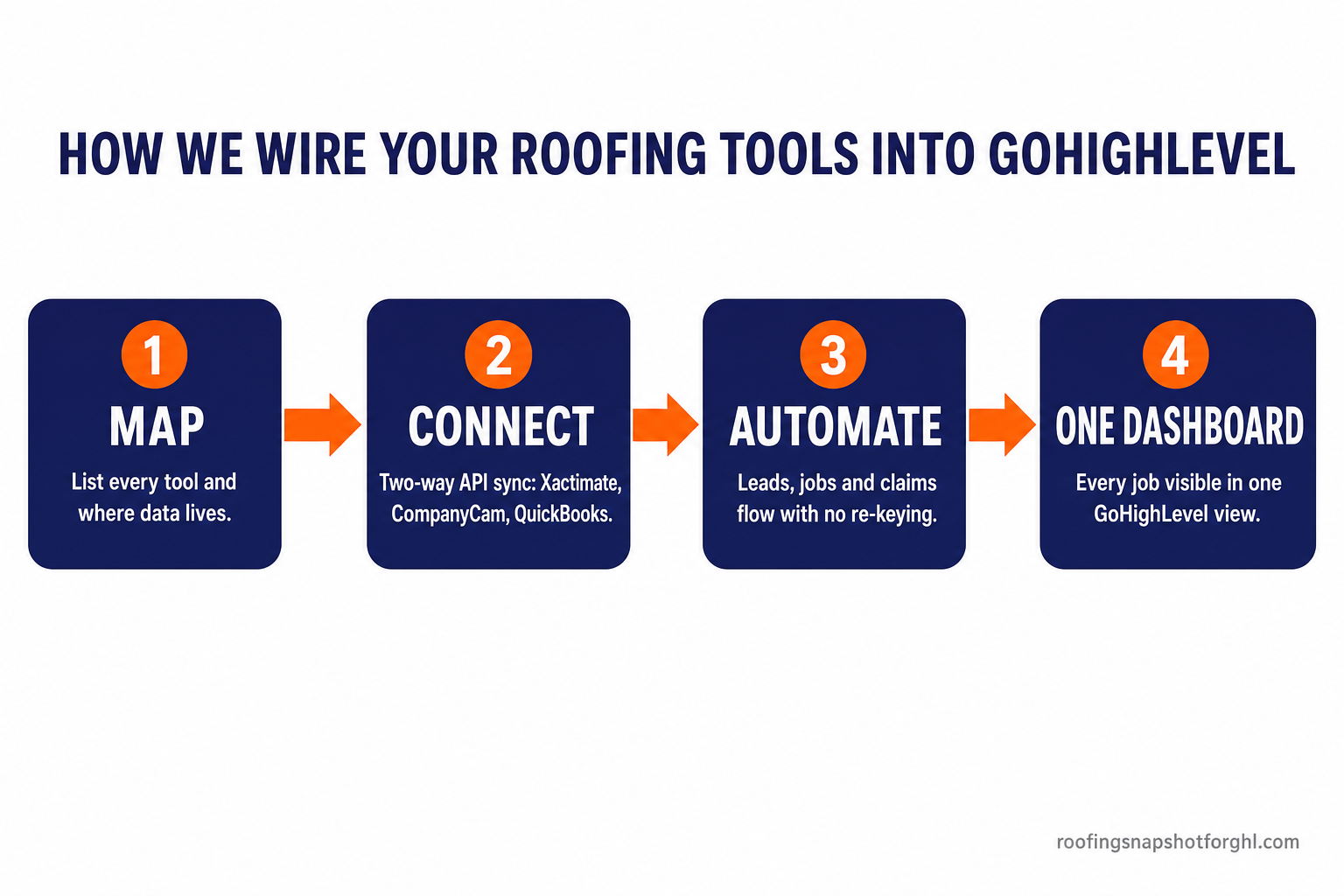
It starts with a free 30-minute discovery call to look at your GHL setup, the tools you use, and the exact gap you’re trying to close. You get back a written scope with a fixed price and timeline — no hourly meter running while engineers type, no surprise invoices. Platform-to-GHL connectors start around $3K–$8K; full migrations onto GHL run $3K–$10K depending on data volume; custom roofing AI agents run $5K–$15K; and larger job-management or claim dashboards land in the $15K–$40K range. Prefer pay-as-you-go? There’s a $75/hr retainer, and every fixed-price build includes a 30-day bug-fix warranty free.
Here’s the infographic version of the cost you’re weighing it against — the quiet tax a disconnected stack charges every week:
If you’d rather have someone run the connected system day to day once it’s built, our GHL Elite Expert + Dev plan pairs a full-time GoHighLevel VA with a developer for ongoing integrations and maintenance — so the pipeline stays wired and worked, not just launched.
Frequently asked questions: GHL integrations for roofers
Can you really connect any platform to GoHighLevel?
If it has an API, a webhook, or even just an export, yes. We regularly sync GoHighLevel with JobNimbus, AccuLynx, Roofr, CompanyCam, QuickBooks, Xactimate, EagleView, Hover, SumoQuote, Leap, and Stripe. Connections are typically two-way and near real time, so contacts, job stages, tags, photos, and estimates stay matched across systems without anyone re-keying data. For tools with no API at all, the browser UI can sometimes be automated directly.
Do I have to give up AccuLynx or JobNimbus to use GoHighLevel?
No. Many roofing companies keep their production tool — AccuLynx, JobNimbus, or Roofr — and connect it to GoHighLevel so sales and marketing live in GHL while the office keeps working where it's comfortable. A webhook-driven connector keeps both in sync. The point isn't to rip anything out; it's to stop the two systems from disagreeing and to end the double entry between them.
How much does it cost to connect my roofing tools to GHL?
Platform-to-GHL connectors typically run $3,000–$8,000 as a fixed-price project. Full migrations onto GoHighLevel run $3,000–$10,000 depending on data volume, custom AI agents $5,000–$15,000, and larger dashboards or portals $15,000–$40,000. There's also a $75/hour retainer if you prefer pay-as-you-go, and every fixed-price build includes a free 30-day bug-fix warranty. You get a written scope and fixed price after a free discovery call — no hourly surprises.
How does data entry actually stop being duplicated?
Once the tools are connected, a piece of information is entered once and syncs everywhere it's needed. A lead fills out your website form, and their details flow into GoHighLevel, trigger follow-up, and sync to your production tool and QuickBooks automatically. Nobody retypes the phone number into three systems — which also removes the typos that come from doing exactly that. Research puts duplicative work at around 236 hours a year per worker; connecting your stack is how you claw that back.
We only have a few storms a year in New York — is this worth it?
That's often when it matters most. Storm leads arrive in concentrated surges — New York averaged 6.2 billion-dollar disasters a year over 2020–2024, up from 2.1 historically — and a disconnected stack can't absorb a surge without dropping leads. Because responding in 5 minutes makes you 21× more likely to qualify a lead than waiting 30, the jobs you lose to slow, manual handoffs during a surge usually dwarf the cost of connecting your tools.
How long does a GHL integration take to build?
A single connector between two systems is usually a matter of a couple of weeks; a full migration or a custom dashboard takes longer and is scoped up front. The discovery call and written quote come first, so you know the timeline and the fixed price before any work starts. Most roofing companies start with the one connection that's causing the most re-keying, then expand from there.
The bottom line
For a New York roofing company, the disconnected-stack question comes down to one honest look at your week: how many hours does your team spend copying data between tools, and how many leads go cold in the gap between “submitted” and “someone called back”? The research says both numbers are bigger than they feel — roughly 4 hours a week lost to app-switching, 236 hours a year to duplicative work, and a 21× swing in qualification odds riding on whether you respond in 5 minutes or 30.
You don’t fix that by buying another app. You fix it by connecting the ones you have into a single GoHighLevel system that enters data once, follows up automatically, and shows every job in one place. Keep the tools that earn their keep, wire them together, and let the system do the holding-together your office is doing by hand today. When the next storm surge hits Long Island or the Hudson Valley, the roofer whose stack is connected is the one who signs the roof first.
About the author
Priya Vance is Roofing Snapshot’s Insurance Claims & Process Lead, based in Denver. She cut her teeth as a supplement coordinator for a Front Range roofing company, shepherding claims from first inspection through final deposit, and is obsessed with the unglamorous middle of the funnel — the follow-up cadences, document chasing, and system handoffs where most roofing revenue quietly leaks out. She writes about the GoHighLevel pipelines and integrations that keep a job from stalling between inspection and check. Have a question about connecting your roofing stack? Talk to a real person.
Related posts
- How to Migrate Your Roofing Business to GoHighLevel: A Step-by-Step Guide
- Why Atlanta Roofing Companies Outgrow Spreadsheets — and When Custom Software Pays Off
- The insurance claim follow-up system that stops jobs from dying
- Why a 30-second response wins storm jobs
- Roofing Sales Pipeline: The 7 Stages From Storm Lead to Signed Deposit