When does an Atlanta roofing company actually need custom software? The moment the cost of holding your business together by hand — re-typing the same job into a spreadsheet, AccuLynx, QuickBooks, and a group text — grows bigger than the cost of building a system that does it once. For most Atlanta roofers, that tipping point arrives somewhere between the third crew and the second storm season, when the tools that got you to $1M in revenue quietly start capping you there. This guide breaks down where disconnected software leaks money, why Atlanta’s storm-driven volume makes the leak worse, and the honest decision framework for when custom software pays off — written for the roofing owner who’d rather be signing deductibles than reconciling three versions of the same job list.
Key Takeaways
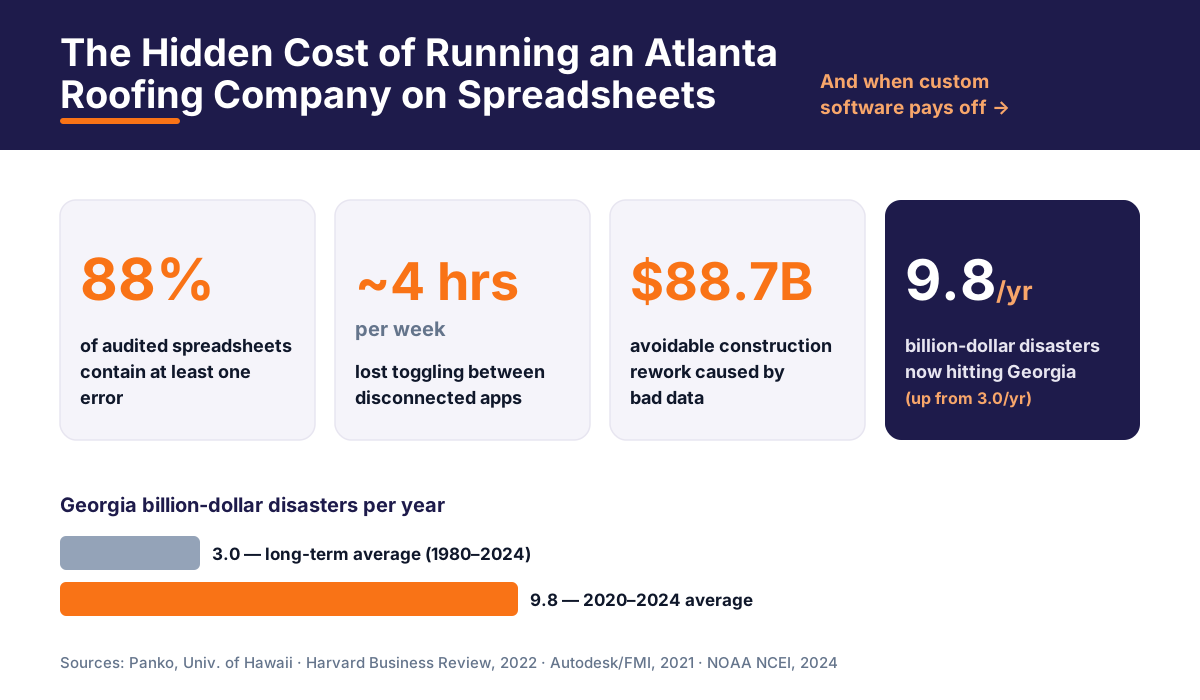
- 88% of audited spreadsheets contain at least one error (Panko, University of Hawaii, 1998/2008) — the exact tool most roofers use to track jobs, commissions, and claims is the least reliable one in the building.
- Office workers lose about 4 hours a week just re-orienting after switching between apps — roughly 1,200 toggles a day (Harvard Business Review, 2022) — and a roofing back office that lives in 5+ disconnected tools pays that “toggle tax” every day.
- Bad data cost the global construction industry an estimated $1.85 trillion in 2020, including $88.7 billion in avoidable rework (Autodesk + FMI, 2021) — disconnected systems are where “bad data” is born.
- Georgia now averages 9.8 billion-dollar weather disasters a year (2020–2024), up from a long-term average of 3.0 (NOAA NCEI, 2024) — Atlanta’s storm-driven job spikes overwhelm manual systems exactly when you can least afford it.
- Custom software pays off when it recovers more in reclaimed hours, saved jobs, and avoided rework than it costs to build — not because it’s fashionable. For many Atlanta roofers that’s a project in the low five figures, not a $500k platform.
Table of contents
- The short answer for Atlanta roofers
- The hidden tax of spreadsheets and disconnected apps
- Why Atlanta roofers feel the pain worse
- The 5 places disconnected software bleeds money
- Off-the-shelf vs. custom: what actually changes
- When does custom software actually pay off?
- What custom roofing software looks like
- FAQ
The short answer for Atlanta roofers
Spreadsheets and off-the-shelf tools aren’t the problem on day one — they’re the problem when your business outgrows them. A single crew closing a handful of jobs a month can run on a Google Sheet and a phone. But the moment you’re juggling storm leads, insurance supplements, multiple crews, and commission splits, the “system” becomes you — your memory, your late nights, and a stack of apps that don’t talk to each other.
Here’s the honest test. You probably need to look hard at custom software when three things are true at once: (1) the same job gets typed into more than two places, (2) you can’t answer “how many jobs are stuck in supplementing right now?” without opening four tabs, and (3) something profitable is already falling through the cracks — a claim that stalled, a rep who got underpaid, a homeowner who never got a callback. If that’s you, the question isn’t whether the manual system is costing money. It’s how much, and whether a purpose-built system would cost less than the leak.
The hidden tax of spreadsheets and disconnected apps
Every roofing company that “isn’t ready for real software yet” is already paying for software — in hours, errors, and lost jobs. It just doesn’t show up as a line item. Three well-documented costs stack up fast.
Spreadsheets are quietly unreliable. The landmark audit of real-world spreadsheets found that 88% contained at least one error (Panko, University of Hawaii, 1998/2008). That’s not a knock on your bookkeeping — it’s the nature of hand-keyed cells. When your commission math, your claim tracker, and your job costing all live in spreadsheets, an invisible ~5% cell-error rate compounds into underpaid reps, missed supplements, and jobs you think are profitable but aren’t.
The “toggle tax” is real and daily. A Harvard Business Review study of workers at large firms found people toggle between apps roughly 1,200 times a day and lose about 4 hours a week — nearly 9% of their time — just re-orienting after each switch (Harvard Business Review, 2022). Separately, knowledge workers spend around 1.8 hours a day searching for and gathering information (McKinsey Global Institute, 2012). Your office manager copying a new lead from a Facebook DM to a spreadsheet to AccuLynx to QuickBooks is that tax.
Hours lost per office worker per week to disconnected, manual systems: ~4 hrs re-orienting after app-switching (HBR, 2022) and ~9.3 hrs searching and gathering information (McKinsey, 2012). For a two-person back office, that’s most of a workday, every week.
App sprawl compounds it. Even the smallest companies (under 50 employees) run an average of about 36 different applications (Okta, Businesses at Work 2024). Every app that doesn’t share data with the next one becomes a manual bridge a human has to walk across — and every crossing is a chance to drop a job.
Why Atlanta roofers feel the pain worse
A dentist or a law office has a steady, predictable flow of work. Roofing doesn’t — and Atlanta roofing least of all. Georgia sits in an increasingly active severe-weather corridor, and the data shows it’s accelerating: the state was hit by 134 billion-dollar weather and climate disasters between 1980 and 2024, including 68 severe-storm events, and the annual rate has jumped from a long-term average of 3.0 events per year to 9.8 per year across 2020–2024 (NOAA NCEI, 2024).
Billion-dollar weather disasters hitting Georgia per year — the 2020–2024 average (9.8) is more than triple the long-term average (3.0). Source: NOAA NCEI, Billion-Dollar Disasters — Georgia, 2024.
What that means operationally: an Atlanta roofer’s demand doesn’t arrive evenly. A single hail cell over Cobb or Gwinnett can dump a quarter’s worth of leads into a weekend. A manual system that limps along in the slow months collapses in the busy ones — the exact weeks when every dropped lead is a five-figure job walking to a competitor. When you’re one of roughly 105,876 roofing contractors in the US (IBISWorld, 2025) — several hundred of them right here in Georgia — the winner of the storm is usually whoever’s system didn’t buckle. Speed and organization are the whole game, and that’s covered in depth in our guide to roofing sales pipeline stages.
Homeowners raise the bar too. Across industries, 83% of customers expect to interact with someone immediately when they reach out, and 59% prefer self-service for simple questions (Salesforce, State of the Connected Customer, 2022). A storm-stressed Atlanta homeowner wants a status update on their claim at 9 p.m. without calling you — and a spreadsheet can’t give them one.
The 5 places disconnected software bleeds money
When roofers add up the cost of “just using what we have,” it almost always concentrates in these five leaks.
1. Double (and triple) data entry
The same job gets keyed into the lead sheet, the CRM, the estimating tool, and QuickBooks. Every re-entry burns minutes and invites the ~5% spreadsheet error rate into your billing. This is the single most common — and most fixable — leak.
2. Slow, dropped follow-up
Leads and claims sit in whoever’s inbox or memory they landed in. In roofing, speed-to-lead decides who signs the roof, and follow-up is where revenue quietly dies — the same failure we break down in the insurance claim follow-up system. Disconnected tools have no way to say “this claim has been stuck for 9 days — nudge someone.”
3. No single source of truth
Ask three people the status of a job and you get three answers, because the truth is spread across three apps. Owners end up as the human integration layer, personally reconciling reality every morning. That doesn’t scale past a couple of crews.
4. No homeowner-facing portal
Homeowners want to upload photos, see their claim status, and sign documents without a phone call. Off-the-shelf roofing tools rarely offer a branded, self-service portal — so your team fields status calls all day instead of closing new work.
5. Reporting blind spots
You can’t improve what you can’t see. If pulling your close rate, average claim cycle time, or per-crew margin means a Sunday-night spreadsheet marathon, you’re flying blind on the exact roofing KPIs that separate a $1M shop from a $5M one.
Off-the-shelf vs. custom: what actually changes
To be clear: off-the-shelf tools are the right first step. AccuLynx, JobNimbus, QuickBooks, and a well-built GoHighLevel CRM run most roofing companies just fine — and if you’re not on a real CRM yet, start there, not with custom code. Our step-by-step guide to migrating a roofing business to GoHighLevel is the right move for most operators.
Custom software earns its place when off-the-shelf tools stop fitting — when you’re paying for features you don’t use, bolting on integrations that half-work, and still exporting to a spreadsheet to get the one report you actually need.
Running on disconnected tools vs. purpose-built software
Same job typed into 4 places. Status lives in someone's head. Homeowners call for updates. Reports mean a Sunday spreadsheet marathon. Storm spikes break the system. ~5% of cells wrong, and you find out at payroll.
Enter a job once; it flows everywhere. One dashboard shows every job's real status. Homeowners self-serve in a branded portal. Live KPIs on demand. Workflows flag stalled claims automatically. The system scales when the storm hits.
The construction data backs the direction: the broader construction and design software market is growing from $10.96 billion in 2024 to a projected $19.12 billion by 2030 (a 10.4% CAGR) (Grand View Research, 2024) — contractors are moving off manual systems because the math works, not because it’s trendy.
When does custom software actually pay off?
Custom software is a tool, not a trophy. It pays off when the return beats the build cost — and the return comes from three measurable buckets: reclaimed hours (the toggle tax and re-entry you eliminate), saved jobs (leads and claims that no longer fall through), and avoided rework and errors (the bad-data cost you stop manufacturing).
Signs you’ve hit the tipping point:
- You’re running 5+ disconnected tools and a human bridges them by hand.
- You’ve hired someone whose real job is “keep the spreadsheets in sync.”
- Off-the-shelf software forces your process into its shape instead of fitting yours.
- You need a homeowner portal, a claims dashboard, or a report your current tools simply can’t produce.
- Storm-season volume regularly breaks whatever system you have.
Signs you should wait and fix the basics first: you don’t have a CRM yet, your process changes weekly, or a configured GoHighLevel account and tighter workflows would solve 90% of it. Good GHL development is far cheaper than custom code and solves most problems — reach for custom software only when it genuinely won’t.
What custom roofing software looks like
Custom doesn’t mean rebuilding Salesforce from scratch. For a roofing company it usually means a focused system built around how you actually work — and, increasingly, one that layers AI where it saves the most time. In practice that looks like:
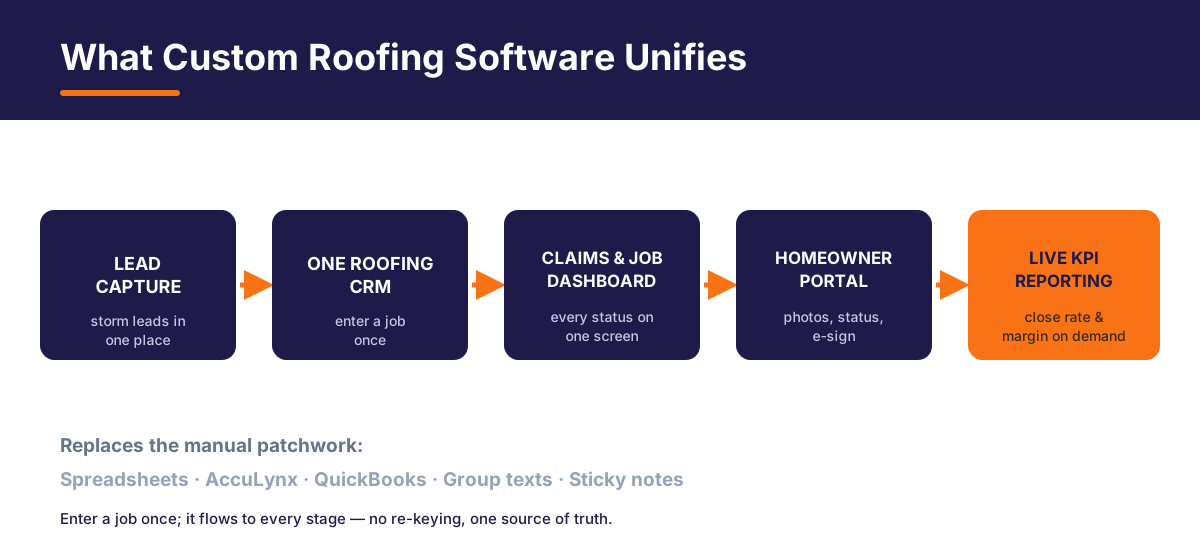
- A roofing-specific CRM where a job is entered once and flows to every stage — no re-keying.
- A homeowner / claims portal with client login, so homeowners upload photos, track claim status, and sign documents without calling your office.
- Estimate and inspection dashboards that show every job’s real status on one screen.
- Custom AI agents — an intake bot that qualifies storm leads by roof type and service area, or a claim-and-estimate processor that reads Xactimate scopes and extracts RCV/ACV line items automatically.
- Integrations that actually hold — GHL, AccuLynx, or QuickBooks wired together so data stops falling between them.
This isn’t science fiction, and it isn’t only for the big players. 58% of small businesses now use generative AI, up from 40% in 2024, and more than 80% report productivity gains (U.S. Chamber of Commerce, 2025). The roofer down the street is already automating the busywork you’re still doing by hand.
Frequently asked questions
Custom software for Atlanta roofing companies — FAQ
When should an Atlanta roofing company move off spreadsheets?
When the same job is entered in more than two places, no one can state a job's status without opening several apps, and profitable work is already slipping through the cracks. Given that 88% of audited spreadsheets contain at least one error, most roofers should be on a real CRM well before they consider custom software.
Do I need custom software, or just a better CRM?
Most roofers need a better-configured CRM first — an off-the-shelf tool like a well-built GoHighLevel setup solves the majority of problems for a fraction of the cost. Custom software makes sense only when off-the-shelf tools stop fitting your process, you need something they can't build (a homeowner portal, a claims dashboard, a specific AI agent), or storm-season volume regularly breaks your current system.
How much does custom roofing software cost?
It varies by scope. Our custom software projects are fixed-price from $3,000 up to $50,000+ for larger platforms, or $75/hour with no minimums. The right question isn't the sticker price — it's whether the reclaimed hours, saved jobs, and avoided rework add up to more than the build. For most growing Atlanta roofers, the annual cost of the manual status quo is already in five figures.
Why does Atlanta specifically need this?
Georgia's billion-dollar storm events have jumped from a long-term average of 3.0 per year to 9.8 per year across 2020–2024 (NOAA NCEI, 2024). Atlanta roofers face bursty, storm-driven demand that overwhelms manual systems exactly when the most money is on the line — so organization and speed matter more here than in steadier trades.
Will custom software replace AccuLynx or QuickBooks?
Not necessarily. Often the smartest build integrates the tools you already rely on — wiring AccuLynx, QuickBooks, and your CRM together so data stops falling between them — and adds only the custom pieces you're missing, like a homeowner portal or an AI claim processor. You own the result either way.
The bottom line
Spreadsheets and off-the-shelf tools aren’t a moral failing — they’re a stage. Every Atlanta roofing company starts there, and most should stay there longer than they think. But there’s a point where the manual system stops saving money and starts costing it: when double entry, dropped follow-up, and bad data quietly add up to more than a purpose-built system would cost to build. The data on spreadsheet errors, the toggle tax, and construction’s $1.85 trillion bad-data problem all point the same direction — disconnected tools are expensive; they just hide the bill.
The move isn’t to buy custom software because it’s impressive. It’s to run the payback math honestly, fix the CRM basics first, and reach for custom software only when it clearly costs less than the leak. In a storm market like Atlanta, the roofer whose system doesn’t buckle in the busy weeks is the one still standing in the slow ones.
About the author
Dale Rourke spent eleven years running crews and the sales board for a storm-restoration outfit in Tornado Alley before moving full-time into GoHighLevel automation. He has lived the 2 a.m. hail-event scramble, the deductible conversation on a homeowner’s porch, and the chaos of a 300-lead week — and he builds systems that tame exactly that. He writes about speed-to-lead, storm-chase capture, and the operations tooling that decides who signs the roof first.
Related posts
- How to migrate your roofing business to GoHighLevel
- Roofing KPIs: the 12 metrics every roofing company should track
- Roofing sales pipeline: the 7 stages from storm lead to signed deposit
- The insurance claim follow-up system that stops jobs from dying
Sources
- Panko, R. — What We Know About Spreadsheet Errors (University of Hawaii)
- Harvard Business Review — How Much Time and Energy Do We Waste Toggling Between Applications? (2022)
- Asana — Anatomy of Work Global Index (2023)
- McKinsey Global Institute — The Social Economy
- Okta — SMBs at Work 2024
- Autodesk + FMI — Harnessing the Data Advantage in Construction (2021)
- Grand View Research — Construction & Design Software Market Report
- IBISWorld — Roofing Contractors in the US: Number of Businesses
- Salesforce — State of the Connected Customer
- NOAA NCEI — Billion-Dollar Weather and Climate Disasters: Georgia
- U.S. Chamber of Commerce — Empowering Small Business: AI Adoption (2025)