
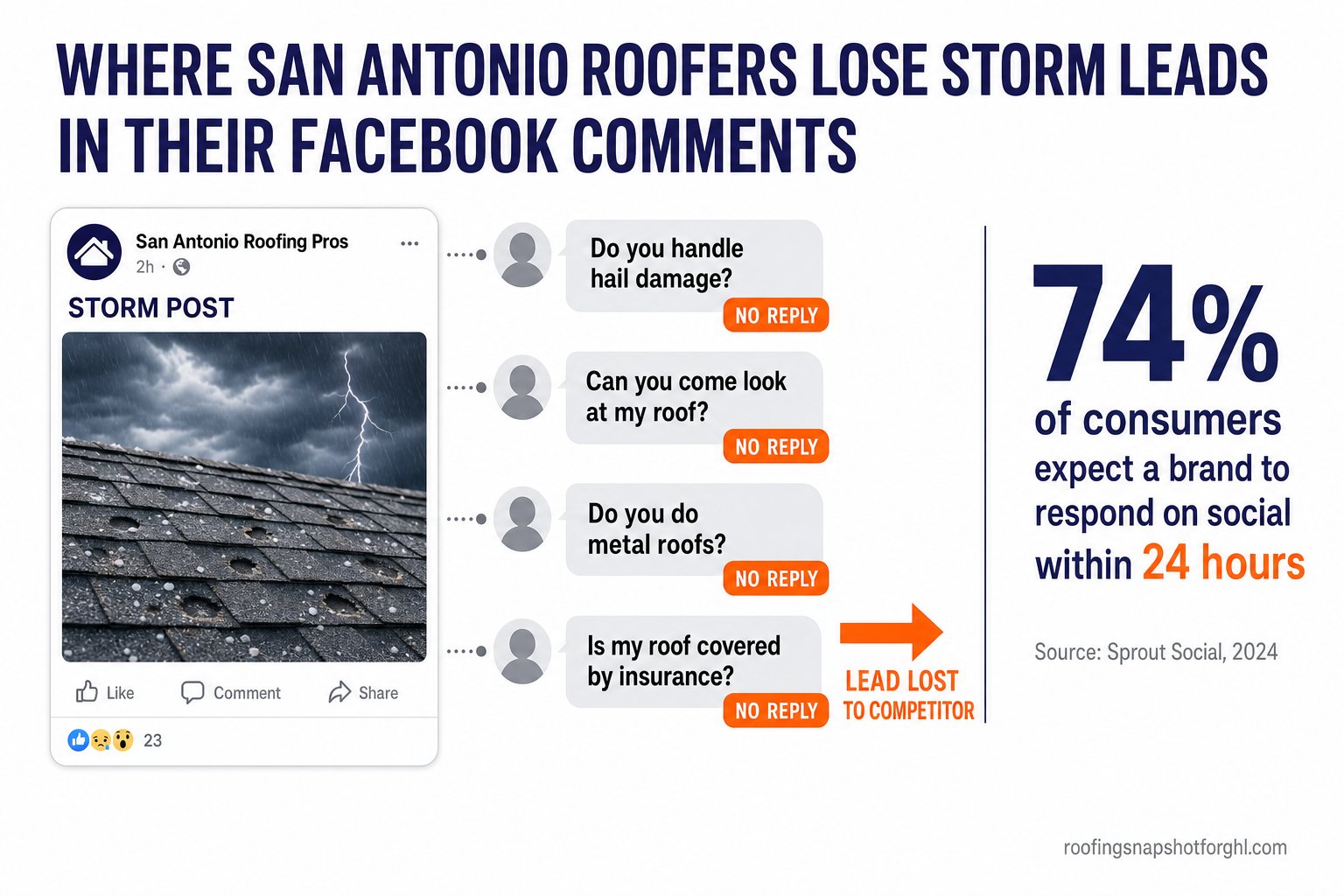
Why do San Antonio roofing companies lose storm leads in their Facebook comments? Because after a hailstorm, a single “do you handle hail damage?” post fills with dozens of homeowner comments — and by the time anyone on the crew sees them, those homeowners have already commented on three other roofers’ pages and booked with whoever replied first. The comment was a lead. The silence handed it to a competitor. Comment automation closes that gap by replying to every comment in seconds, moving the conversation to DM, and booking the inspection — around the clock, in your company’s voice.
This post is written for the San Antonio roofing owner whose Facebook and Instagram blow up after every April storm but whose booked-job count never seems to move, and for the GoHighLevel agency wiring social automation for roofing clients. Every number below is tied to a real, cited source — no “78% buy from the first responder” folklore, because that stat has no verifiable origin. The research that does hold up tells the same story, and it’s more convincing.
Key takeaways
- Texas led the nation in major hail events for the 10th straight year with 878 in 2024 (WFAA / Verisk, 2024), and San Antonio sits on the edge of hail alley — so your social posts flood with homeowner comments exactly when your crews are slammed.
- 71% of U.S. adults use Facebook and about half use Instagram (Pew Research Center, 2025). That’s where storm-damaged homeowners ask around first.
- Nearly three-quarters of consumers expect a brand to respond on social within 24 hours, and a similar share will buy from a competitor if a brand ignores their question (Sprout Social Index, 2024). An ignored comment isn’t neutral — it’s a lost job.
- Responding to a lead in 5 minutes instead of 30 makes you ~100× more likely to reach them and 21× more likely to qualify them (Lead Response Management Study, 2007). No human answers comments in five minutes at 9 PM during a storm. Automation does it in seconds.
- An AI comment agent replies publicly, moves hot leads to DM, qualifies them, and books the inspection into your CRM — turning comment threads you were ignoring into a booked calendar.
Table of contents
- The short answer for San Antonio roofers
- Why San Antonio roofers drown in comments after every storm
- What one ignored comment actually costs
- The four ways your comments leak leads
- How comment automation actually works
- What to automate vs. keep human
- How it plugs into your pipeline
- FAQ
The short answer for San Antonio roofers
Every comment under a storm post is a raised hand. The roofer who answers that hand first books the roof — and after a San Antonio hail event, “first” means minutes, not the next morning. Comment automation replies to each one instantly, pulls the serious homeowners into a private message, qualifies them, and drops a booked inspection onto your calendar, so no “can you come look at my roof?” ever goes cold at 9 PM.
Here’s why speed decides it. The most rigorous study on lead response — three years of data, more than 15,000 leads and 100,000 call attempts — found that reaching out within five minutes instead of thirty made a business about 100× more likely to make contact and 21× more likely to qualify the lead (Lead Response Management Study, 2007).
Advantage of responding to a lead in 5 minutes vs. 30 minutes (multiplier). Source: Lead Response Management Study, Oldroyd / InsideSales, 2007.
A crew chief buried in tear-offs can’t hit five minutes on a Facebook comment. An AI comment agent hits five seconds, every time, on every platform, forever. That’s the entire pitch.
Why San Antonio roofers drown in comments after every storm
San Antonio doesn’t get a roofing season so much as a roofing siege. The city sits on the southern edge of “hail alley,” the central Texas corridor that produces some of the most destructive hail in the country, and the April–June storm season is brutal on roofs. When a supercell rolls through Bexar County, a single evening of golf-ball to baseball-sized hail can put thousands of roofs into the claims pipeline at once.
That’s not a local fluke — it’s the pattern. Texas has led the United States in major hail events for ten straight years, with 878 in 2024 alone (Roofing Contractor / NOAA data, 2024). CoreLogic’s severe-storm analysis found Texas had more homes struck by damaging two-inch-plus hail than any other state in 2024 — over 180,000 (CoreLogic, via Carrier Management, 2025). Every one of those events dumps a wave of homeowner demand into local roofers’ phones, inboxes, and — increasingly — comment threads at the same moment.
Now add where that damaged-roof demand actually goes first: social media. 71% of U.S. adults use Facebook and roughly half use Instagram (Pew Research Center, 2025). After a storm, homeowners don’t open a spreadsheet of contractors — they post in the neighborhood group, comment on the roofing companies they already follow, and DM the page whose before/after reel they saw last week. Every one of those is an inbound lead landing in a comment thread or an inbox, not a phone call.
The problem was never demand. The problem is what happens to that demand after the crews go home — the comment sitting unanswered under last Tuesday’s storm post while the homeowner keeps scrolling to the next roofer.
What one ignored comment actually costs
Most roofers treat an unanswered comment as a zero — a little missed, no harm done. The data says it’s a negative. Nearly three-quarters of consumers expect a brand to respond on social media within 24 hours, and a similar share say they’ll buy from a competitor if a brand fails to respond to their question on social (Sprout Social Index, 2024). Ignoring a “do you do metal roofs?” comment doesn’t hold the lead steady — it actively pushes that homeowner toward the roofer who replied.
And most businesses are painfully slow to reply anywhere. When researchers audited 2,241 U.S. companies, only 37% responded to an inbound web lead within an hour, 23% never responded at all, and the average response time was 42 hours (Harvard Business Review, 2011). Forty-two hours after a San Antonio hailstorm, the roof is already signed.
How fast 2,241 U.S. companies responded to inbound leads (share of companies, %). Source: Harvard Business Review, “The Short Life of Online Sales Leads,” 2011.
There’s a second, quieter cost. Comments are engagement, and engagement is what the Facebook and Instagram algorithms reward with reach. A storm post where you reply to all 40 comments gets pushed to more local homeowners than the identical post left silent. So every ignored comment costs you twice: the lead you didn’t answer, and the reach you didn’t earn.
The four ways your comments leak leads
When we audit a roofer’s social accounts, the leaks are almost always the same four:
- The after-hours storm surge. Hail hits at 6 PM, the post blows up by 9 PM, and nobody’s watching the page until the next morning. Peak intent, zero coverage — and roof-damage searches spike at exactly the hours your office is closed.
- The public question that never gets a public answer. “Do you handle hail damage?” left hanging tells every other homeowner reading the thread that you don’t answer — while a fast, helpful reply is a free ad seen by everyone who scrolls past.
- The comment that should’ve become a DM. A homeowner comments “can you come look at my roof?” but nobody moves them into a private message to get their address and book. The lead stalls in public where you can’t qualify it.
- The reply with no system behind it. Even when someone does reply, the conversation lives and dies in the comments — no contact created, no pipeline stage, no follow-up. It’s a chat, not a lead, and it evaporates.
How comment automation actually works
Comment automation isn’t a canned “Thanks for reaching out!” bot. Done right for roofing, it’s a four-step handoff that runs on Facebook, Instagram, and TikTok:
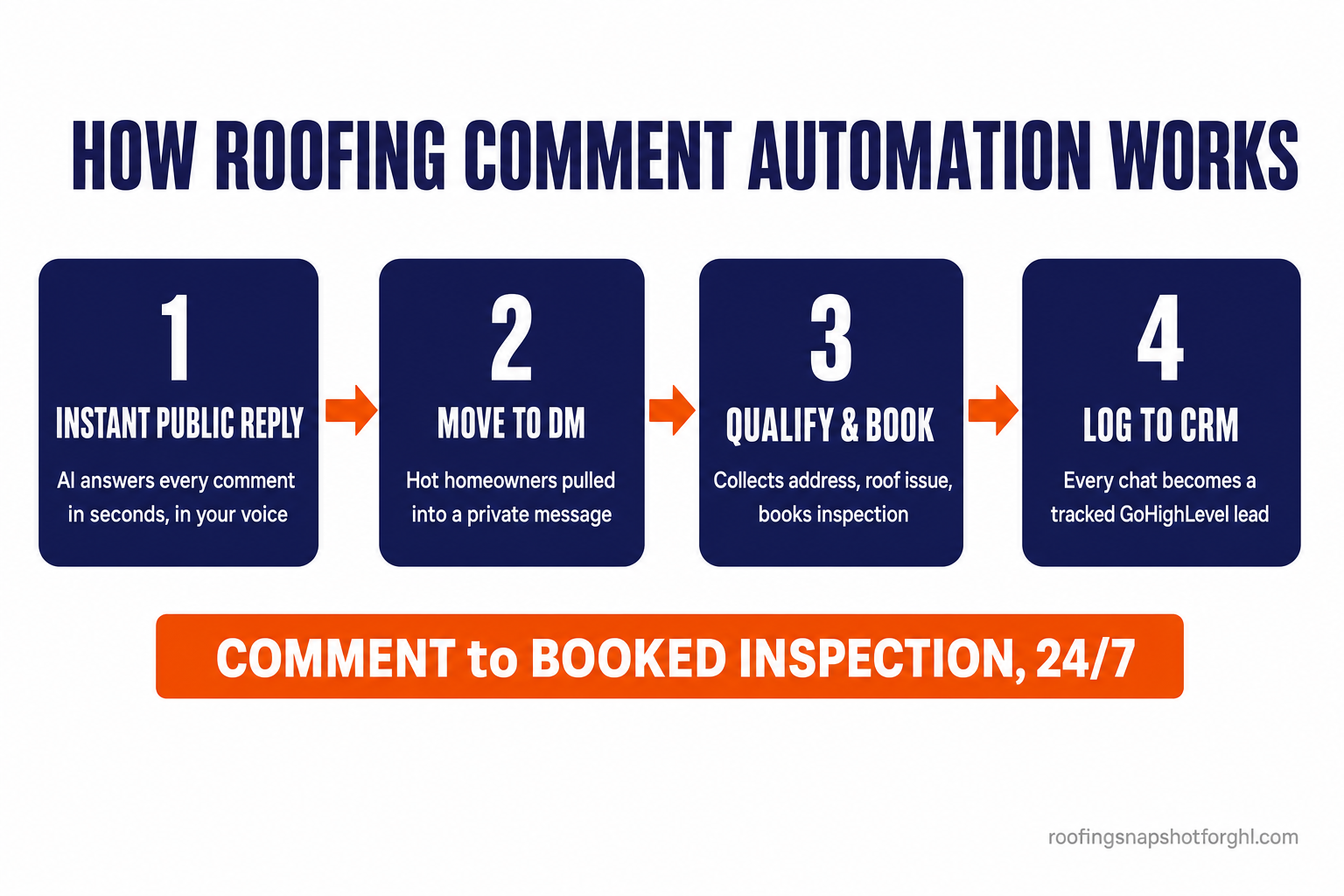
- Instant public reply. The moment a homeowner comments on a storm post, reel, or ad, the AI answers in your company’s voice — helpful, specific, and visible to everyone else reading. That reply is both a response to the lead and a public signal that you show up.
- Move to DM. For anyone showing real intent (“can you come out?”, “do you take my insurance?”), the agent moves the conversation into a private message to collect the details you can’t ask for in public — name, address, roof age, insurance status.
- Qualify and book. In the DM, the AI DM agent qualifies the homeowner and books a free inspection straight onto your calendar, syncing to the Google Calendar you already run your day from — 24/7, no crew member needed.
- Write it to the CRM. Every conversation becomes a tracked contact and a pipeline stage in GoHighLevel, so your speed-to-lead SMS, claim tracking, and review requests pick up automatically. It’s a booked lead, not a disappearing chat log.
The reason this beats a faster human is simple: the human doesn’t exist at 9 PM during a storm. Automation replies in seconds at any hour — and given that answering in 5 minutes instead of 30 makes you 21× more likely to qualify a lead, an agent that answers in seconds beats every slower competitor on the one metric that decides who signs the roof.
What to automate vs. keep human
Automation isn’t “replace your sales rep.” It’s “never miss the raised hand, and hand a warm, qualified homeowner to a human.” Here’s the split we run for roofers:
| Automate (instant, 24/7) | Keep human |
|---|---|
| First reply to every comment on posts, reels, and ads | The actual inspection and the on-porch close |
| Answering common questions (hail damage, metal, insurance, service area) | Judgment calls on complex commercial or disputed claims |
| Moving hot commenters into a DM | Pricing conversations that need a real estimate |
| Collecting name, address, roof issue, insurance status | Relationship-building with repeat and referral customers |
| Booking the free inspection onto your calendar | Anything the homeowner explicitly asks a person for |
| Logging every conversation as a CRM contact | — |
The goal is that a human never spends a minute on a lead that isn’t already qualified and booked — and never loses one because they were on a roof when the comment came in.
How it plugs into your pipeline
Comment automation is only worth it if it feeds the system that turns a booked inspection into a signed contract and a paid supplement. Wired into GoHighLevel, every comment-to-DM conversation becomes a contact, a pipeline stage, and a booked appointment your follow-up automations already know how to work — the same CRM running your speed-to-lead SMS, insurance-claim tracking, and review harvesting. One system, not a pile of disconnected apps.
That’s why we build it as part of done-for-you roofing social rather than a bolt-on bot: the content that generates the comments, the agents that answer them, and the CRM that closes them are the same machine. For a roofer already running the Roofing Snapshot, it’s a wiring job on a foundation you already have — and the homeowner commenting at 9 PM during the next April hail event is exactly the lead it’s built to catch.
Frequently asked questions
Facebook & Instagram comment automation for San Antonio roofers
What is comment automation for a roofing company?
It's an AI agent that automatically replies to comments on your Facebook, Instagram, and TikTok posts, reels, and ads in your company's voice. Instead of leaving a 'do you handle hail damage?' comment to go cold, it answers instantly and publicly, moves serious homeowners into a private message to qualify them, books a free inspection onto your calendar, and logs the whole conversation to your CRM as a tracked lead.
How is comment automation different from DM automation?
Comments are public replies under your posts, reels, and ads; DMs are private one-to-one messages. Comment automation catches the public raised hand — the questions dozens of homeowners leave on a storm post — and hands the hot ones off to DM automation, which collects their details and books the inspection. Most roofers only set up one; you want both, because after a hailstorm the leads arrive in both places.
Why does this matter so much for San Antonio roofers specifically?
San Antonio sits on the edge of hail alley, and Texas has led the U.S. in major hail events for ten straight years — 878 in 2024 (WFAA/Verisk). Every hail event floods your social posts with homeowner comments at once, usually in the evening after the storm when your crews are done for the day. That after-hours surge is exactly what automation covers and a human team can't.
Won't an automated reply sound like a robot and hurt my brand?
A bad bot will. A good one is trained on your services, your service area, and real roofing questions — hail vs. wind damage, metal roofs, insurance claims — and replies in your company's voice. Because nearly three-quarters of consumers expect a response within 24 hours and will switch to a competitor if you ignore them (Sprout Social, 2024), a fast, helpful, on-brand reply beats a slow human one — and beats silence every time.
Does answering comments actually get me more reach?
Yes. Comments are engagement, and engagement is what the Facebook and Instagram algorithms reward with reach. A storm post where you reply to every comment gets pushed to more local homeowners than the same post left silent — so comment automation earns you free reach on top of the leads it captures.
Do I need GoHighLevel to run comment automation?
Not strictly, but it's the easiest path if you want the comments to turn into revenue instead of just conversations. Connected to GoHighLevel, every comment-to-DM chat becomes a contact, a pipeline stage, and a booked inspection that your speed-to-lead SMS, claim tracking, and review automations can work — instead of a chat that vanishes in your notifications.
What does done-for-you roofing social with comment automation cost?
Our done-for-you roofing social starts at $397/month for one brand — that includes 5-day-a-week content across all 9 channels plus three AI agents: a Comment agent for TikTok, Instagram, and Facebook, a DM agent that books inspections, and a website Web Chat agent. It's white-label with no setup fees. See the social-media page for the full breakdown.
About the author — Marcus Ellison. Marcus runs a small GoHighLevel agency on the Gulf Coast that productizes roofing snapshots for contractors across hurricane and hail country. He thinks like an operator first and a marketer second: reviews that compound, Google profiles that rank, and social systems that turn last night’s storm into this week’s booked inspections. He writes for both the agency owner reselling GHL and the roofer who just wants the phone — and the comments — to convert.
Related posts
- Facebook & Instagram DM automation for roofing companies — the private-message half of the same lead-capture system.
- Social media marketing for roofing contractors — what to actually post so your comments fill up.
- Roofing lead response time: the speed that wins jobs — the data behind answering first.
- How to add an AI chat widget to your roofing website — the same speed-to-lead logic, applied to your site.
- Get more Google reviews for your roofing company — turn those booked jobs into reviews that compound.