
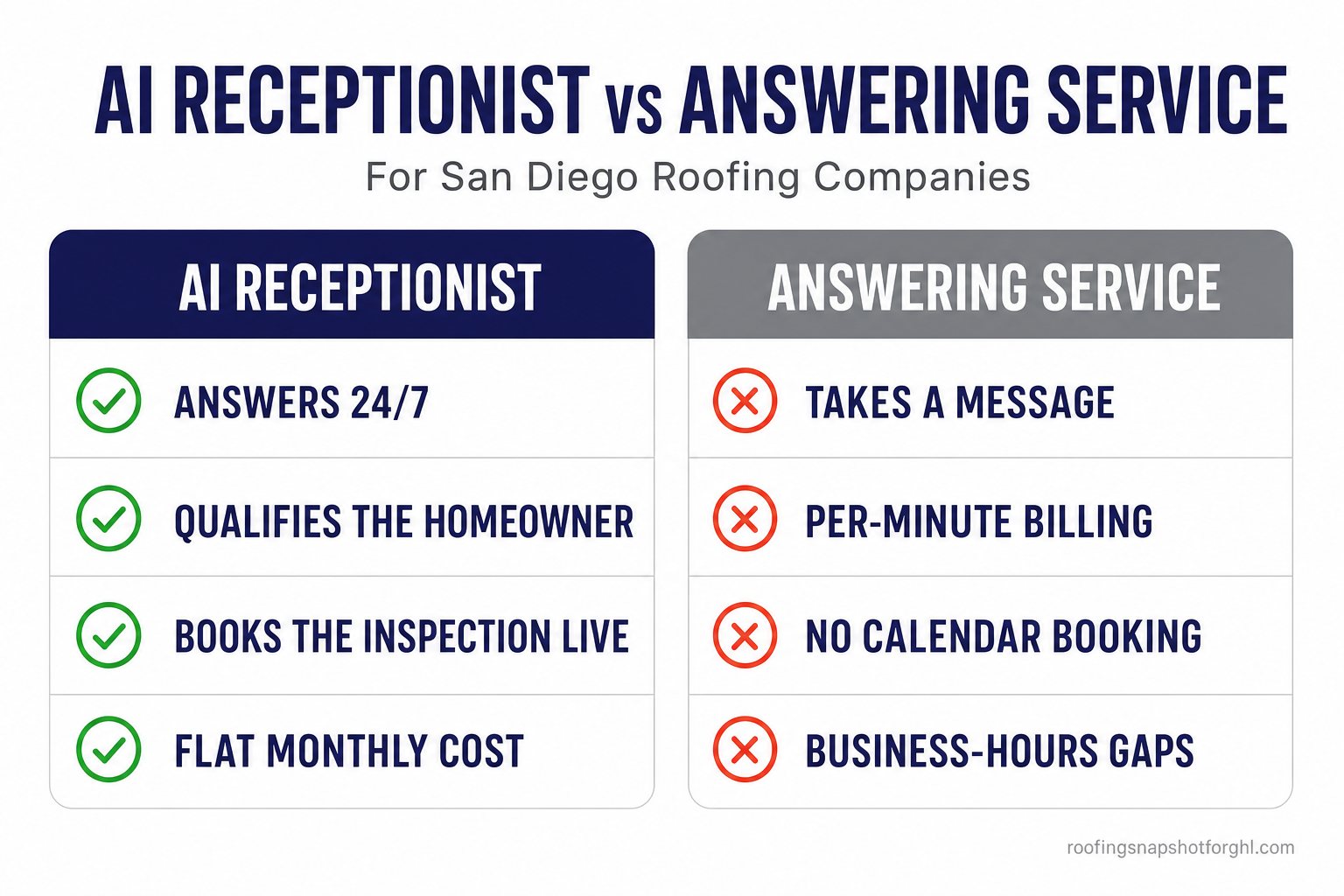
Which is better for a San Diego roofing company — an AI receptionist or a human answering service? For most roofers the answer is the AI receptionist, because it does the one thing a message-taking service can’t: it qualifies the homeowner and books the inspection live on your calendar, 24/7, for a flat monthly cost instead of a per-minute bill. A human answering service is a real upgrade over voicemail, but its core product is a message — someone still has to call that homeowner back before a competitor does.
This guide compares the two head-to-head (plus the in-house front-desk hire most owners consider first) on the things that actually decide whether a call turns into a signed roof: cost, coverage hours, speed-to-lead, and whether the inspection gets booked. It’s written for the San Diego roofing owner who’d rather be walking a tile roof in Chula Vista than chasing voicemails — and for the GHL agency serving roofing clients across Southern California.
Key Takeaways
- An AI receptionist books the inspection; a human answering service takes a message. That single difference is the whole comparison — one closes the loop, the other hands you a callback to make before the lead goes cold.
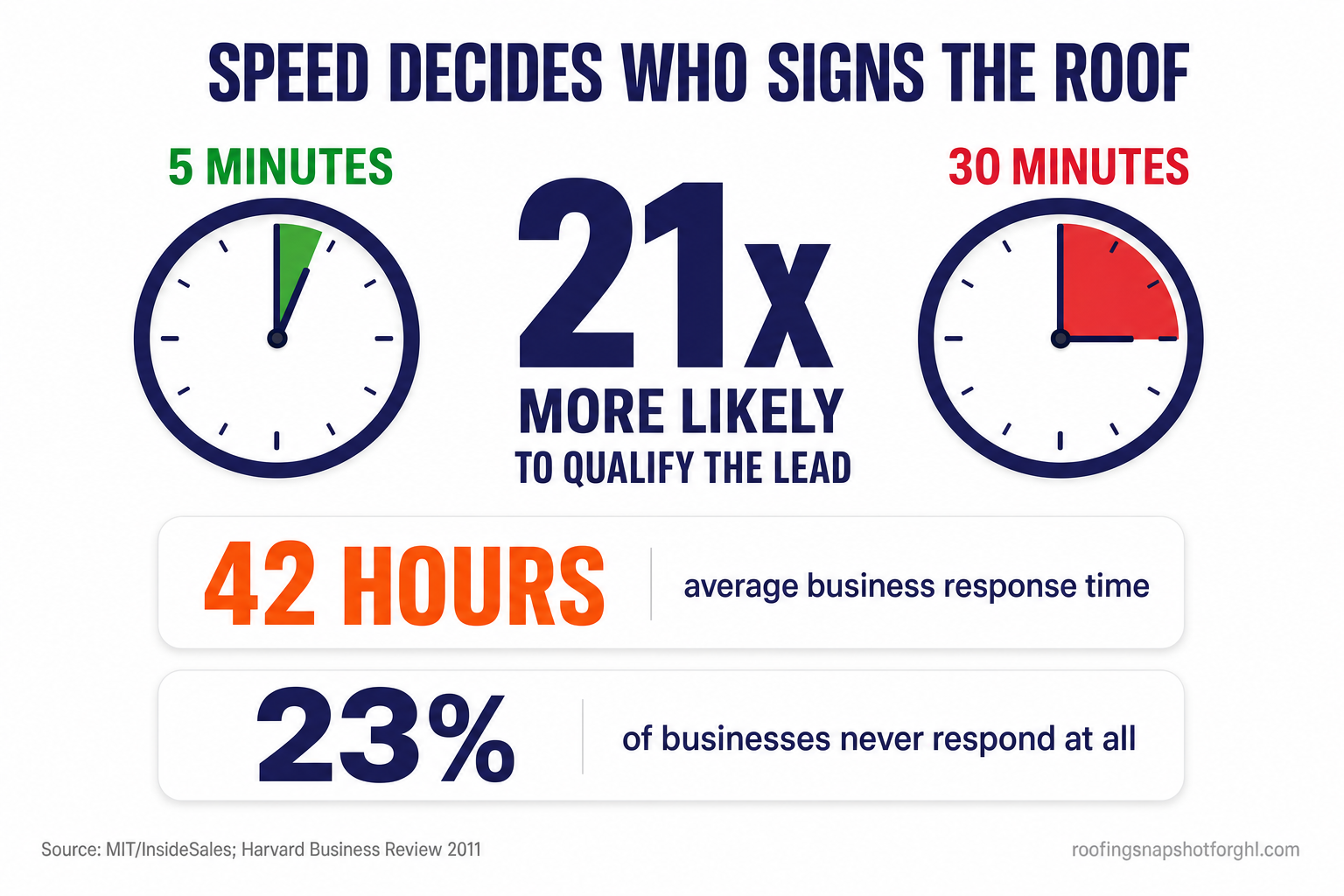
- Speed is the game. Contacting a lead within 5 minutes instead of 30 makes you about 21× more likely to qualify it (MIT / InsideSales Lead Response Management study) — yet the average business takes 42 hours to respond and 23% never respond at all (Harvard Business Review, 2011).
- Home-service businesses miss about 14% of inbound calls (CallRail, analysis of 1.1M leads, 2025) — and in a market where the average U.S. roof replacement runs about $9,500 (Angi, 2026), each missed call can be a five-figure job.
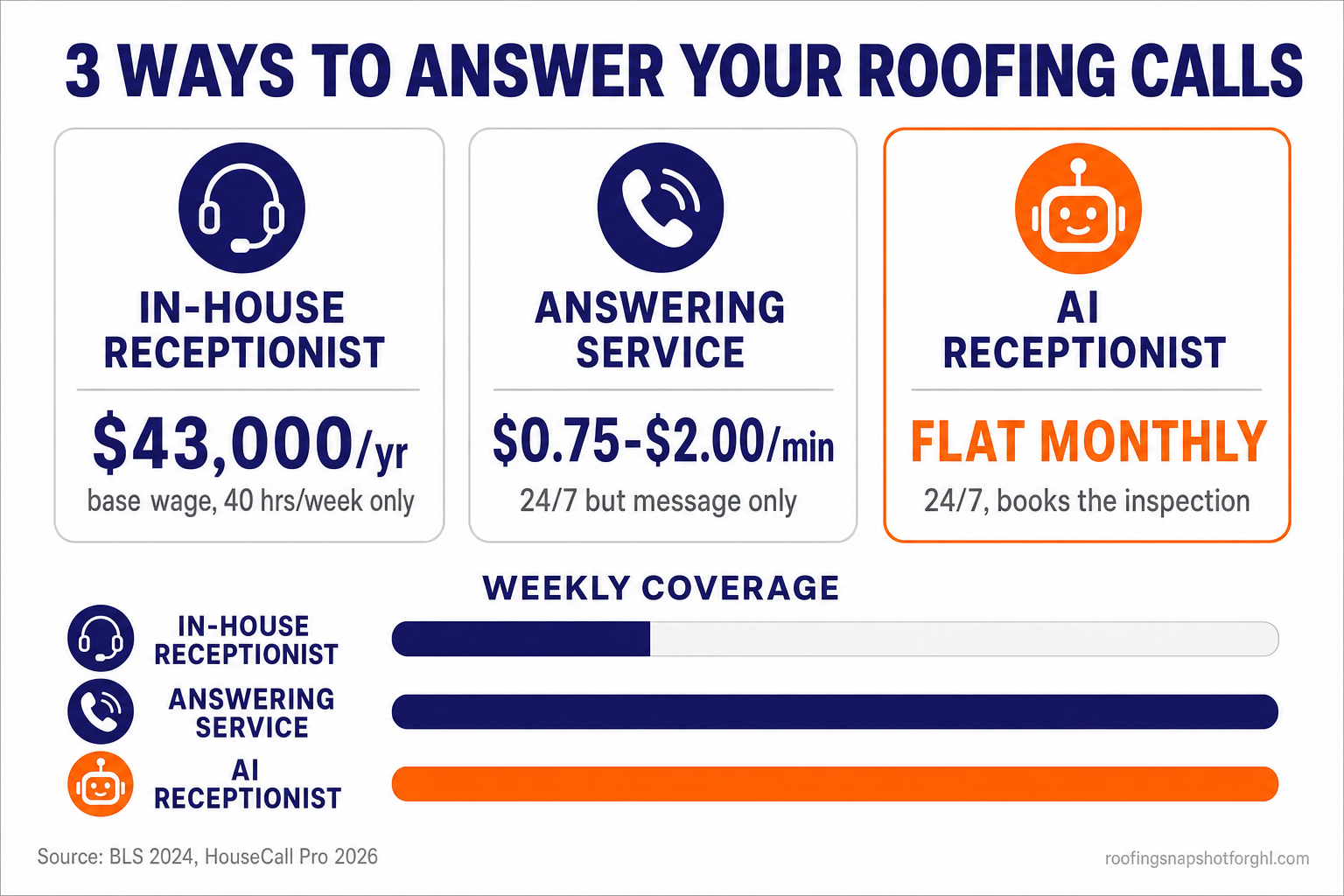
- The cost math favors AI. One full-time in-house receptionist in the San Diego metro averages $20.76/hour — about $43,000/year in base wages alone (U.S. BLS, May 2024) for 40 hours a week. A human answering service typically bills $0.75–$2.00 per minute (HouseCall Pro, 2026). An AI receptionist is a flat monthly cost for 24/7 coverage.
- This isn’t fringe tech. Gartner projected conversational AI would cut contact-center labor costs by $80 billion by 2026 (Gartner), and the AI voice-agent market is growing at roughly a 39% CAGR (Grand View Research).
Table of contents
- The short answer for San Diego roofers
- Why San Diego is a 24/7, high-value roofing market
- What each option actually is
- AI receptionist vs answering service vs in-house: the comparison
- The cost math, side by side
- Speed-to-lead: why booking beats message-taking
- When a human answering service still wins
- How the AI receptionist plugs into your pipeline
- FAQ
The short answer for San Diego roofers
For most San Diego roofing companies, an AI receptionist is the better call — it answers every call 24/7, qualifies the homeowner, and books the inspection straight onto your crew calendar for a flat monthly fee, while a human answering service mostly takes messages you still have to act on and bills you by the minute. The in-house front-desk hire — the option owners reach for first — is the most expensive and only covers business hours.
The distinction that matters isn’t “robot vs human.” It’s message-taking vs booking. A message-taking service, human or not, just moves the follow-up back onto your plate: someone on your team still has to call that homeowner, and every hour of delay bleeds the lead. A system that books the appointment while the homeowner is still on the line is the only one that actually closes the gap — and that’s the job a roofing-trained AI receptionist is built for.
The rest of this article backs that up with numbers on cost, coverage, and speed — and they all point the same way.
Why San Diego is a 24/7, high-value roofing market
San Diego isn’t a hail market like Dallas or Oklahoma City. Roofing demand here is driven by age, value, wind, and fire — and it runs year-round, which changes what “covering your phones” has to mean.
Start with the stakes. San Diego County’s median home value is roughly $854,700 (U.S. Census / ACS, 2024) — well above the California and national medians. These are high-value homes with tile, slate, and premium re-roofs, where a single job is a serious ticket. Nationally the average roof replacement is about $9,500 (Angi, 2026), and California typically runs above that. Miss the call, and you’re not out a repair — you’re out a job worth many thousands of dollars.
Then the drivers that make demand unpredictable and after-hours:
- Santa Ana winds. Every fall through spring, offshore Santa Ana events drive gusts that reach hurricane-force in the passes and canyons (National Weather Service) — tearing tiles, lifting flashing, and sending homeowners to the phone the moment the wind lays down, often in the evening.
- Wildfire. California logged 8,110 wildfires that burned over 1,077,000 acres and destroyed 1,837 structures in 2024 (CAL FIRE, 2024). Fire-hardened roofing and post-fire rebuilds are steady, high-intent demand across the county.
- Aging roofs + solar. A huge installed base of 20-to-30-year-old roofs, plus roof-plus-solar re-roofs, means a constant drip of repair and replacement calls that don’t wait for business hours.
What each option actually is
Before comparing them, it’s worth being precise about what you’re actually buying with each.
A human answering service
A live, off-site operator answers your calls — usually 24/7 — using a script you provide. They’re real people, and for empathy on a sensitive call that’s genuinely valuable. But their core deliverable is a message: they take the caller’s name, number, and reason for calling, then email or text it to you. Most bill per minute (typically $0.75–$2.00) or per call (HouseCall Pro, 2026), with small-business plans often landing around $135–$400/month before overage (AnswerConnect, 2025). Most generic services can’t see your crew calendar or qualify a roof, so booking still comes back to you.
An in-house receptionist
A front-desk hire who knows your business and can book directly. The catch is cost and coverage: in the San Diego metro, receptionists earn a mean $20.76/hour — about $43,000/year in base wages for a 40-hour week (U.S. BLS, May 2024) — before payroll taxes, benefits, and PTO. And a 40-hour hire still leaves nights, weekends, lunch breaks, and sick days uncovered — the exact windows when San Diego roof calls come in.
An AI receptionist
A roofing-trained AI voice agent that answers on the second ring, 24/7, holds a natural conversation, qualifies the homeowner (address, roof type, tile vs. shingle, wind vs. fire vs. leak, insurance status), and books the inspection live on your calendar — then texts a confirmation and logs the lead in your CRM. It’s a flat monthly cost with no per-minute meter. This isn’t a “press 1 for sales” phone tree; it’s the same job a great front-desk rep does, minus the salary, the schedule, and the voicemail. Gartner projected conversational AI would strip $80 billion out of contact-center labor costs by 2026 (Gartner), and the AI voice-agent market is compounding at roughly 39% a year (Grand View Research) — this is where inbound is heading.
Global AI voice-agents market size, USD billions (2025 ≈ $2.54B, projected ~$35.24B by 2033, ~39% CAGR). Source: Grand View Research.
AI receptionist vs answering service vs in-house: the comparison
Here’s the head-to-head on what actually matters to a roofing company. The dividing line is the “Books the inspection” row — everything else follows from it.
| What matters for a roofing call | AI receptionist | Human answering service | In-house receptionist |
|---|---|---|---|
| Coverage | 24/7/365, no gaps | Usually 24/7 | Business hours only (~40 hrs/wk) |
| Answers every call | Yes — no hold, no lunch | Yes, but hold times on busy lines | No — misses nights, weekends, PTO |
| Qualifies the homeowner | Yes — roof type, wind/fire/leak, insurance | Rarely — generic script | Yes, if trained |
| Books the inspection live | Yes — on your calendar | No — takes a message | Yes |
| Speed of follow-up | Instant (booked on the call) | Delayed (you call back) | Instant, in hours; delayed after |
| Cost model | Flat monthly, no per-minute meter | Per-minute / per-call + overage | ~$43k/yr base + taxes & benefits¹ |
| Logs lead into your CRM | Yes — automatic | Sometimes, manual | Manual |
| Scales on a busy night | Unlimited simultaneous calls | Limited by staffed operators | One person, one call |
¹ Mean San Diego metro receptionist wage $20.76/hr × 2,080 hrs (BLS, May 2024), before payroll tax, benefits, and PTO.
The cost math, side by side
Cost is where the three options separate hardest — but only if you count coverage alongside the sticker price.
An in-house receptionist is the most expensive and the least available: about $43,000/year in base wages for the San Diego metro (BLS), and that’s before payroll taxes, benefits, and PTO push the fully loaded cost well past $55,000 — all for ~40 hours a week. Nights and weekends, when a lot of Santa Ana and leak calls land, are simply uncovered.
A human answering service is far cheaper up front — but it’s metered. At $0.75–$2.00 per minute (HouseCall Pro), a normal week is affordable, but a windy stretch that triples your call volume can blow past your plan minutes into overage. And you’re still paying to receive a message, not a booked job.
An AI receptionist is a flat monthly cost for 24/7, unlimited-call coverage — the meter doesn’t spin faster on your busiest night, and it books the appointment instead of handing you a callback list.
Speed-to-lead: why booking beats message-taking
This is the heart of it. The reason “books the inspection” beats “takes a message” isn’t convenience — it’s that speed decides who signs the roof.
The classic MIT/InsideSales Lead Response Management study found that contacting a web lead within 5 minutes instead of 30 makes you about 21× more likely to qualify it, and roughly 100× more likely to reach the person at all (via LeadAngel). Harvard Business Review’s audit of 2,241 U.S. companies found the average firm took 42 hours to respond to an inbound lead, only 37% responded within an hour, and 23% never responded at all (HBR, 2011).
Now map that onto the answering-service model. The service answers at 8 PM, takes a message, and emails it to you. You see it at 7 the next morning — an 11-hour gap — and call back, and by then the homeowner has already booked the roofer who answered live. The message-taking model builds in the delay the data says kills the lead. An AI receptionist collapses that gap to zero: the inspection is booked before the caller hangs up.
Share of inbound calls that go unanswered, by industry (home services ≈ 14%). Source: CallRail analysis of 1.1M leads, 2025.
Even a 14% miss rate (CallRail) is brutal when each answered call can be a $9,500-plus job (Angi). Roughly one in seven callers hits a dead end today — and the ones who do rarely wait around. This is the same reason a 30-second response wins storm jobs: whoever answers and books first, wins.
When a human answering service still wins
To be fair to the alternative: a human answering service is a legitimate choice, and there are cases where it’s the right one.
- You want human empathy on emotional calls. After a fire loss or a major leak, some homeowners want a person. A well-trained human operator handles that warmth better than any AI — though the best AI voice agents are now remarkably natural.
- Your call volume is tiny and predictable. If you get two calls a week, a bare-bones message service or even a good voicemail-to-text may be enough, and the ROI on any automation is thin.
- You have complex, non-standard intake that resists any script. Some commercial or specialty work needs a human judgment call at first contact.
For the roofing owner who mainly wants the phone answered so a person exists on the other end, an answering service beats voicemail every time. The point of this comparison isn’t that answering services are bad — it’s that if your goal is booked inspections, message-taking leaves the most important step undone.
How the AI receptionist plugs into your pipeline
An AI receptionist isn’t a standalone gadget — its value is that it feeds the rest of your system. A booked inspection is only the start; what makes it pay off is everything wired behind it.
When the AI books the call, it drops the homeowner straight into your CRM’s storm-or-repair pipeline and fires the follow-up: an SMS confirmation and reminder cadence so the inspection doesn’t no-show, the AI chatbot catching the same homeowner if they’d rather message than call, and review harvesting turning the finished job into the social proof that wins the next one. The receptionist answers; the automation makes sure answering turns into a signed, paid roof.
If you’d rather a human still own the relationship while the AI covers the phones, that’s what pairing it with a dedicated GHL VA is for — the AI never misses a call, and your VA works the pipeline the AI fills. And if you want the whole storm-to-deposit system behind it, that’s the Roofing Snapshot: the AI caller, the pipelines, the follow-up, and the site, installed and live in about 24 hours.
For the deeper case on why missed calls quietly bleed a roofing business, see our breakdown of why roofers lose jobs to missed calls and why a 30-second response wins.
Frequently asked questions
AI receptionist vs answering service for San Diego roofers — FAQ
What's the real difference between an AI receptionist and an answering service?
An answering service's core product is a message — a human operator takes the caller's details and passes them to you to act on. An AI receptionist qualifies the homeowner and books the inspection live on your calendar during the call, then logs the lead in your CRM. One closes the loop; the other hands you a callback to make. For roofing, where speed-to-lead decides who signs the job, booking beats message-taking.
Is an AI receptionist cheaper than a human answering service for a San Diego roofing company?
It depends how you count. A human answering service is cheap up front — typically $0.75–$2.00 per minute or around $135–$400/month for a small plan — but it's metered, and it only takes messages. An AI receptionist is a flat monthly cost for 24/7 unlimited-call coverage that also books the job. On cost per booked inspection, the AI usually wins because it doesn't leave the most valuable step undone. Both are far cheaper than an in-house receptionist, who averages about $43,000/year in base wages in San Diego (BLS, May 2024) for only 40 hours a week.
Will an AI receptionist sound robotic to my customers?
Modern roofing-trained AI voice agents hold a natural, conversational back-and-forth — they're not the old 'press 1 for sales' phone trees. They answer on the second ring, ask the right roofing questions (roof type, wind vs. fire vs. leak, insurance status), and book the appointment. For emotionally sensitive calls, such as a fire loss, some owners still prefer a human touch, which is a fair reason to keep a human answering service in the mix.
Why does San Diego specifically need 24/7 call coverage if there's no hail?
San Diego's roofing demand is driven by Santa Ana winds, wildfire, aging roofs, and solar re-roofs rather than hail — and those calls come in year-round and after hours. Santa Ana events reach hurricane-force gusts (NWS) and California saw 8,110 wildfires in 2024 (CAL FIRE). A 40-hour in-house hire leaves nights and weekends — prime call windows — uncovered, which is exactly where an always-on AI receptionist earns its keep.
How fast do I actually need to respond to a roofing lead?
Fast. Contacting a lead within 5 minutes instead of 30 makes you about 21× more likely to qualify it (MIT/InsideSales), yet the average business takes 42 hours to respond and 23% never respond at all (HBR, 2011). A message-taking service builds that delay back in; an AI receptionist that books on the call collapses response time to zero.
Can I use an AI receptionist and still have a human involved?
Yes — that's the common setup. The AI answers every call 24/7 and books inspections; a human (your team or a dedicated GHL VA) works the pipeline the AI fills, handles complex intake, and calls back the rare case that needs a person. You get full coverage without paying for a night-shift front desk.
Related posts
- Why Charlotte Roofers Lose Jobs to Missed Calls (and How an AI Receptionist Fixes It)
- Why a 30-Second Response Wins Storm Jobs
- Never Miss a Storm Call Again
- How to Add an AI Chat Widget to Your Roofing Website
- AI for Roofing Contractors
Written by Dale Rourke, Roofing Operations Strategist (Oklahoma City, OK). Dale spent eleven years running crews and the sales board for a storm-restoration outfit before moving full-time into GoHighLevel automation. He has lived the after-hours lead scramble and the deductible conversation on a homeowner’s porch, and he builds snapshots that make sure no roof call — day or night — ever hits voicemail.