
It is a Thursday night and you are trying to put a real number into a spreadsheet so you can decide what software to run your roofing company on next year. You open the JobNimbus pricing page. Four plans, and every one has a button that says “request pricing.” No number. So you book a demo, sit through forty minutes, and the rep talks around the total.
Here is the short answer. JobNimbus does not publish a price in 2026, but from consistent third-party reporting the base plan runs roughly $225 a month for a small team up to about $550 for a larger one, plus $20 to $75 per user per month by role, before you add texting (Projul, 2026). Texting is a separate add-on, migration can cost extra, and the measurement and photo tools you still need sit outside the bill entirely. This post tears the whole thing apart: every tier, every fee the demo skips, three cost scenarios by team size, and what the new private-equity owner means for your next renewal.
Key Takeaways
- JobNimbus hides its price in 2026. All four plans show “request pricing,” so every number below is third-party reporting, not a published rate (Projul, 2026).
- It is a three-layer bill: a monthly base (about $225 to $550), plus $20 to $75 per user per month by role, plus texting as a separate add-on (Projul, 2026).
- SumoQuote is now included, since JobNimbus bought it in January 2024 and folded its proposals into every subscription (JobNimbus, 2024).
- The owner changed. Sumeru Equity Partners made a $330 million control investment in November 2024, and private-equity ownership usually pushes pricing up (Business Wire, 2024).
- Use a published price to negotiate. Roofr lists everything, free up to $349 a month with no per-seat fee (Roofr, 2026).
Table of contents
- Why JobNimbus will not show you a price
- What JobNimbus actually costs per month in 2026
- The per-user trap: you pay by the seat, by the role
- The costs the quote will not include
- Three real cost scenarios: solo, mid-size, and large
- What the Sumeru deal means for your renewal
- How to force the real number out of the demo
- JobNimbus vs the vendors that publish a price
- A compliance note before you automate follow-up
- Who JobNimbus is actually right for
- Objections, answered straight
- Frequently asked questions
Why JobNimbus will not show you a price
JobNimbus is one of the two names every roofer hears when shopping for a CRM, and it is a genuinely capable production tool. But in 2026 it still runs the oldest play in software sales: no price on the page, book a demo, let a rep frame the number against your pain instead of a competitor. The plans are Essentials (up to 3 users), Pro (up to 10), Premium (up to 19), and Enterprise (20 and over), and each carries a “request pricing” button rather than a dollar figure (Projul, 2026).
A quote-only page lets the rep anchor high and discount down. The problem is you cannot budget against a question mark, and that is the tax a hidden price puts on your week.
What JobNimbus actually costs per month in 2026
Since JobNimbus publishes nothing, the most reliable figures come from third-party reporting of real quotes. Using the older plan names the estimates are built on, the base runs about $225 a month for the smaller “Growing” tier and about $550 for the larger “Established” tier, before per-user fees (Projul, 2026). On top of that base, each person adds a seat fee, reported at $20 to $75 per user per month by role.
Treat those as a planning range, not a sticker. The base buys the core CRM, pipeline, scheduling, and now the SumoQuote estimating experience, which JobNimbus bundled into every subscription after buying the company in January 2024 (JobNimbus, 2024). That is a genuine plus, since SumoQuote proposals used to be a separate bill. The catch is everything the base does not include, where the quote and the bill start to drift apart.
The per-user trap: you pay by the seat, by the role
The biggest reason a JobNimbus quote surprises people is the per-user model. You pay the base plus a fee for every person in the system, and that fee changes with their role: reported rates land around $75 a month for an admin, $55 for a salesperson, $30 for a field tech, and $20 for a subcontractor (Projul, 2026).
Here is why that matters more than it looks. The whole point of a CRM is to get everyone into it, your office, your reps, your crews, so nothing falls through the cracks. But every head you add raises the bill, which quietly pushes you to keep people out to save money, the opposite of what you bought it for. A five-person shop with an admin, two sales reps, and two field techs is already paying the base plus roughly $235 a month in seats before a single text goes out. The model scales against you, not with you, so audit your seat list every quarter against who actually logs in.
The costs the quote will not include
The monthly software line is the part you can see. The expensive part is everything stacked around it. Here are five costs a demo tends to leave out, and how each breaks a budget.
1. Texting is a separate add-on. SMS runs through a module called Engage, not the base price, with reported packages of $49 to $249 a month by volume (Projul, 2026). For a shop that lives on speed-to-lead, texting is not optional, so treat it as part of the real base. How it breaks: you budget the base, then find the feature you needed most is the line you did not count.
2. Migration and data import. Moving your existing jobs, contacts, and photos in is sometimes a paid service, and the reported export out is CSV for contacts and basic job data, thinner than people expect (Projul, 2026). How it breaks: you assume five years of history comes across clean, then learn full migration is a professional-services line item.
3. Onboarding and training. Premium support and training are reported as extra, with no published amount (Projul, 2026). How it breaks: you skip the paid onboarding to save a few hundred dollars, half-configure the pipeline, and the team drifts back to the group text.
4. Plan limits that force an upgrade. The smaller reported plan caps automations and integrations, with limited or no API access (Projul, 2026). How it breaks: you build the follow-up sequence that finally fixes your lead leak, hit the automation cap, and the only way forward is the next tier.
5. The tools JobNimbus does not replace. You still pay separately for aerial measurement (EagleView or HOVER) and jobsite photos (CompanyCam), plus any marketing retainer. How it breaks: you tally the JobNimbus line, feel good, then remember the three other software checks you write every month.
Three real cost scenarios: solo, mid-size, and large
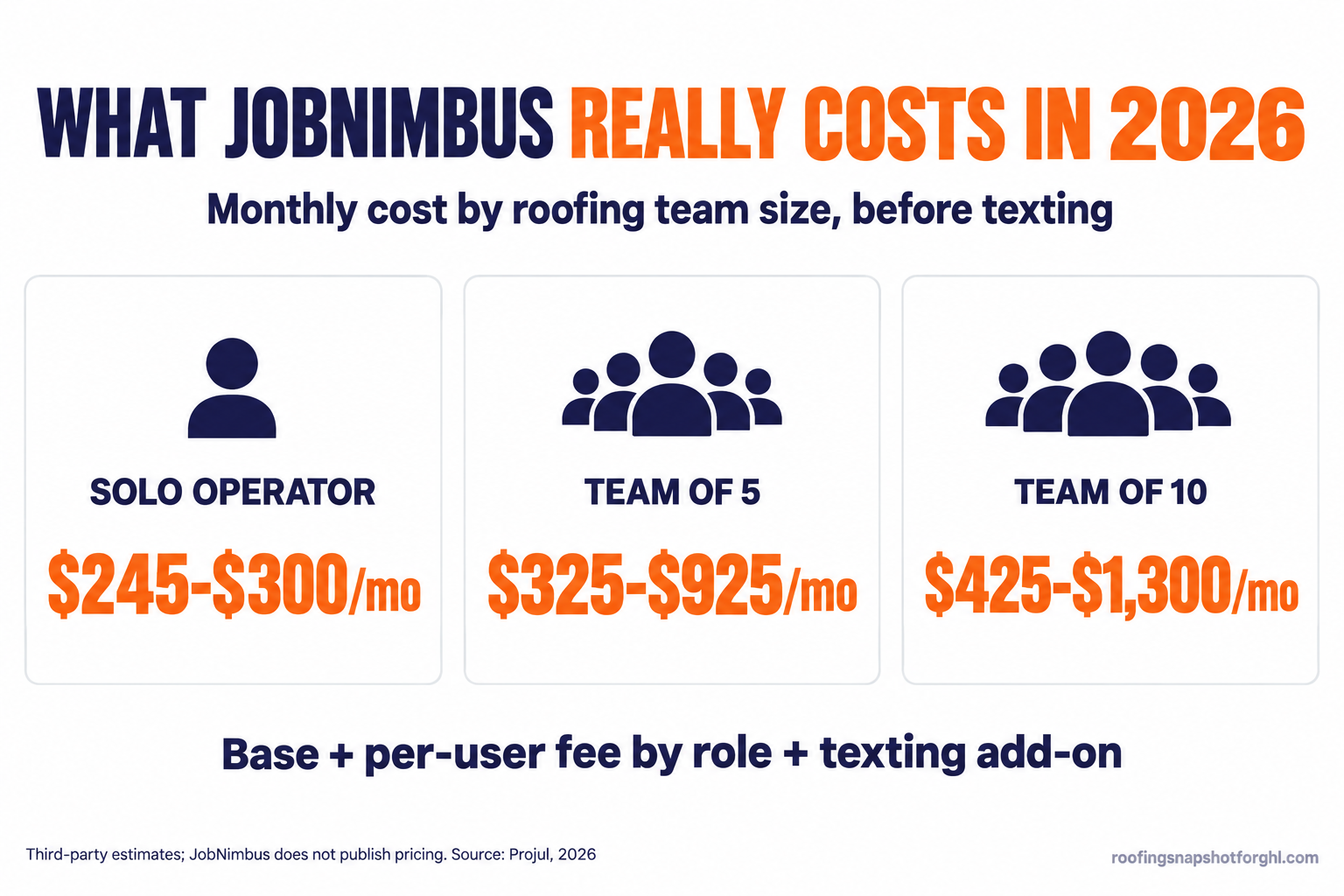
The honest way to price any per-user CRM is to run it for the shop you actually are. Using the reported base-plus-seat ranges, before texting: a solo operator at $245 to $300 a month, a team of five at $325 to $925, a team of ten at $425 to $1,300, a team of twenty at $625 to $2,050 (Projul, 2026).
Estimated JobNimbus monthly cost by team size (high end of the reported base-plus-seat range, before texting; solo starts near $245, a team of five near $325). Third-party estimates because JobNimbus does not publish pricing. Source: Projul, 2026.
Look at the shape of that. The cost does not rise in a gentle line; it steps up hard every time you add people, because every hire is a two-part cost, the person and the seat. The scenario that gets expensive quietly is the mid-size team in storm season: you hire up for the surge, every new rep and tech is a new seat, you add a bigger texting package, and the line you set in spring looks nothing like the one you pay in July. Most storm-driven roofing is seasonal, so a headcount-metered bill punishes you in exactly the months you are busiest.
What the Sumeru deal means for your renewal
Here is the context most pricing posts skip, and it matters before you sign a long term. In November 2024, Sumeru Equity Partners made a $330 million control investment in JobNimbus (Business Wire, 2024). A private-equity firm now holds the wheel.
PE ownership of a tool you depend on has a predictable pattern. Owners buy growth, and in a mature category the fastest lever is the existing customer base: raise prices, push users up the tier ladder, tighten renewals. The same story is playing out across this niche. AccuLynx is tangled in a forced $2.35 billion sale to the insurance-data giant Verisk, which a Delaware court ordered to keep pursuing in August 2026 (Insurance Journal, 2025), and Leap is majority-owned by Nexa Equity. The buyers are not in it to hold your price flat.
What that means for you is defensive. Do not lock into a multi-year term as the owner looks to grow revenue off the installed base: keep your contract short, confirm in writing how you export your data and what it costs, and treat your renewal as a negotiation. For the wider picture, our pillar on what roofing software actually costs in 2026 prices every major vendor side by side.
How to force the real number out of the demo
Since JobNimbus will not put a price on the page, your job in the demo is to extract one and pin it down. Steal this, word for word.
Open with the seat count and make them name a total: “Quote me the base, the per-user rate for each role, and the monthly total for my exact team: [list your heads and what each does].” Then price the feature you cannot live without: “Add Engage texting at [your] volume. What is the new all-in?” Write every line down, because the all-in is the number that matters, not the base they lead with. Then close the two traps most people miss: “What is the contract term and the notice period to cancel?” and “How do I export my full job history, contacts, and photos if I leave, and is there a charge?” Vagueness on term, notice, or data export is itself the answer.
Finally, anchor against a published price: “Roofr publishes its full pricing, free to start, top tier $349 a month, no per-seat fee (Roofr, 2026). Walk me through why your all-in is worth paying by the seat on top of that.” That line puts the rep on defense against a real number. If you are switching from another tool, our guide to migrating a roofing business to GoHighLevel walks through getting your data out cleanly.
JobNimbus vs the vendors that publish a price
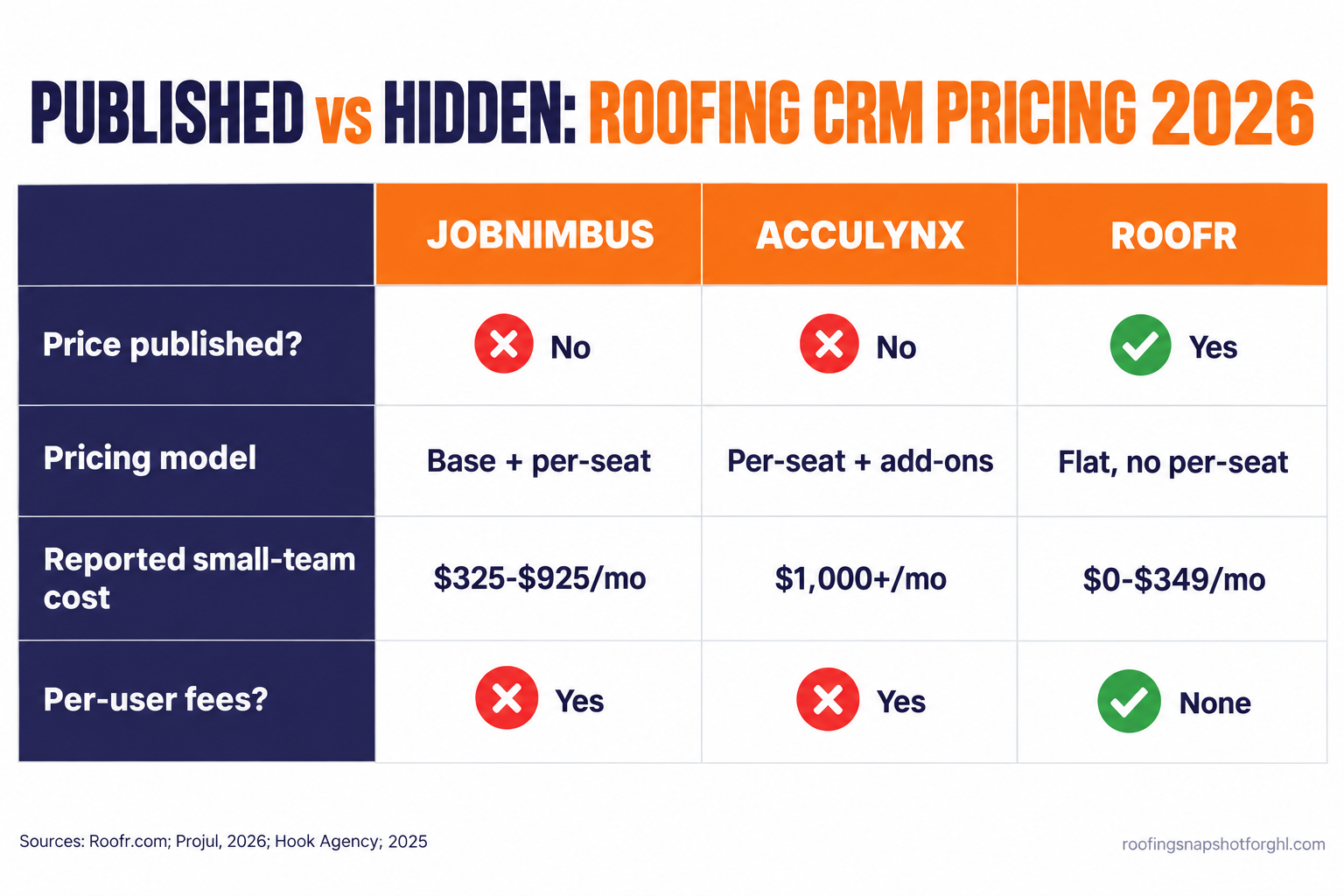
The sharpest contrast is with the one vendor that shows its whole hand. Here is the field at a glance.
| Vendor | Pricing published? | Model | Reported all-in, small team |
|---|---|---|---|
| JobNimbus | No, quote-only | Base + per-user by role + texting add-on | ~$300–$925/mo for a team of five (Projul, 2026) |
| AccuLynx | No, quote-only | Per-user, add-ons | ~$1,000+/mo once seats and add-ons are in (Hook Agency, 2025) |
| Roofr | Yes, in full | Flat tiers, no per-seat | $0 to $349/mo top tier, unlimited users (Roofr, 2026) |
| Roofing Snapshot | Yes | One-time install, your own account | $997 one time, unlimited users, no monthly seat meter |
The pattern is the point. JobNimbus and AccuLynx meter your headcount and hide the number; Roofr publishes a flat price with no per-seat fee, the right anchor in any negotiation. For the full teardown, see our AccuLynx pricing breakdown, Roofr pricing in 2026, the JobNimbus vs AccuLynx head-to-head, and our Leap CRM review.
A compliance note before you automate follow-up
Whatever CRM you land on, the texting inside it is regulated. Automated follow-up to a cell phone falls under the Telephone Consumer Protection Act, and business texting runs through the carrier registration system called A2P 10DLC. You need real consent on file before the first automated text, logged where you can prove it. Running texts through JobNimbus Engage does not make that the vendor’s problem; it is yours. On top of federal rules, states like Florida and Wisconsin bar contractors from offering to handle a homeowner’s claim or absorb a deductible, which kills a lot of the follow-up copy roofing shops still run. Before you load a storm-lead sequence into any CRM, read our breakdown of roofing insurance claim laws so your automation does not put your license at risk.
Who JobNimbus is actually right for
Price only means something next to fit. For a solo or two-person shop, JobNimbus is reasonable at $245 to $300 a month and the bundled SumoQuote proposals help; the real question is whether you need a full production suite or mostly need to answer leads fast and follow up, which is a lighter, flatter spend. For a mid-size team, five to ten crews, do the math with eyes open: if most of your people live in the system daily it can be worth it, but if half your seats are crews who only drop photos, you are paying production-suite rates for light users. For a large operation, twenty-plus, you are the customer JobNimbus and AccuLynx are built for, and the per-user bill is the cost of a real platform; protect your contract with a short term and a clean export.
Objections, answered straight
“Everybody in roofing uses JobNimbus, so it must be the right call.” Popularity is a signal, not a verdict. JobNimbus is popular because it is a solid production CRM and markets hard to roofers. That does not make its per-user, quote-only pricing right for a five-person storm shop that mostly needs speed-to-lead and follow-up. Buy for your workflow and head count, not for the logo everyone at the trade show is wearing.
“The per-user price is small, it is not worth sweating.” It is small per head and large per year. A team of five can run $325 to $925 a month, up to $11,100 a year before texting, and it climbs every time you hire (Projul, 2026). Over three years the seat meter is often the biggest line in the budget.
“I already pay for JobNimbus, so I am locked in.” You are not. Your contract has a term and a notice period, and your data, contacts and basic job records, exports to CSV (Projul, 2026). The switching cost is finite, and smaller than three more years of a bill you have outgrown.
“Do I have to be technical to run any of this?” No. Paid onboarding exists so you do not have to be. The real risk is not complexity, it is a half-finished setup. Get it configured properly once, so the system runs the follow-up instead of you remembering to.
The bottom line
Back to that Thursday night and the empty cell in your spreadsheet. The number you could not get is roughly a $225 to $550 base, plus $20 to $75 per person by role, plus texting, which lands most five-person storm shops between $325 and $925 a month before the add-ons you forgot. It is a capable CRM, and also a headcount meter with a hidden sticker, owned now by a firm whose job is to grow revenue off you. Price it with the three questions, anchor it against Roofr’s published number, and keep your term short and your data portable. If the seat meter is the part that keeps breaking your budget, the Roofing Snapshot installs the whole storm-to-deposit pipeline into your own GoHighLevel account for a one-time build, with no per-seat fee on the other side.
Frequently asked questions
How much does JobNimbus cost per month in 2026?
JobNimbus does not publish pricing. From third-party reporting, the base runs about $225 a month for a smaller team up to about $550 for a larger one, plus $20 to $75 per user per month by role, before texting. A team of five commonly lands between $325 and $925 a month all in (Projul, 2026).
Does JobNimbus publish its prices?
No. As of 2026 all four plans, Essentials, Pro, Premium, and Enterprise, show a 'request pricing' button instead of a dollar figure, so you have to book a demo for a quote (Projul, 2026).
Is SumoQuote free with JobNimbus now?
SumoQuote is bundled into every JobNimbus subscription rather than billed separately. JobNimbus acquired it in January 2024 and folded its proposals, good-better-best pricing, and digital signatures into the product (JobNimbus, 2024).
Does JobNimbus charge extra for texting?
Yes. SMS runs through an add-on called Engage, not the base price, with reported packages of $49 to $249 a month by volume, so treat texting as part of your real base (Projul, 2026).
Who owns JobNimbus?
Sumeru Equity Partners made a $330 million control investment in JobNimbus in November 2024. Private-equity ownership of a tool you depend on usually points toward rising prices over time, which is a reason to keep your contract short (Business Wire, 2024).
Is there a roofing CRM that publishes its full price?
Yes. Roofr publishes everything: a free Starter plan, paid tiers up to $349 a month, and no per-seat fees (Roofr, 2026). It is the natural price anchor to use against a demo-gated vendor like JobNimbus or AccuLynx.