It is the morning after a hail line rolled through your county. Your phone buzzes with an Angi lead before you finish your coffee. A homeowner two neighborhoods over wants an inspection. You call back in four minutes, feeling good. She answers, annoyed, and says, “You are the third roofer to call me in the last ten minutes.” That is the whole business model in one sentence.
Here is the short answer. Angi and HomeAdvisor leads can work for a brand-new shop with no other pipeline, but they are rarely worth it once you can generate your own leads, because you are buying the same homeowner that three to eight competitors just bought (LeadTruffle, 2026). The per-lead price looks cheap. The real cost, divided by how few shared leads you sign, lands most roofers at $400 to $1,400-plus per booked job. This post breaks down what you really pay, the fine print nobody reads until they try to cancel, every lead source side by side, and the owned pipeline that beats shared leads.
Key Takeaways
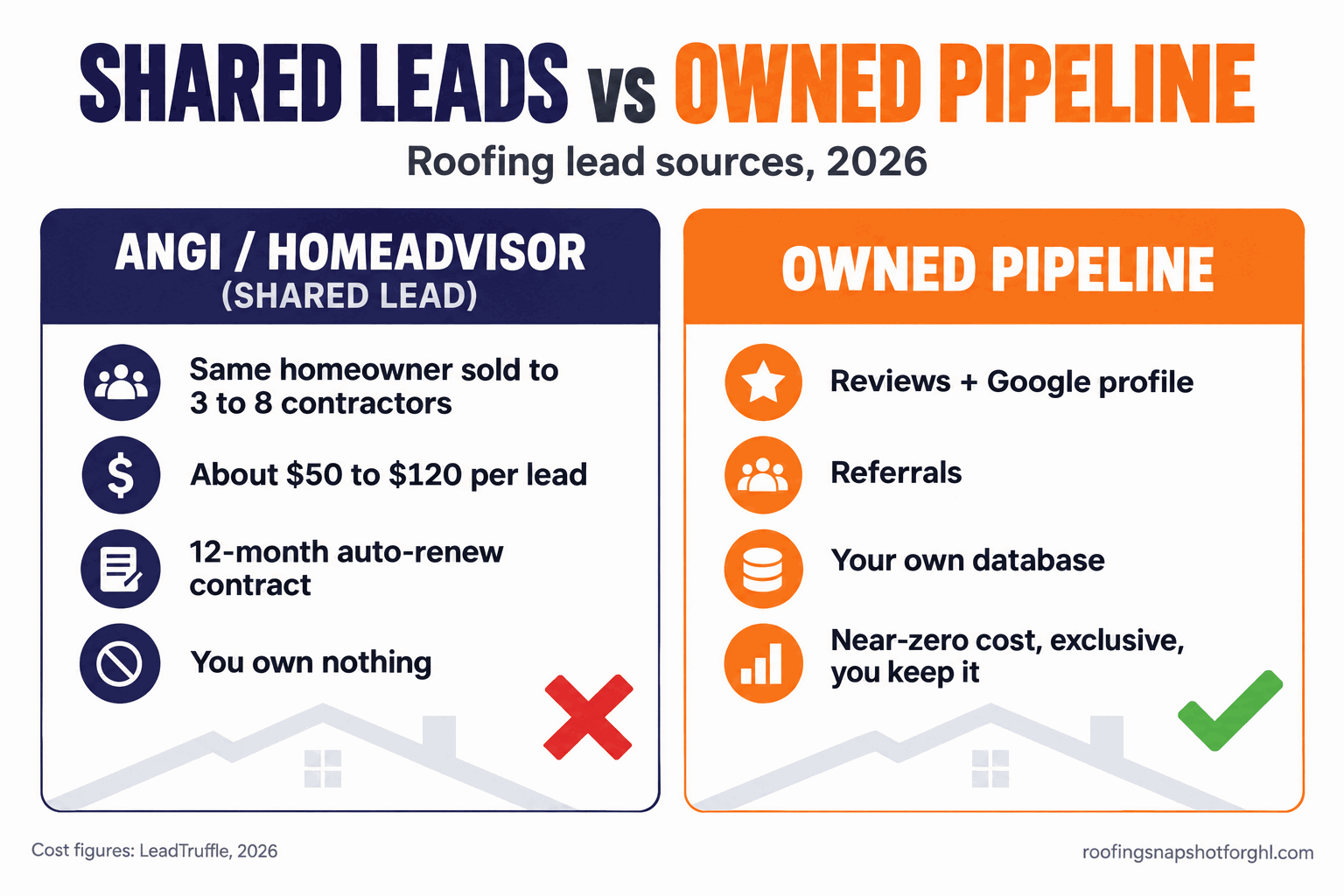
- A shared lead is not an exclusive lead. Angi and HomeAdvisor typically sell each lead to three to eight contractors at once, so your odds on a single lead can be as low as one in five (LeadTruffle, 2026).
- The sticker hides the real cost. Leads run roughly $50 to $120, but divide by a 5 to 15 percent close rate and the cost per booked roof lands near $400 to $1,400-plus (LeadTruffle, 2026).
- The contract is the trap. Expect a roughly $300 annual membership, a 12-month auto-renew term, credits instead of cash for bad leads, and an early-cancel fee of 30 to 35 percent of the remaining contract (LeadTruffle, 2026).
- The FTC already fined the model. HomeAdvisor agreed to pay up to $7.2 million in 2023 over misleading claims about lead quality, and later sent more than $3 million back to contractors (FTC, 2023).
- What beats shared leads is owning the pipeline: speed-to-lead on exclusive leads, your Google profile, referrals, and your own database. Nobody can switch those off.
Table of contents
- How Angi and HomeAdvisor actually work in 2026
- What Angi and HomeAdvisor leads really cost a roofer
- Six things the signup rep will not tell you
- Every roofing lead source, side by side
- Steal this: how to actually close a shared lead
- Three scenarios: solo, mid-size, and large
- What beats shared leads: owning the pipeline
- The legal line before you text a bought lead
- Objections, answered straight
- Who shared leads are actually right for
- Frequently asked questions
How Angi and HomeAdvisor actually work in 2026
First, the names, because they are the same company. Angi and HomeAdvisor both sit under Angi Inc, the Denver business that grew out of Angie’s List. HomeAdvisor merged in back in 2017, Angie’s List was renamed Angi in 2021, and the two run on the same engine (Angi Inc, 2024). So “Angi or HomeAdvisor” is two doors into one marketplace.
The product most roofers mean is the pay-per-lead side, Angi Leads. A homeowner fills out a form asking for a roof inspection, that request becomes a “lead,” and the platform sells it, not to you alone, but to a handful of contractors at once (LeadTruffle, 2026).
What Angi and HomeAdvisor leads really cost a roofer
Neither platform publishes a roofing rate card, so the numbers below come from third-party reporting. The consistent picture: roughly $50 to $120 per roofing lead, an annual membership near $300, and each lead shared among three to eight contractors (LeadTruffle, 2026).
The per-lead price is the number the rep leads with, and it lies to you. What matters is cost per booked roof: the lead price divided by your close rate. Shared leads are reported to close around 5 to 15 percent for shops with weak follow-up and 15 to 25 percent for shops with strong systems (Zentora Marketing, 2026). If you pay $90 a lead and sign one in ten, that roof cost you $900 in lead fees before you paid a rep or ordered a square of shingles.
What a $90 shared roofing lead really costs per booked roof as your close rate falls. Lead price and close-rate ranges from LeadTruffle, 2026 and Zentora Marketing, 2026.
That curve is the whole argument: your close rate on a shared lead is capped by the four other roofers who got the same number. For a fuller benchmark, our breakdown of how much a roofing lead costs in 2026 prices every channel side by side.
Six things the signup rep will not tell you
The demo sells you volume and a low per-lead price. Here are the six things that decide whether you make money.
1. The lead is shared, so you are racing four other roofers. Each lead goes to several contractors at once, and the homeowner signs with whoever is fastest (LeadTruffle, 2026). Call back in an hour because you were on a roof, and the job is already sold. A one-man shop that cannot answer a form fill in 60 seconds loses it to the office-staffed competitor every time. Slow follow-up is not a small miss, it is a total loss.
2. Bad leads get credits, not refunds. Wrong numbers and out-of-area requests are common, and the platforms typically hand you a credit toward future leads rather than your money back, with a small dispute limit per territory (LeadTruffle, 2026). You contest a dead number and walk away with a coupon for another one.
3. The contract is a 12-month auto-renewal. Many roofers expect month-to-month and find a year-long term with auto-renew, a 60-day cancellation notice, and an early-termination fee reported at 30 to 35 percent of the remaining contract (LeadTruffle, 2026). The leads go junk in month two, and you pay for ten more months either way.
4. The leads do not always match your service or area. This is not just griping. The FTC found HomeAdvisor misled contractors about lead quality, including leads that did not match the provider’s services or sat outside their area, and ordered it to pay up to $7.2 million in 2023 (FTC, 2023). You paid for a reroof and got a gutter cleaning forty minutes away.
5. Your reviews live on their platform, not yours. Your ranking and lead flow lean on your star rating inside their walled garden, not your own Google profile (TradeBridge, 2025). You pour effort into reviews on a site you do not control instead of the Google profile that feeds you free leads.
6. You bid against out-of-state storm chasers. After a hail event, shared leads in a hard-hit county get bought by every roofer within range, transient crews included. A local shop with a real warranty gets lumped in with chasers and has to win on speed. More in why out-of-state storm chasers beat local roofers.
Every roofing lead source, side by side
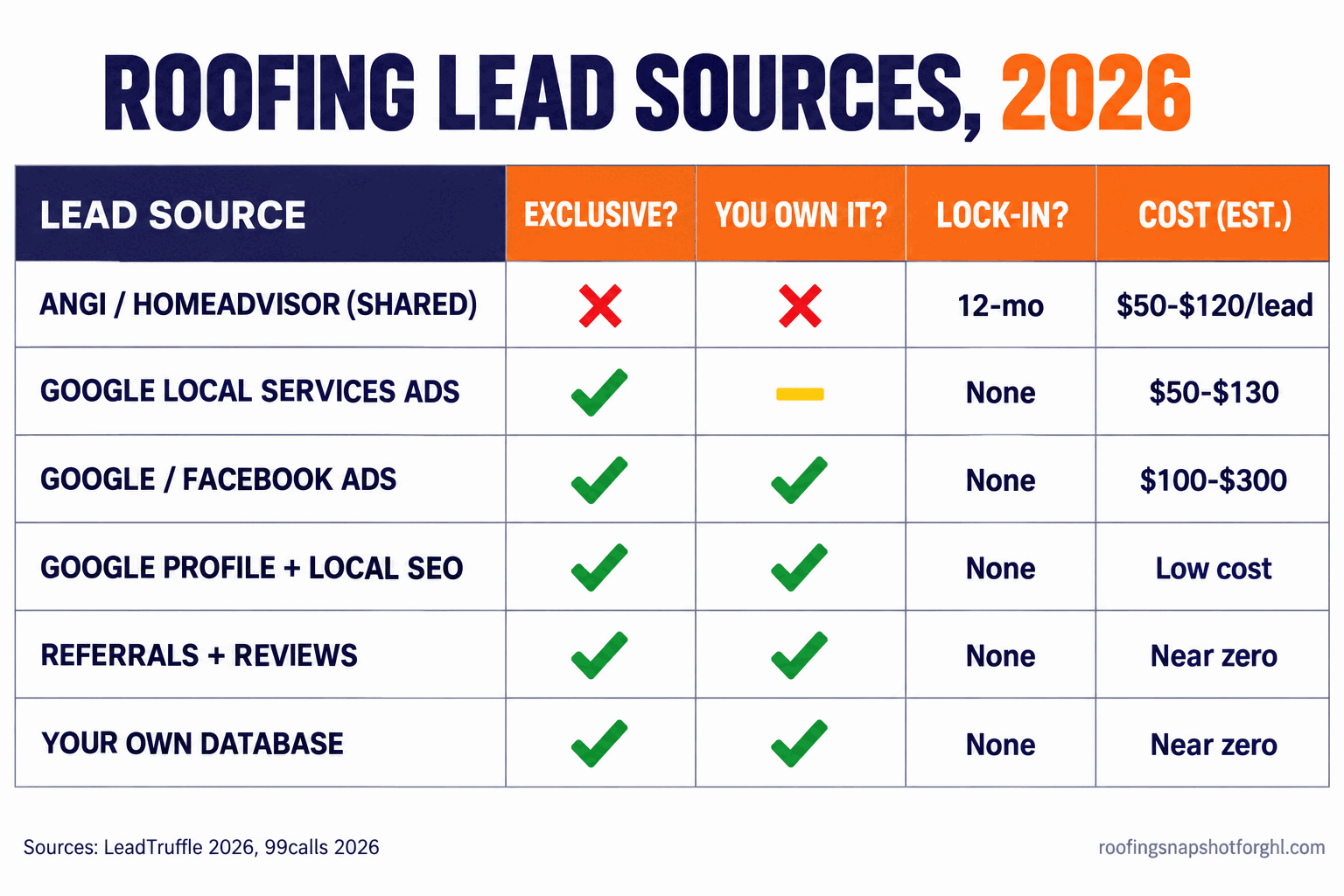
The honest way to judge shared leads is next to everything else you could spend that money on. Here is the field, scored on what matters to a 1 to 5 crew shop: price, whether the lead is yours alone, whether you own the source, and lock-in.
| Lead source | Reported cost per lead | Exclusive to you? | Do you own it? | Lock-in |
|---|---|---|---|---|
| Angi / HomeAdvisor (shared) | ~$50 to $120 (LeadTruffle, 2026) | No, 3 to 8 at once | No | 12-mo auto-renew |
| Google Local Services Ads | ~$50 to $130 (PushLeads, 2026) | Mostly, you get the call | Account yes, pipeline no | None |
| Google / Facebook ads | ~$100 to $300 (99calls, 2026) | Yes | Account + pixel, yes | None |
| Google profile + local SEO | Low marginal cost | Yes | Yes, fully | None |
| Referrals + reviews | Near zero | Yes | Yes | None |
| Your own database (reactivation) | Near zero | Yes | Yes | None |
Read the right two columns, not the left one. The shared marketplaces are the only row where both “is it exclusive” and “do you own it” are no, and the only row with a lock-in. Google Local Services Ads is a reasonable middle ground: you pay per lead, but the homeowner usually calls you, you can dispute bad leads, and it carries the Google Guaranteed badge (99calls, 2026). The bottom three rows are the quiet winners.
Steal this: how to actually close a shared lead
If you buy shared leads anyway, the only way to not lose money is speed and a tight cadence.
The instant text, inside 60 seconds of the lead landing. The most important message you send, because it beats the four other roofers to the inbox.
“Hi [First name], this is [Your name] with [Company], a local roofer here in [City]. I just got your request about your roof and I can take a look this week. Are you free [day] morning or [day] afternoon for a free inspection? I can text you a photo of the damage from the roof while I am up there.”
The 30-second voicemail if they do not pick up. Shared-lead callers screen unknown numbers, so leave something a human left.
“Hey [First name], [Your name] with [Company], local roofing, returning your inspection request. I will text you now so you have my number. Happy to get you on the schedule this week, no pressure and no cost to look.”
The day-two nudge if they went quiet. Most shops quit after one call; one more touch wins jobs the pushy chaser lost.
“[First name], still happy to get eyes on your roof before the next rain. I had a cancellation [day]. Want me to swing by? I will send the inspection photos either way so you know where you stand.”
That cadence is the difference between a 5 percent and a 15 percent close on the same lead. A one-person shop cannot run it by hand from a roof, which is the whole reason the next section matters. See our storm-lead follow-up sequence and why roofing lead response time decides who signs the roof.
Three scenarios: solo, mid-size, and large
The right call depends on which shop you run today.
The solo operator or two-person shop. This is who shared leads hurt most. You are on a roof all day and cannot answer a form fill in 60 seconds, so you lose the race every time. If you buy Angi as a brand-new shop with zero pipeline, treat it as a short-term bridge, pair it with an automated instant-text, do not sign a long term, and start building referrals and a Google profile from job one.
The mid-size team, two to five crews. You have enough office coverage to run the speed cadence, so shared leads can pencil out, but only if you track cost per booked roof by source. The trap is buying volume for storm season, watching your close rate sag because every lead is shared four ways, and never noticing the real cost per job crept past $1,000. Use them as a topping-up channel.
The large operation, five-plus crews. Shared leads are usually the least efficient dollar you spend. You have the brand, reviews, and crew count to dominate owned channels, yet a marketplace puts you shoulder to shoulder with a one-truck chaser on the same lead. Your engine should be your Google profile, your database, and referrals.
What beats shared leads: owning the pipeline
Shared leads feel like a treadmill because you are renting, not owning: stop paying and the leads stop. The fix is a pipeline you control, built from four things no vendor can switch off.
Speed on exclusive leads. A lead you answer in 60 seconds beats a shared lead every time, because you are not racing anyone, which is exactly what a proper CRM and missed-call text-back solve.
Your Google profile and local SEO. A ranked Google Business Profile feeds you exclusive leads for free, and they already trust you because they found you, not a form farm. Our guide to local SEO for roofing contractors walks through it.
Referrals and reviews. A finished roof is the cheapest lead source you will ever have, and it closes higher than anything you buy. See our roofing referral program playbook.
Your own database. Every estimate you ever sent is a list you own, and a reactivation campaign mines signed jobs out of leads you already paid for once (database reactivation).
None of those four carry a contract, a shared homeowner, or a credit-instead-of-refund policy. That is the whole point.
The legal line before you text a bought lead
Whatever lead source you run, the follow-up is regulated, and a bought lead does not come pre-cleared. Automated texts and calls to a cell phone fall under the Telephone Consumer Protection Act, and business texting runs through carrier registration called A2P 10DLC. You need real, logged consent before the first automated text, and a form fill on a third-party marketplace is not a blanket license to blast someone forever. Our A2P 10DLC registration for roofing contractors guide covers the setup.
A second line is sharper in some states. Florida and Wisconsin bar contractors from offering to handle a homeowner’s insurance claim or absorb a deductible, which kills a lot of the storm follow-up copy roofing shops still run. A bought storm lead does not change that. Read what roofers can and cannot legally say about insurance claims before you load any storm sequence.
Objections, answered straight
“Shared leads are all I have, so I cannot quit them.” Then do not quit cold, swap gradually. Keep buying this quarter, but put every dollar of margin into the owned channels above, so in six months your Google profile and referrals carry the base and the marketplace is just the topping. The point is not to never buy a lead, it is to stop being a renter.
“I close plenty off Angi, so it works for me.” Maybe, and the only way to know is cost per booked roof, not gut feel. Track lead spend by source against jobs signed for 90 days. If a shared lead costs you $900 a roof and a referral costs a gift card, you are not closing plenty, you are overpaying.
“Exclusive leads from Angi fix the sharing problem.” They help, but exclusive leads on these platforms are reported to cost roughly 2.5 to 3.5 times the shared price (LeadTruffle, 2026), and you are still renting on a contract you cannot easily leave. For that money, Google Local Services Ads or your own search ads usually buy a better lead you keep.
“Do I need to be technical to own my pipeline?” No. The speed-to-lead cadence that beats shared leads is a setup-once system, not a daily chore. The risk is not complexity, it is a half-built setup that drops leads. Configure it once and it runs the follow-up for you.
Who shared leads are actually right for
Shared leads make sense in exactly one situation: a brand-new shop with no reviews, no ranking, no referral base, and no database, that needs job flow this week. Answer instantly and treat it as a bridge with a deadline. For everyone else, even a shop with a handful of five-star reviews, the money is better spent owning the pipeline.
Back to that homeowner who told you that you were the third roofer to call. You will win some of those on speed, and you should answer every one in 60 seconds while you are still buying them. But the roof you sign without a race, the referral or the homeowner who found your Google profile and already trusts you, costs a fraction and closes twice as often. That is the pipeline worth building, and the Roofing Snapshot installs the whole thing into your own account so the follow-up runs whether the lead was bought or earned.
Frequently asked questions
How much do Angi and HomeAdvisor leads cost for roofers in 2026?
Neither publishes a roofing rate card. From third-party reporting, roofing leads run roughly $50 to $120 each, plus an annual membership near $300, and each lead is typically sold to three to eight contractors at once (LeadTruffle, 2026). The number that matters is cost per booked roof, which commonly lands near $400 to $1,400-plus once you divide by your close rate.
Are Angi and HomeAdvisor the same company?
Yes. Both sit under Angi Inc, the Denver company that grew out of Angie's List. HomeAdvisor merged in during 2017 and Angie's List was renamed Angi in 2021, so the two run on the same marketplace (Angi Inc, 2024).
Can I cancel Angi Leads whenever I want?
Usually not without a fee. Many roofers report a 12-month term with auto-renewal, a 60-day cancellation notice, and an early-termination charge of 30 to 35 percent of the remaining contract value, so read the term before you sign (LeadTruffle, 2026).
Did the FTC take action against HomeAdvisor?
Yes. In 2023 the FTC ordered HomeAdvisor to pay up to $7.2 million over misleading claims about its leads, including leads that did not match a provider's services or area, and later sent more than $3 million in refunds to affected contractors (FTC, 2023).
What is a better alternative to shared leads for roofers?
Owning the pipeline: fast follow-up on exclusive leads, a ranked Google Business Profile, a referral engine, and reactivating your own database. Those cost far less per booked roof and no vendor can shut them off. Google Local Services Ads is a reasonable paid middle ground since the homeowner usually calls you directly (99calls, 2026).